
Strategies for effective communication in the workplace are systematic practices designed to enhance clarity, foster transparency, and align team objectives to prevent confusion and inefficiency. Poor communication costs organizations far more than most leaders realize. It shows up as missed deadlines, duplicated work, and team members who feel unseen or confused about their role. The good news is that communication problems are structural, not personal. Fix the structure, and the behavior follows.
What are the key strategies for enhancing communication clarity and accountability?
Clear communication starts with eliminating vague language. Vague language is a structural problem, not a personality flaw. When instructions are subjective, teams fill the gaps with assumptions, and those assumptions rarely align.
Every goal, deadline, and ownership assignment must answer three questions: Who is responsible? By when is it due? What does "done" look like? These three questions eliminate accountability gaps before they form. Without them, two people can complete the same task differently and both believe they succeeded.
The contrast between vague and clear communication is stark in practice:
- Vague: "Can someone handle the client report soon?"
- Clear: "Jordan owns the client report. First draft due Thursday by 3:00 PM. Done means reviewed by the account lead and uploaded to the shared drive."
- Vague: "Let's improve response times."
- Clear: "Customer support replies to all tickets within 4 hours during business hours. Escalations go to the team lead within 1 hour."
Every item on the vague list creates a decision someone else has to make silently. Every item on the clear list removes that burden entirely.
Pro Tip: Before sending any task assignment, run it through the three-question test: Who, When, and What does done look like? If you cannot answer all three, rewrite it before sending.
Replacing subjective instructions with explicitly documented expectations also prevents project derailment. Teams that document outcomes rather than activities spend less time in clarification meetings and more time executing.
How do you establish effective communication channels and norms?
Most teams suffer from channel chaos. Urgent requests get buried in email threads. Sensitive conversations happen in group chats. Policy updates land in Slack channels nobody checks. The fix is a channel-message matrix: a written document that specifies which type of information lives in which channel.
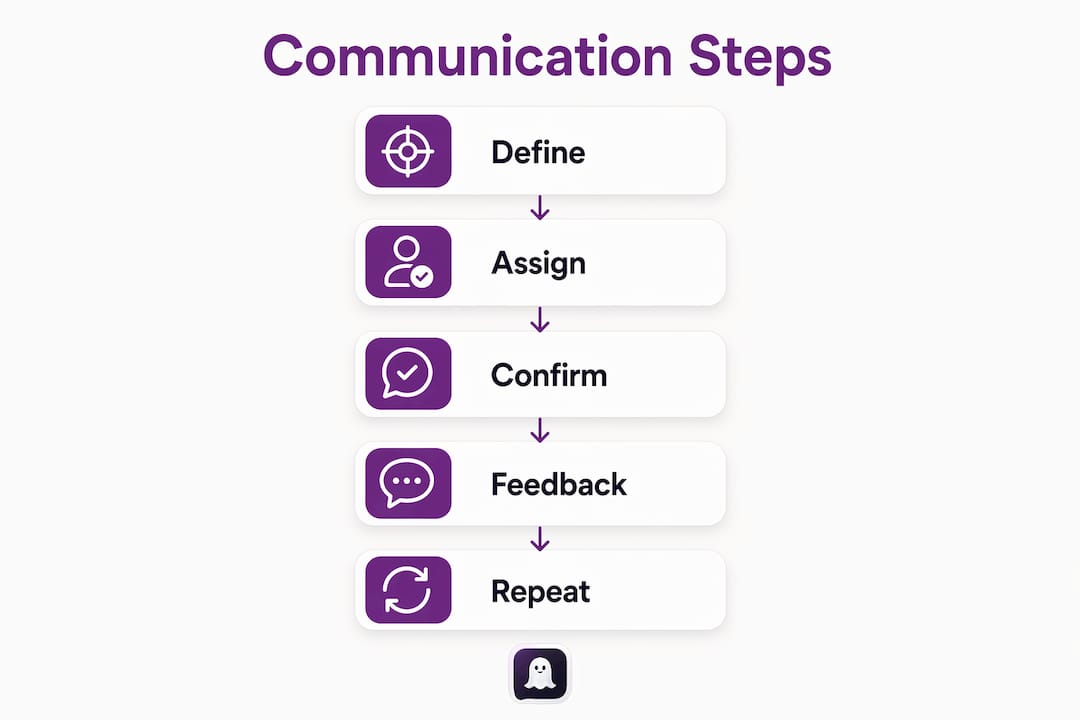
A practical matrix looks like this:
| Channel | Best for | Response expectation |
|---|---|---|
| Slack or team chat | Quick questions, status updates | Within 4 hours |
| Formal updates, documentation | Within 24 hours | |
| Phone or video call | Urgent issues, sensitive topics | Immediate |
| Project management tool | Task tracking, deliverables | Updated at task completion |
| Shared docs | Policies, decisions, reference material | Maintained, not replied to |
Defining clear response windows prevents the friction caused by mismatched expectations. One person treats Slack as a real-time conversation. Another checks it twice a day. Without a written standard, both feel frustrated by the other.
- Write the matrix down. A verbal agreement evaporates within two weeks.
- Share it during onboarding, not after a miscommunication incident.
- Review it quarterly. Channels and tools change, and the matrix must keep up.
- Assign a single owner for each channel type to answer questions about its use.
- Enforce it consistently. One senior leader ignoring the matrix signals to the whole team that it is optional.
Mixing communication types in the wrong channels erodes trust and creates noise. When teams cannot predict where to find information, they stop trusting that the information exists at all.
Why are active listening and feedback loops essential for team communication?

Active listening is the most underused communication skill in professional settings. Most people in meetings are preparing their response while the other person is still talking. That habit creates a chain of misinterpretations that compounds across a project.
Active listening, treated as a structured meeting norm, requires participants to summarize what they heard before responding. This single practice stops misunderstandings from spreading downstream. It also signals respect, which makes people more willing to share honest input.
Techniques that build active listening into team culture:
- Require a brief verbal summary before any rebuttal in meetings: "What I heard you say is X. Is that right?"
- Rotate a "listener" role in larger meetings. That person's job is to capture key points and surface anything that was glossed over.
- Explicitly invite dissent. Teams that only agree in meetings are performing, not communicating. Ask directly: "What are we missing? Who sees a risk we haven't named?"
- End every meeting with a written summary sent within one hour. This closes the interpretation gap before it widens.
Pro Tip: Replace "Does everyone understand?" with "Can someone walk me back through what we just decided?" The first question gets nods. The second reveals whether the message actually landed.
Feedback loops are the other half of this equation. Collecting feedback without acting on it is worse than not asking at all. Feedback loops only function when visible changes occur. Leaders must explicitly share how team input influenced a decision. That transparency builds the willingness to contribute again. Without it, people stop speaking up because they assume nothing will change.
What cultural and leadership behaviors shape communication in the workplace?
Leadership behavior sets the communication standard more than any written policy. A manager who sends Slack messages at 11:00 PM trains the team to expect responses at 11:00 PM. A leader who documents decisions publicly teaches the team that transparency is the norm. The written policy matters far less than what people observe daily.
Communication culture is established in the first 30 days of an employee's tenure. Attempting to fix it afterward rarely works without visible process changes modeled by leadership. Onboarding is the highest-leverage moment for setting communication expectations.
Behaviors that build a strong communication culture:
- Model the channel matrix. Leaders who use the right channel for the right message give everyone else permission to do the same.
- Document decisions publicly. When a decision is made, write down what was decided, why, and who owns it. This counters misinformation and reduces the "I didn't know about that" problem.
- Recognize effective communication publicly. When a team member sends a clear, well-structured update or surfaces a risk early, name it. Public recognition reinforces the behavior across the whole team.
- Communicate on a predictable rhythm. Predictable weekly communication rhythms requiring only about 2 hours per week can significantly reduce team anxiety. Posting priorities on Monday, holding brief one-on-ones midweek, and running a short all-hands on Friday replaces ad hoc communication with structure people can rely on.
The rhythm matters because it removes the anxiety of not knowing. When people know exactly when they will receive updates, they stop sending "just checking in" messages and focus on their work instead.
Key Takeaways
Effective workplace communication requires structured norms, clear accountability, and leadership that models the behavior it expects.
| Point | Details |
|---|---|
| Define accountability clearly | Every task must answer who owns it, when it is due, and what completion looks like. |
| Use a channel-message matrix | Match each communication type to a specific channel with written response time expectations. |
| Practice active listening | Require meeting summaries before responses to stop misinterpretations from spreading. |
| Close feedback loops visibly | Share how team input influenced decisions to build long-term trust and participation. |
| Set culture during onboarding | The first 30 days determine communication behavior more than any later policy change. |
What I've learned from watching communication systems succeed and fail
The teams I've seen communicate best share one trait: they treat communication as a system, not a personality trait. They do not rely on people being "good communicators." They build structures that make clear communication the path of least resistance.
The most common failure I observe is channel mixing. A leader sends a sensitive performance note in a group Slack channel. A team member escalates an urgent client issue by email on a Friday afternoon. These are not careless mistakes. They happen because no one ever wrote down where things should go.
The second most common failure is the feedback loop that never closes. A manager runs a team survey, thanks everyone for their input, and then nothing changes. Six months later, participation in the next survey drops by half. People are not apathetic. They are rational. They stopped contributing because the signal was clear: input does not lead to action.
The fix for both problems is the same. Write it down. Assign an owner. Review it regularly. Communication clarity is not a soft skill. It is an operational discipline, and it deserves the same rigor you apply to any other business process.
— DSean
How Ghosttextai helps you read workplace messages more clearly
Knowing the right communication strategies is one thing. Understanding what a message actually means in the moment is another challenge entirely.
Ghosttextai is an AI-powered communication coach that helps professionals decode the real meaning behind workplace messages before they respond. You can paste a conversation or upload a screenshot and receive instant analysis of tone, intent, emotional signals, and suggested replies. When a colleague's message feels off, or a manager's feedback is hard to interpret, Ghosttextai gives you clarity instead of guesswork. Visit Ghosttextai to see how it works and start communicating with more confidence at work.
FAQ
What are the most effective communication strategies for the workplace?
The most effective strategies include defining clear accountability for every task, using a channel-message matrix, practicing active listening, and closing feedback loops visibly. These practices reduce ambiguity and build team trust over time.
How do you improve communication clarity in a team?
Replace vague instructions with outcome-oriented expectations that answer who owns the task, when it is due, and what completion looks like. Written standards outperform verbal agreements every time.
Why do communication channels matter for workplace teams?
Using the wrong channel for a message creates noise and erodes trust. A written channel-message matrix that specifies response times for each channel prevents friction and keeps information findable.
How does active listening improve workplace communication?
Active listening, practiced as a meeting norm where participants summarize before responding, stops misinterpretations from spreading. It also signals respect, which encourages more honest and open contributions from the team.
When is the best time to establish communication norms with employees?
Communication culture is set in the first 30 days of an employee's tenure. Onboarding is the highest-leverage moment to introduce channel expectations, response time standards, and feedback practices before habits form.