
What are the best AI communication coaches right now?
The strongest AI communication coach tools in 2026 are Poised, Yoodli, NexPhrase, Hedy, Talaera (Talk to Tally), and Vocalis. Each targets a distinct use case: Poised for discreet real-time meeting feedback, Yoodli for enterprise roleplay at scale, NexPhrase for live phrase coaching during high-stakes conversations, Hedy for privacy-first executive coaching, Talaera for non-native English speakers, and Vocalis for deeply personalized professional development. The table below maps all featured tools across the dimensions that matter most for professional buyers.
| Tool | Best For | Real-Time Feedback | Personalization | Pricing | Supported Scenarios | Workflow Integration | Accuracy |
|---|---|---|---|---|---|---|---|
| Poised | Meeting presence | Yes, discreet | Goal-based tracking | Freemium | Meetings, presentations | 800+ platforms | High |
| Yoodli | Enterprise onboarding | Yes, roleplay | Brand voice, custom personas | Enterprise tiers | Pitch, sales, public speaking | LMS/CRM sync | High |
| NexPhrase | Sales, interviews, negotiations | Yes, whispered | Persona and project-based | Free; Pro ~40 hrs/mo; Team ~80 hrs/mo | Sales, interviews, negotiations | Zoom, Meet, Teams | High |
| Hedy | Executives, team leaders | Yes, context-aware | Cross-session learning | Freemium | Meetings, pitches, interviews | No bot, device-local | High |
| Talaera | Non-native English speakers | Yes, voice-based | Role, industry, seniority | $20/mo (Professional) | Meetings, emails, presentations | Team/enterprise plans | High |
| Vocalis | Role-specific professionals | Yes, immediate | Age, role, industry, goal | Free to start | Executive, career, leadership | Standalone | High |
| Ghost Text | Text-based professional and personal conversations | Post-message analysis | Tone, intent, scenario context | Freemium; Pro subscription | Dating, professional, family, friendships | Screenshot/paste upload | High |
| Orai | Public speaking prep | Post-session | Delivery goals | Freemium | Speeches, presentations | Standalone | Moderate |
| Microsoft Coach | Office 365 users | During presentations | Basic delivery metrics | Included in M365 | Presentations | PowerPoint, Teams | Moderate |
| GetMee | Scalable skill-building | Post-session | Customizable modules | Not publicly listed | General communication | Standalone | Moderate |
| Speeko | Speech improvement | Post-session | Pacing, filler words | Freemium | Public speaking | Standalone | Moderate |
| Lepaya | Corporate L&D | Blended (AI + human) | Role-based | Enterprise | Employee development | LMS integration | High |
| Stimuler | Engagement-driven learners | Post-session | Gamified progress | Not publicly listed | General communication | Standalone | Moderate |
| SmallTalk | Casual conversation | Conversational | Informal scenarios | Not publicly listed | Everyday communication | Standalone | Moderate |
| Read | Team messaging clarity | Embedded | Tone and clarity | Not publicly listed | Team communication | Collaboration tools | Moderate |
| Gabble.AI | Conversational fluency | Interactive | Dialogue-based | Not publicly listed | Speaking practice | Standalone | Moderate |
| Elsa | Pronunciation, accent | Post-session | Speech recognition | Freemium | Spoken English | Standalone | High |
Pro Tip: If you are evaluating tools for a team, prioritize workflow integration and manager-level analytics over individual features. A tool your team will actually open every day beats a technically superior one that sits unused.

How AI communication coaches work and why professionals use them
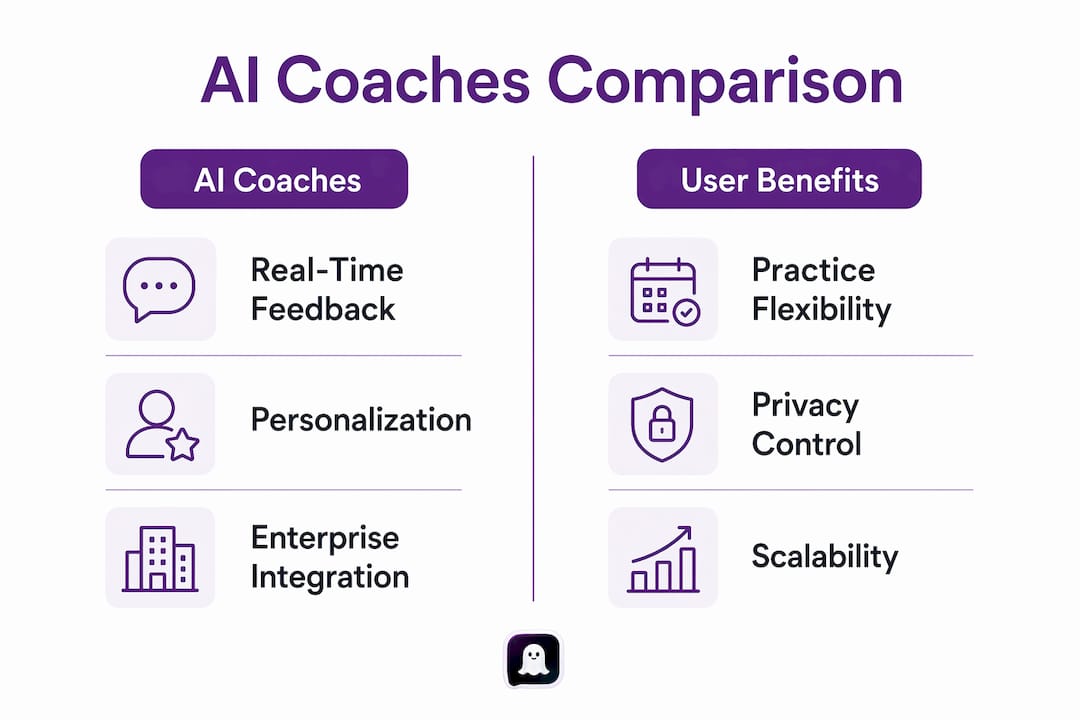
AI communication coaches work by listening to or reading your communication in real time, then surfacing specific, targeted feedback before, during, or after the interaction. The core mechanisms vary: some tools deliver whispered live-text prompts during a call, others run post-session analytics that map your performance across multiple dimensions, and platforms like Yoodli use structured roleplay simulations to rehearse high-stakes scenarios before they happen.

The practical benefits go well beyond what a traditional coaching session offers. You get judgment-free practice at any hour, no scheduling required, and feedback calibrated to your specific goals rather than a generic rubric. For professionals who dread public speaking, that low-stakes repetition builds real confidence over time.
Enterprise adoption tells the clearest story. Google Cloud used Yoodli to certify over 15,000 employees with a 92% customer satisfaction score, and Snowflake saved over 1,200 hours of manager coaching per quarter by shifting to AI-powered roleplay. Those numbers reflect something real: AI coaching scales in ways human coaching simply cannot.
Key benefits professionals report most often:
- On-demand access: Practice a pitch at 11 PM the night before a board meeting, not when a coach has an opening.
- Privacy: Tools like Poised and Hedy run coaching invisibly. Nobody on the call knows you are using them.
- Data-driven progress: Unlike a human coach's subjective notes, AI tools track pacing, filler words, and clarity metrics across every session.
- Efficiency at scale: Workflow integration lets managers track team-wide progress alongside individual feedback, turning coaching from a one-off event into a continuous development loop.
Privacy deserves a specific mention. Many professionals hesitate to adopt AI tools because of corporate IT restrictions. Platforms like Hedy address this directly by running coaching entirely on-device, with no bot joining the call and no recordings sent externally. That design choice removes the IT approval bottleneck that stalls adoption in regulated industries.
Common pitfalls to watch for with AI communication coaches
AI coaching tools are genuinely useful, but they are not without real limitations. Understanding where they fall short helps you choose the right tool and set realistic expectations.
- Distraction risk from live prompts: Real-time suggestions during a call can pull your attention away from the conversation itself. Not every professional adapts well to reading coaching nudges while speaking.
- Generic feedback without proper setup: Tools that lack role, industry, and goal inputs tend to surface surface-level corrections. Telling you to "speak more slowly" is not the same as coaching you on executive presence in a board meeting.
- Data privacy constraints: Corporate security policies often prohibit tools that record calls or send audio to external servers. Always verify whether a tool offers a local-only or no-bot mode before deploying it in a regulated environment.
- Subscription costs add up: Free tiers are typically limited. NexPhrase's free plan caps usage at 30 minutes per month, which is enough to evaluate the tool but not to build a real practice habit. Professional tiers unlock meaningful usage but carry monthly costs.
- Context gaps in text-based coaching: Tools that analyze written messages can miss vocal tone, body language, and the interpersonal dynamics that a human coach would catch immediately.
The most common complaint from users on forums like Reddit is that AI coaches feel generic after the first few sessions. That is almost always a setup problem, not a product flaw. Tools like Vocalis and Talaera are built specifically to avoid this by reading multiple dimensions of your profile before every session.
How AI coaches compare to traditional human coaches
Human coaches bring something AI cannot replicate: the ability to read the room, sense emotional undercurrents, and adjust their approach based on years of interpersonal experience. For professionals working through a career pivot, a confidence crisis, or a high-stakes negotiation, that human judgment has real value.
Where AI wins is scale, speed, and consistency. A human coach is available for one hour a week at best. An AI coach is available every time you open your laptop.
The most useful frame is not "AI versus human" but "AI as a silent sidekick." The best tools act as a background layer that keeps you sharp during live conversations, while a human coach handles the deeper strategic work. Poised, for example, runs invisibly during meetings, giving you real-time nudges without anyone on the call knowing. That is not replacing a coach. It is extending one.
Here is how the two approaches break down practically:
- AI strengths: Instant feedback, unlimited availability, objective metrics, no scheduling friction, scales to thousands of users simultaneously.
- Human coach strengths: Nuanced emotional intelligence, personalized long-term strategy, accountability relationships, and the ability to coach on things that are hard to quantify.
- Hybrid approaches: Platforms like Lepaya combine AI-driven practice modules with human coaching sessions, giving teams the efficiency of AI and the depth of a skilled trainer. Talaera does something similar, pairing Talk to Tally's AI practice with access to human communication coaches for teams that need both.
For most professionals, the right answer is to use an AI coach daily for practice and reserve human coaching for strategic inflection points.
In-depth look at the leading AI communication coach tools
Poised
Poised is the go-to choice for professionals who want real-time coaching without anyone knowing they are using it. It supports over 800 communication platforms including Zoom, Google Meet, Slack, and Microsoft Teams, and delivers feedback on pacing, filler words, and clarity without a bot joining the call. The post-meeting summary and action items are genuinely useful, not just a transcript dump. Poised tracks your progress against specific meeting goals over time, so you can see whether you are actually improving or just repeating the same habits.
Yoodli
Yoodli is built for scale. Its roleplay platform lets enterprises customize AI personas, upload brand voice guidelines, and certify reps against specific communication standards. The Google Cloud deployment, covering over 15,000 employees, is the clearest proof that the platform holds up under enterprise conditions. Yoodli is SOC 2 Type 2 certified, which matters for security-conscious organizations. It also syncs with the tools teams already use, reducing the adoption friction that kills most L&D initiatives.
NexPhrase
NexPhrase is the most aggressive real-time coaching tool on this list. It listens to live conversations on Zoom, Meet, Teams, and phone calls, then whispers context-aware phrase suggestions at the exact moment you need them. The persona and project setup is what separates it from generic tools: you teach the AI your product, your goals, and your communication style before the first call. The free plan offers 30 minutes per month, the Pro plan scales to 40 hours, and the Team plan goes up to 80 hours per user per month.
Hedy
Hedy's core differentiator is privacy. No bot joins your call. No audio leaves your device. It runs coaching entirely locally, which means it clears the IT security bar that blocks most AI tools in enterprise environments. Beyond privacy, Hedy builds cross-session intelligence, learning your communication patterns over time and sharpening its suggestions accordingly. The platform has earned a 4.8-star rating across 500+ reviews, with users consistently citing the quality of real-time suggestions during live conversations.
Talaera (Talk to Tally)
Talaera's Talk to Tally is the strongest option for non-native English speakers working in professional settings. Tally builds a communication profile using a 500-point framework, maps your strengths and gaps across core skills, and lets you switch into your native language mid-session for a quick explanation before jumping back into English practice. The $20/month Professional plan includes Talk to Tally, and enterprise teams can purchase it as a standalone or bundle it with Talaera's human coaching programs. For multilingual global teams, this is the most practical option on the market.
Vocalis
Vocalis takes personalization further than any other tool here. Its AI coach, Aria, reads your age range, current role, industry, and communication goal before every session, then builds scenarios entirely from your answers. A 28-year-old software developer and a 47-year-old clinical director get completely different sessions, even if they share a job title. Dual-track coaching evaluates both articulation precision and communication structure simultaneously, and every piece of feedback names the exact word or phrase, never a vague generality. Vocalis is free to start.
Ghost Text
Ghost Text takes a different angle than the voice-focused tools above. Rather than coaching you during a call, it analyzes written conversations, whether you paste a message thread or upload a screenshot, and surfaces tone, intent, emotional signals, and red flags you might have missed. For professionals navigating complex written exchanges, from a difficult client email to a sensitive team conversation, that kind of analysis fills a gap the other tools leave open. Ghosttextai's freemium model offers limited free reads, with Ghost Text Pro unlocking unlimited analysis, advanced red flag detection, and premium reply generation.
Orai, Speeko, and Elsa
These three tools focus on specific, narrower skills. Orai targets public speaking delivery, with practice tools built around vocal clarity and pacing. Speeko offers speech analytics with feedback on filler words and tone, designed for individuals who want a low-friction daily practice habit. Elsa is the strongest option for pronunciation-specific coaching, using speech recognition to target accent and fluency for language learners. All three offer freemium entry points.
Microsoft Coach, GetMee, Lepaya, Stimuler, SmallTalk, Read, and Gabble.AI
Microsoft Coach is embedded in PowerPoint and Teams, making it the path of least resistance for organizations already running Microsoft 365. It covers basic delivery metrics during presentations but lacks the depth of dedicated coaching platforms. GetMee, Stimuler, SmallTalk, Read, and Gabble.AI each address narrower communication niches: scalable skill modules, gamified practice, casual conversation, team messaging clarity, and conversational fluency respectively. Lepaya stands out in the corporate L&D space for its blended model, combining AI practice with human coaching sessions for enterprise teams.
Pro Tip: Before committing to a paid tier, run the free version of your top two or three candidates in real work situations, not demo scenarios. The tool that fits your actual workflow will be obvious within a week.
What the research and enterprise results tell us about AI coaching effectiveness
The evidence for AI communication coaching is strongest at the enterprise level. Google Cloud's 92% satisfaction score across an over-15,000-person deployment is not a marketing claim. It reflects a structured rollout with measurable certification outcomes. Snowflake's result, saving over 1,200 coaching hours per quarter, points to a different kind of value: not just skill improvement but operational efficiency at scale.
What separates effective AI coaching from a glorified grammar checker is context-awareness. Tools that calibrate feedback to your role, industry, and communication goal produce meaningfully different outcomes than tools that flag filler words and call it coaching. Vocalis and Talaera are the clearest examples of this principle in practice: both read multiple dimensions of your profile before generating a single suggestion.
Coaching modality also shapes outcomes. Some professionals respond better to whispered real-time prompts during live conversations; others find post-session analytics more useful because they can review feedback without splitting their attention. The right choice depends on your working style, not on which modality sounds more impressive in a product demo.
Privacy configurations are increasingly a deciding factor for corporate adoption. Local-only AI processing, as offered by Hedy, removes the data sensitivity concerns that block deployment in healthcare, finance, and legal environments. For teams in those sectors, a tool's privacy architecture is not a secondary consideration.
For professionals building effective communication strategies in distributed teams, the most durable gains come from tools that integrate into daily workflows rather than requiring a separate practice session. AI coaching embedded in the tools you already use, whether that is Teams, Zoom, or a messaging platform, compounds over time in a way that standalone apps rarely do.
Key Takeaways
The best AI communication coaches combine real-time feedback, deep personalization, and workflow integration to produce measurable skill gains that standalone practice tools cannot match.
| Point | Details |
|---|---|
| Enterprise results are real | Yoodli helped Google Cloud certify over 15,000 employees with a 92% satisfaction score. |
| Personalization drives outcomes | Tools like Vocalis and Talaera calibrate every session to role, industry, and goal for meaningful improvement. |
| Privacy architecture matters | Hedy's local-only processing removes the IT security barriers that block adoption in regulated industries. |
| Modality fit is personal | Real-time whispered coaching suits some professionals; post-session analytics suit others. Test both before committing. |
| Ghosttextai fills the text gap | For written conversations, Ghosttextai analyzes tone, intent, and red flags that voice-focused tools miss entirely. |
Ghosttextai covers the communication gap the other tools leave open
Most of the tools reviewed here coach you on how you speak. Ghosttextai coaches you on what you write and what the other person actually means. If you have ever sent a message and immediately wondered whether it landed the way you intended, or received one and had no idea how to read it, that is exactly the gap Ghosttextai addresses.
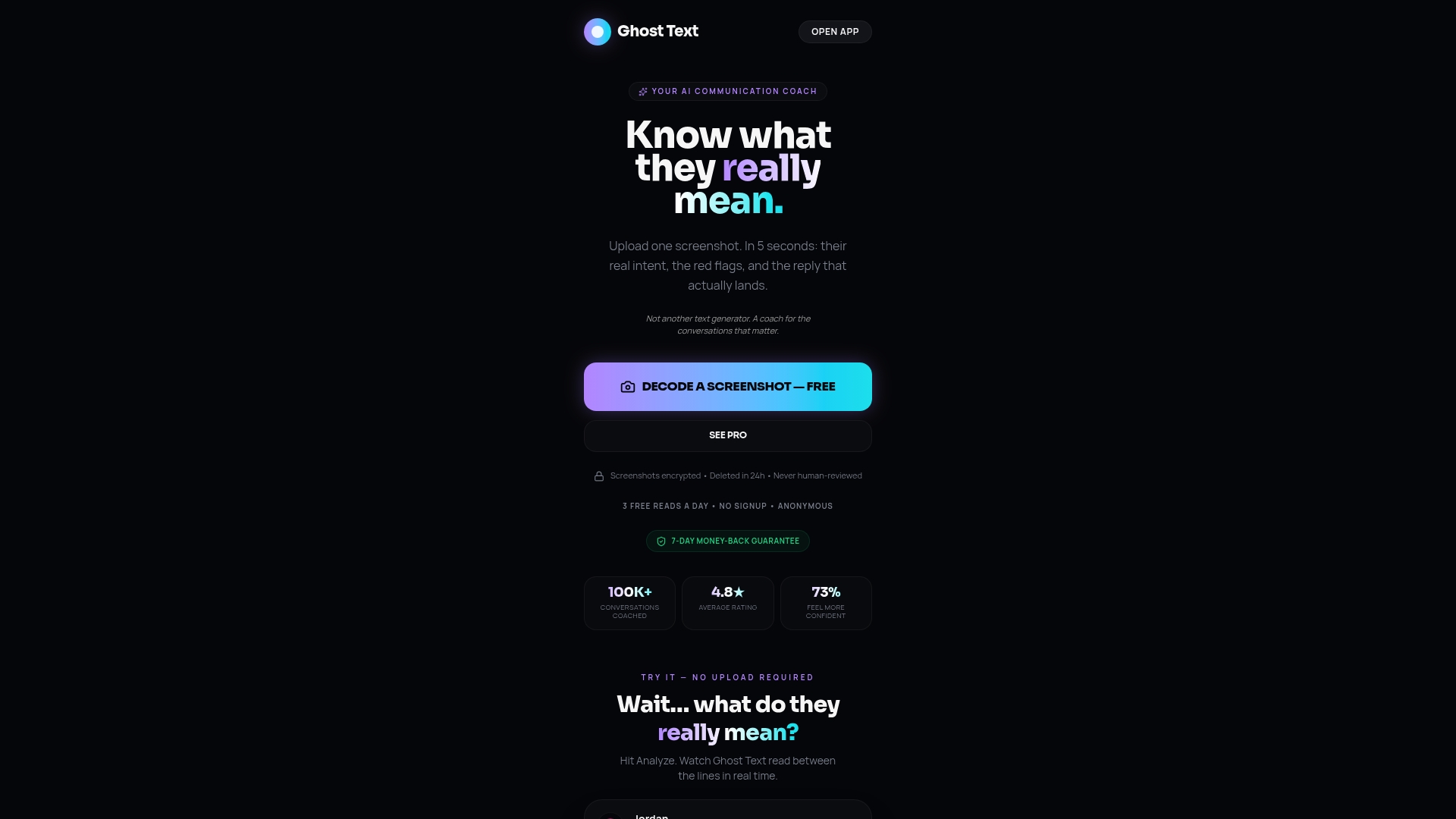
Paste a conversation or upload a screenshot, and Ghosttextai surfaces the tone, intent, emotional signals, and any red flags in seconds. It then generates reply suggestions you can customize by tone and style, whether you need to sound direct, warm, or diplomatic. It works across professional emails, client threads, team messages, and personal conversations. The freemium plan lets you try it immediately, and Ghost Text Pro unlocks unlimited reads, advanced red flag detection, and premium reply generation for professionals who rely on written communication daily. For a deeper look at how conversation analysis works in practice, the Ghosttextai blog walks through real examples.