
Conflict resolution in friendships is the process of addressing disagreements through clear, empathetic communication and shared responsibility to preserve the connection. Most people assume conflict itself destroys friendships. The research says otherwise. Avoidance and distancing drive friendship dissolution far more than conflict does. The real threat is silence, not disagreement. Knowing how to handle conflict in friendship, and when to act, is the skill that separates friendships that last from those that quietly fade.
How does emotional understanding improve conflict resolution in friendships?
Emotional understanding is the foundation of every productive friendship dispute solution. Without it, conversations about conflict become debates about who was right. With it, they become opportunities to actually reconnect.
The first step is naming your feelings before the conversation starts. Naming feelings reduces their intensity and leads to clearer thinking. That is not a soft suggestion. It is a cognitive shift. When you label an emotion, the brain's prefrontal cortex engages more fully, which means you think more clearly and react less impulsively.

The concept of "feeling felt" matters just as much. Your friend does not need to agree with you. They need to demonstrate that they understand your experience. When that happens, emotional regulation improves on both sides, and the conversation can move forward.
Self-connected communication takes this further. Instead of rehearsing your argument, you check in with your body first. Where do you feel the tension? What need is going unmet? Identifying those private signals before speaking opens you up to vulnerability, which is the actual entry point for connection.
- Name your emotion specifically. "I felt dismissed" lands differently than "I was upset."
- Separate the feeling from the story. "I feel hurt" is different from "You hurt me on purpose."
- Check your body before the conversation. Tight chest, shallow breathing, and clenched jaw all signal unmet needs.
- Ask yourself what you actually need from this conversation, not just what you want to say.
Pro Tip: Write down three feelings you experienced during the conflict before you reach out to your friend. This simple act lowers emotional charge and helps you speak from clarity rather than reaction.
What communication techniques work best for resolving friend conflicts?
The biggest mistake people make when resolving friend conflicts is treating the conversation like a debate. The goal is not to win. The goal is to be understood and to understand.
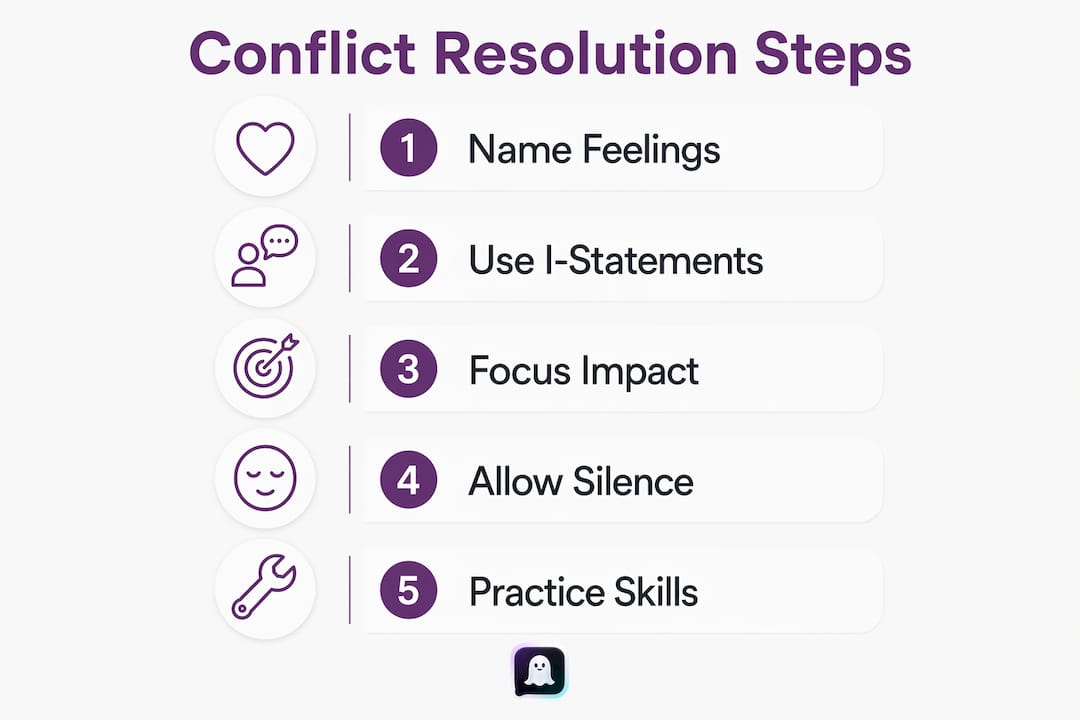
Most people escalate conflict by arguing their position rather than naming the difficulty of the conversation itself. A simple opener like "This is hard for me to bring up, but I care about our friendship" does more to lower defenses than any carefully constructed argument. Vulnerability signals safety. Safety opens dialogue.
Three communication patterns consistently block resolution:
- Defensiveness: Responding to a concern with a counter-complaint shuts down the other person immediately.
- Dismissiveness: Minimizing your friend's experience ("You're overreacting") invalidates their reality and deepens the rupture.
- The fixing impulse: Jumping to solutions before your friend feels heard makes them feel like a problem, not a person.
Focus on impact, not intentions. Saying "When you canceled last minute, I felt like I wasn't a priority" is far more productive than "You never consider my feelings." The first describes your experience. The second assigns character.
Connection conversations differ from resolution conversations in one key way. Connection conversations focus on understanding shared needs. Resolution conversations focus on reaching agreement. You often need the first before the second is even possible.
| Approach | What it does | When to use it |
|---|---|---|
| Connection conversation | Builds mutual understanding and emotional safety | Early in the conflict, before problem-solving |
| Resolution conversation | Reaches specific agreements or changes | After both people feel heard |
| "I" statements | Describes your experience without blame | Throughout any conflict discussion |
| Naming the difficulty | Opens vulnerability and lowers defenses | At the very start of a hard conversation |
Pro Tip: Before your next difficult conversation, write one "I" statement that describes your experience without mentioning your friend's behavior. Practice saying it out loud. The phrasing will feel more natural when it counts.
When should you let go of a friendship instead of repairing it?
Not every friendship conflict deserves repair. That is one of the most underacknowledged truths in conflict management in friendships.
High-conflict, unbalanced, or boundary-intruding friendships can be genuinely unhealthy to maintain. When a friendship consistently costs more than it gives, when boundaries are repeatedly ignored, or when accountability is always one-sided, the healthier choice may be to step back. Letting go in these cases is not failure. It is self-respect.
There is a meaningful difference between a friendship fading naturally and one ending because of unhealthy dynamics. Natural fading happens when lives diverge, schedules shift, and both people drift without resentment. Unhealthy endings involve patterns of harm that one or both people refuse to address.
Ending a friendship that consistently violates your boundaries or drains your mental health is not a conflict resolution failure. It is a form of self-care that protects your capacity for healthier relationships.
Signs that letting go may be the right call:
- One person consistently apologizes while the other repeats the same behavior.
- Conversations about the conflict leave you feeling worse, not better.
- The friendship requires you to shrink yourself or suppress your needs regularly.
- Boundary violations happen repeatedly, even after they have been named clearly.
Emotional preparation for closure matters. Acknowledge the grief. A friendship ending, even a difficult one, represents a real loss. Give yourself permission to mourn it without needing to justify the decision to anyone else.
How do you repair and maintain a friendship after conflict?
Repairing a friendship after conflict is not a single conversation. It is a process that requires honesty, patience, and follow-through from both people.
Step 1: Acknowledge the rupture directly. Mutual acknowledgment of the damage is the starting point. Both people need to name what happened and agree that it mattered. Skipping this step and jumping to "let's move on" leaves the wound unaddressed.
Step 2: Offer a sincere apology without qualifiers. A sincere apology acknowledges the emotional impact on the other person without adding "but" or "if you felt that way." Qualifiers signal that you are protecting yourself, not repairing the relationship.
Step 3: Check your motivation for repair. Verify your motivation before reaching out. Guilt and loneliness often drive reconciliation attempts that are not sustainable. The most durable repairs come from a genuine desire to rebuild, not from discomfort with the loss.
Step 4: Allow silence after the apology. Letting silence follow an apology gives your friend space to respond authentically. Over-explaining or filling every pause with reassurance puts pressure on them and can repeat the original harm.
Step 5: Build the skill through low-stakes practice. Assertive communication skills develop incrementally. Practicing on small issues, like saying you did not enjoy a restaurant choice, builds the capacity to address larger conflicts without resentment building up first.
| Repair step | What it looks like in practice |
|---|---|
| Acknowledge the rupture | "I know things have been off between us, and I want to address it." |
| Sincere apology | "I'm sorry for what I said. I understand it hurt you." |
| Check motivation | Ask yourself: Am I doing this for the friendship or to feel better? |
| Allow silence | Send the message, then wait. Do not follow up within hours. |
| Low-stakes practice | Speak up about small preferences to build your conflict confidence. |
Pro Tip: After an apology, resist the urge to immediately ask "Are we okay?" Give your friend at least 24 hours to process before following up. Authentic repair takes time.
Key Takeaways
Effective conflict resolution in friendships requires emotional honesty, mutual accountability, and the willingness to distinguish between friendships worth repairing and those worth releasing.
| Point | Details |
|---|---|
| Avoidance causes more damage than conflict | Distancing and silence dissolve friendships faster than disagreements do. |
| Name feelings before the conversation | Labeling emotions reduces their intensity and improves clarity for both people. |
| Use connection conversations first | Build mutual understanding before attempting to reach any specific agreement. |
| Sincere apologies skip the qualifiers | Accountability without "but" signals genuine repair intent, not self-protection. |
| Low-stakes practice builds conflict skills | Asserting small preferences trains you to handle larger conflicts without resentment. |
What I've learned about friendship conflict that most advice gets wrong
Most conflict resolution advice treats friendship disputes like workplace mediation. Get both sides, find the middle ground, shake hands, move on. That framing misses the point entirely.
Friendships are not contracts. They are living things. The conflicts that damage them most are rarely the big blowups. They are the small, repeated moments of avoidance. The text you never sent. The concern you swallowed. The boundary you let slide because you did not want to make things awkward. Those accumulate quietly until one day the friendship just feels hollow, and neither person can explain exactly why.
What I have seen work, consistently, is the practice of small repairs. Not grand gestures. Not long emotional conversations every time something goes wrong. Just the habit of saying, early and calmly, "Hey, that bothered me a little." That single habit, practiced regularly, prevents the kind of resentment that makes real repair feel impossible later.
The hardest part is not the conversation itself. It is the moment before it, when you are deciding whether to say something or let it go. Most people default to letting it go. And most people end up losing friendships they actually valued because of that default. Vulnerability feels risky. Silence feels safe. But the data and lived experience both point the same direction: silence is the actual risk.
Knowing when to let go is equally important. Not every friendship is worth the repair effort, and recognizing that early saves both people significant pain. The communication skills that serve you in friendships are the same ones that protect your energy across every relationship in your life.
— DSean
Ghosttextai can help you say the right thing
Knowing what to say in a difficult friendship conversation is genuinely hard. Ghosttextai is an AI-powered communication coach that reads the tone, intent, and emotional signals in your conversations before you respond.
You can paste a message or upload a screenshot and get instant insight into what is really being communicated, along with suggested replies that are clear, empathetic, and grounded. Whether you are preparing for a repair conversation, trying to understand a friend's distant response, or figuring out how to bring up a boundary, Ghosttextai gives you the clarity to respond with confidence rather than anxiety. Stop second-guessing what a message means and start communicating with intention.
FAQ
What is conflict resolution in friendships?
Conflict resolution in friendships is the process of addressing disagreements through honest communication, mutual accountability, and shared effort to preserve the relationship. It requires both people to engage, not just one.
Why does avoidance hurt friendships more than conflict?
Avoidance and distancing dissolve friendships faster than open conflict does because unaddressed tension builds resentment over time. Conflict, when handled well, can actually strengthen a friendship.
How do I know if a friendship is worth repairing?
A friendship is worth repairing when both people show mutual accountability and genuine motivation to rebuild. When one person consistently avoids responsibility or repeats harmful behavior, letting go may be healthier than continued repair attempts.
What makes an apology effective in friendship repair?
An effective apology names the specific impact on the other person and contains no qualifiers like "but" or "if you felt that way." Accountability without conditions signals that you are prioritizing the relationship over your own defensiveness.
How can I get better at handling conflict with friends?
Practice assertive communication on low-stakes issues first, like expressing a preference or naming a minor frustration. Building that habit incrementally prepares you to address larger conflicts before resentment takes hold.