
Orbiting is when someone you dated or matched with stops texting or calling but keeps watching your social media, liking posts, or viewing your stories, so you know they're still there without ever hearing from them directly.
If this is happening to you right now, the meaning behind it matters less than protecting your headspace. Do this first:
- Mute or restrict their account so their activity stops showing up in your feed.
- Unfollow or block if you want a cleaner break, especially if checking their profile has become a habit.
- If you want to respond, send one plain line: "I've noticed you're still active on my stuff but not reaching out. I'd rather we just talk or not interact at all."
You don't need to figure out why they're doing it before you're allowed to protect yourself.
Key Takeaways
Orbiting causes more exclusion and self-esteem harm than a direct rejection because ambiguous digital presence blocks emotional closure.
| Point | Details |
|---|---|
| Orbiting defined | Digital presence (likes, story views) continues while direct communication stops entirely. |
| Worse than a clean no | A 2022 study found orbiting causes more exclusion and self-esteem threat than direct rejection. |
| Attachment drives it | Anxious attachment predicts more monitoring behavior; avoidant types orbit to keep distance while staying visible. |
| Platform controls work fastest | Muting or restricting removes the intermittent reinforcement trigger that keeps you checking. |
| Get clarity before reacting | Ghost Text analyzes ambiguous messages and story activity patterns so you're not guessing at intent. |
Table of Contents
- What Is Orbiting in Dating, and Why Does the Term Matter?
- How Orbiting Shows Up: Scenarios and a Symptom Checklist
- Why People Orbit: Attachment Styles and Intermittent Reinforcement
- Orbiting vs. Ghosting, Freckling, and Oystering
- The Platform Mechanics That Make Orbiting Easy
- Emotional Impact and When to Get Professional Help
- How to Confirm Orbiting and Respond to It
- What the Research Says and Where a Tool Can Help
- A Straight Take on Orbiting
- Let Ghost Text Read the Signals So You Don't Have To
- Frequently Asked Questions
- Sources
What Is Orbiting in Dating, and Why Does the Term Matter?
Orbiting in dating describes a specific kind of half-presence: someone maintains digital visibility, a story view, a like, an occasional comment, while avoiding any direct conversation. No texts. No calls. No plans. Just enough contact to remind you they exist, never enough to mean anything.
The label caught on because it names something people were experiencing but couldn't describe. Social media made it possible to stay peripherally visible to an ex or a past match with almost no effort, and attachment researchers have since tied the behavior to real psychological patterns rather than random social noise.
Common behaviors that count as orbiting:
- Viewing your Instagram or Snapchat stories within minutes of you posting, then disappearing again.
- Liking a photo you shared without ever commenting or messaging.
- Leaving one comment every few weeks with zero follow-up when you reply.
- Staying visibly "active" or "online" on messaging apps near your usual online times.
Someone who ghosted you after three dates but still likes every gym selfie you post is orbiting. So is an ex who never texts back but watches every story the day you upload it.
How Orbiting Shows Up: Scenarios and a Symptom Checklist
Orbiting tends to surface in a handful of predictable situations. After a breakup, an ex might stop all direct contact but keep tabs through stories. After one or two dates that fizzled, a match might like your posts for weeks without ever suggesting a second date. Following a ghosting event, the ghost sometimes resurfaces as a silent viewer instead of vanishing completely.
Watch for this pattern:
- Story views that happen consistently, especially right after you post.
- Likes on posts with no direct message, ever.
- Comments that never lead to a real conversation when you respond.
- Contact through mutual friends or shared group chats instead of you directly.
Before you assume you're being orbited, rule out the obvious. Some apps auto-suggest accounts to "top viewers," algorithms resurface old content, and mutual friends create overlap that looks intentional but isn't. Confirm the pattern over a couple of weeks, not a single like.
Why People Orbit: Attachment Styles and Intermittent Reinforcement
Orbiting isn't random. It tracks closely with attachment style, and it works on the brain the same way a slot machine does.
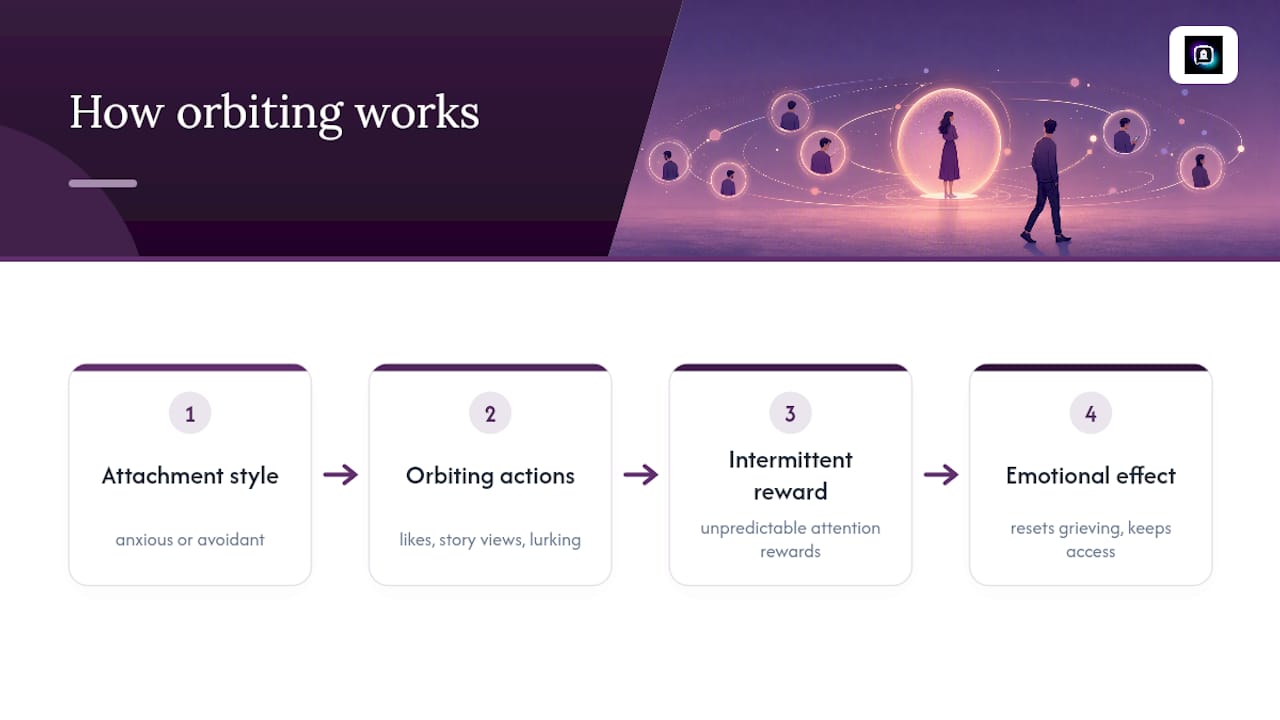
Research from the Attachment Project links anxious attachment to more frequent monitoring behavior, the checking, the lurking, the low-effort likes. People with anxious attachment often orbit because staying peripherally visible feels safer than either full re-engagement or total disappearance. Avoidant types, by contrast, sometimes orbit to keep a partner within reach while dodging the vulnerability of a real conversation.
That combination creates an intermittent reinforcement loop: sporadic, unpredictable attention (a like here, a story view there) triggers the same reward circuitry as a possible payout, which is exactly why the behavior is so hard to walk away from once you start checking. Clinical observations tied to this research describe orbiting as avoidant conflict behavior, a way to skip direct rejection while still holding onto emotional access.
Orbiting creates a kind of buffer that prevents linear grieving. Repeated story views or likes reset emotional progress and keep the brain tuned to intermittent social rewards instead of letting it settle.
Motive varies by person. Sometimes it's genuine curiosity or loneliness. Sometimes it's ego, wanting to be missed without doing any of the work of a relationship. And sometimes it edges into deliberate manipulation, keeping someone on a string as a backup option.
Orbiting vs. Ghosting, Freckling, and Oystering
These terms describe different flavors of digital distance, and the differences change how you should respond.
Ghosting is a total cutoff: no messages, no digital presence, nothing. Orbiting keeps digital presence alive while cutting direct communication. Freckling is intermittent, low-effort messaging with no real follow-through, think a "hey stranger" text every few months. Oystering is staying closed off and unresponsive while still occasionally resurfacing, similar to orbiting but usually with even less consistency.
| Behavior | Presence vs. communication | Intent clarity | Likely emotional effect |
|---|---|---|---|
| Ghosting | No presence, no communication | Clear rejection, blunt | Sharp initial pain, faster closure |
| Orbiting | High digital presence, no direct communication | Ambiguous, unresolved | Prolonged confusion, delayed closure |
| Freckling | Sporadic low-effort messages | Ambiguous, self-serving | Frustration, false hope |
| Oystering | Low presence, rare resurfacing | Ambiguous, passive | Mild confusion, easy to disengage |
Each pattern calls for a different boundary. Ghosting usually needs no response at all. Orbiting and freckling both call for muting or restricting to stop the reinforcement loop. Oystering is often easiest to ignore since the contact is rare enough to fade on its own.
Interestingly, a 2022 study found ghosting produced the strongest feelings of exclusion, but orbiting still caused higher exclusion and self-esteem threat than a direct, spoken rejection. Silence with a side of stalking your Instagram genuinely hurts more than a clean "no."
The Platform Mechanics That Make Orbiting Easy
Orbiting exists because apps are built to make passive watching effortless. Instagram and Snapchat stories show you exactly who viewed them. Algorithms resurface old posts and profiles, keeping former matches visible long after the conversation ended. Mutual followers and shared friend groups mean someone's activity keeps crossing your feed even when you've mentally moved on.

Default settings make this worse: public profiles, auto-play stories, and visible "last active" timestamps all remove the friction that used to come with checking on someone. A generation ago, keeping tabs on an ex took effort. Now it takes a swipe.
Pro Tip: Turn off "activity status" and switch your story viewer list to private-friendly settings before you do anything else. It removes the temptation to check who's watching you back, which is half the battle.
Emotional Impact and When to Get Professional Help
Orbiting produces a specific kind of ache: confusion first, then anxiety, then a slow erosion of self-esteem as you wonder what the silence actually means. Because there's no clean ending, it often turns into what clinicians describe as ambiguous loss, grief without a clear cause to grieve.
Watch for signs it's crossing from annoying into harmful:
- Checking their profile multiple times a day, even when you tell yourself you won't.
- Sleep trouble tied to thinking about the situation.
- Trouble focusing at work or pulling away from friends because you're preoccupied.
- Mood swings that track directly with whether they liked or viewed something that day.
Clinicians describe orbiting as creating psychological closeness without relational engagement, which can prevent emotional resolution long after a relationship or situationship has ended.
If the checking feels compulsive or your mood depends on someone else's digital breadcrumbs, a therapist can help you break the loop. If orbiting escalates into repeated unwanted contact, showing up uninvited, or anything that feels threatening, that's no longer a dating gray area. Contact local authorities.
How to Confirm Orbiting and Respond to It
Confirm the pattern before you act on it. Track three things over two to three weeks: how often it happens, whether it's consistent across platforms, and whether it ever leads to direct contact. If it's isolated to one app or overlaps with mutual friend activity, it might not be orbiting at all.
Once you've confirmed it, move through platform controls in order:
- Mute first if you just want the content out of your feed without confronting anything.
- Restrict if you want to limit their visibility into your activity while staying connected on paper.
- Unfollow when muting isn't enough and you want distance without a full cutoff.
- Block when you want the interaction to stop completely, especially if it's affecting your mood or sleep.
Three scripts worth keeping on hand:
- Neutral boundary: "I've noticed you're still checking in on my stuff without reaching out. I'd rather we just talk directly or not interact at all."
- Call-out: "This on-again-off-again watching without ever texting isn't something I want to keep dealing with. Let's talk or step back completely."
- Final message before blocking: "I'm blocking your accounts. Nothing personal, I just need a clean break to move forward."
For self-care, take a short digital detox from checking their profile, lean on a friend for accountability, and rebuild a routine that doesn't revolve around your phone at certain times of day.
Pro Tip: Delete the app you check them on most, not your whole phone, just that one app, for 72 hours. Most of the compulsive checking dies off within the first day once the habit loop is broken.
What the Research Says and Where a Tool Can Help
The clearest evidence on orbiting comes from a 2022 study comparing ghosting, orbiting, and direct rejection on measures of exclusion and self-esteem threat. Orbiting scored worse than a spoken "no" on both counts, which lines up with what therapists see in practice: ambiguity often hurts more than clarity.
Clinicians consistently recommend boundary-setting and platform controls as the first line of defense. Where things get murky is interpretation, is that comment friendly, awkward, or a signal they want back in?
- A text-analysis tool can help you read tone and intent in a specific message before you respond.
- It won't replace therapy if the situation has triggered real anxiety or depression.
- It's not a substitute for legal advice if the behavior escalates into harassment.
A Straight Take on Orbiting
Orbiting sticks around because it costs the orbiter nothing and it costs you real headspace. The person watching your stories has already gotten what they wanted, a low-risk way to feel connected without accountability, and every hour you spend decoding their likes is an hour they didn't have to earn.
Setting a boundary doesn't require their cooperation or an explanation from them. You control your feed, your notifications, and your attention starting the moment you decide to.
Let Ghost Text Read the Signals So You Don't Have To
Trying to figure out whether a like means interest or just habit is exhausting, and guessing wrong keeps you stuck in the loop longer. Ghost Text was built for exactly this kind of ambiguity: upload a screenshot or paste the conversation, and it breaks down tone, intent, and red flags so you're not left rereading a comment for the tenth time.
Use it to check whether a pattern of likes and story views reflects real interest or just passive monitoring, or to test a boundary script before you actually send it. If you've written one of the scripts above and want a second opinion on how it reads, run it through Ghost Text first. The free tier covers casual checks, and Ghost Text Pro unlocks unlimited reads and deeper red-flag detection for when the situation feels more tangled than one message can explain. Start with a screenshot at Ghosttextai and see what it flags.
Frequently Asked Questions
What does orbiting mean in dating? Orbiting means someone keeps watching your social media, liking posts, or viewing stories after all direct communication has stopped, keeping a passive presence without ever texting or calling.
Is orbiting the same as ghosting? No. Ghosting is a total cutoff with no digital presence at all, while orbiting keeps someone visible on your feed even though they've gone silent in direct messages.
Why does orbiting hurt more than getting rejected outright? A 2022 study found orbiting produces more exclusion and self-esteem threat than a direct rejection, largely because the ambiguity blocks emotional closure.
How do I stop someone from orbiting me? Mute or restrict them first to stop the reinforcement loop, then unfollow or block if the behavior continues or affects your mood.
Should I confront someone who is orbiting me? Only if you want a direct conversation. A short, neutral script works best: tell them you've noticed the pattern and ask them to either engage directly or stop interacting altogether.