
Overtexting in early dating is defined as sending messages at a frequency or depth that outpaces the actual trust and connection built between two people. It feels productive. It feels close. But relationship researchers and psychologists consistently find that premature texting intimacy creates a false sense of closeness that often collapses the moment you meet in person. The real cost is not just awkwardness on a first date. It is the slow erosion of anticipation, attraction, and the natural tension that makes early dating exciting. This article breaks down what overtexting looks like, why it backfires, and how to build a texting rhythm that actually serves your relationship.
What does texting too much look like in early dating?
Texting too much early dating is easier to spot in others than in yourself. The clearest sign is a morning-to-night message thread that leaves no room for curiosity or longing. If you are sending paragraphs when the other person sends sentences, or checking your phone every few minutes waiting for a reply, the pattern has already shifted into anxious territory.
Psychologists use the term "premature intimacy" to describe what happens when two people share deep emotional content before they have built real-world trust. Texting accelerates this process artificially. You feel like you know someone after 300 messages, but you have never seen how they handle a stressful moment, a crowded restaurant, or a bad day. That gap between digital closeness and real chemistry is where early relationships most often break down.
The behavioral markers of overtexting include:
- Sending three or more messages without receiving a reply. Multiple unanswered texts signal anxiety more than enthusiasm, and they often push the other person further away.
- Writing long, detailed messages when the conversation is still new. Length signals emotional investment the relationship has not yet earned.
- Texting from the moment you wake up until you go to sleep, with no natural breaks.
- Double texting to fill silence rather than letting the other person respond in their own time.
- Sharing personal fears, family history, or emotional wounds within the first week of contact.
Pro Tip: Mirror your date's texting tempo before you set your own. If they send short messages every few hours, match that rhythm. Social calibration through mirroring reduces friction and tells you a lot about their communication style before you ever discuss it directly.
Why is texting too much harmful to early relationships?

Constant availability kills anticipation. Responding instantly every time paradoxically lowers attraction because desire requires some distance. When someone can reach you at any moment and always gets an immediate reply, there is nothing left to wonder about. The mystery that makes early dating compelling disappears.
The psychological term for this is conversation exhaustion. Both people in the exchange start to feel the weight of maintaining a constant thread. What began as exciting becomes an obligation. One person starts to dread opening the app. The other person notices the slower replies and sends more messages to compensate, which makes the problem worse.
Texting can create a curated, controlled illusion of intimacy, which may cause people to feel more comfortable with the online persona than the real person. This phenomenon is a major red flag for healthy relationship development.
The "textlationship" trap is the logical endpoint of this pattern. A textlationship is a relationship that exists almost entirely in text form, where both people invest emotional energy without ever building real-world connection. Texting can create an illusion of closeness that substitutes for the vulnerability of actual face-to-face contact. People who struggle with avoidant or anxious attachment styles are especially prone to this trap because texting offers control. You can edit yourself. You can delay. You can present a version of yourself that feels safer than showing up in person.
The practical damage is straightforward. When you finally meet someone you have been texting intensively, the real person rarely matches the mental image built through weeks of curated messages. Premature intimacy in texting leads to false closeness, often resulting in exhaustion or disappointment during the first date when real chemistry fails to match the digital version. That disappointment is not a reflection of the other person. It is the predictable result of building expectations on an incomplete picture.
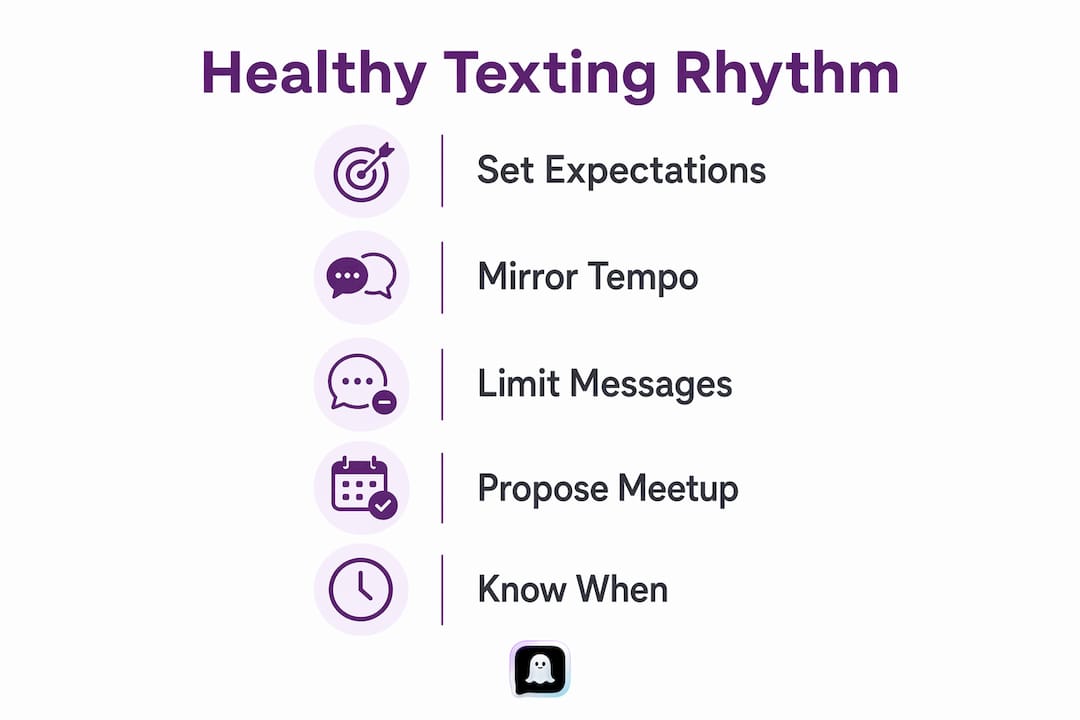
How to find a healthy texting rhythm in early dating
The standard for healthy texting frequency in early dating is a "less is more" approach. A few exchanges per day maintain momentum without creating pressure or exhaustion. Same-day responses are normal and expected. Anxiety over a delayed reply is a signal that the frequency has already climbed too high.
A practical framework for the first one to five dates:
- Keep it light and purposeful. Text to confirm plans, share something genuinely funny, or ask one specific question. Do not text just to fill silence.
- Mirror before you lead. Match your date's message length and response time before you establish your own rhythm. This tells you what they are comfortable with.
- Use texting to set up the next date, not to replace it. The goal of every text thread in early dating is to get both people excited about seeing each other in person. If texting is becoming the relationship, it is time to redirect.
- Have the conversation directly. Asking "Is this texting frequency working for you?" reduces anxiety and builds mutual understanding faster than guessing. Most people appreciate the directness.
- Set a natural endpoint for each conversation. Threads that never close create a low-grade pressure that wears on both people. End conversations clearly and let the next one start fresh.
Failing to set expectations around texting frequency is one of the primary causes of conflict in early dating. Individual preferences vary widely. One person may see a two-hour reply gap as normal. Another may read it as disinterest. Neither interpretation is wrong. The mismatch is the problem, and explicit communication is the fix.
Pro Tip: If you feel the urge to send a third message before getting a reply, write it in your notes app instead. Wait until they respond. That pause protects both your dignity and the other person's breathing room.
What should you do if you feel stuck in a texting-only relationship?
A textlationship, sometimes called "dexting," is defined as investing significant emotional energy into a text-based connection while consistently avoiding in-person meetings. Setting firm, public dates within a clear timeframe is the gold standard for testing whether the other person is genuinely interested or simply comfortable with the digital distance.
Recognizing the signs of a textlationship is the first step:
- Every attempt to make plans is met with vague enthusiasm but no confirmed date.
- The conversation feels deep and connected, but weeks pass without meeting.
- Your date has a consistent excuse for why in-person plans fall through.
- You know their texting style better than you know their voice.
- The relationship feels real in your phone but abstract everywhere else.
The fix is direct and non-negotiable. Propose a specific date, time, and place. Not "we should hang out soon." A real plan. If they decline without offering an alternative, that is your answer. If they accept, the textlationship ends and the actual relationship can begin.
Knowing when to walk away matters. If someone resists every attempt to meet in person, they are choosing the controlled comfort of digital connection over real vulnerability. That choice tells you everything about their readiness for a relationship. You can check for red flags in online dating messages to recognize these patterns earlier and save yourself weeks of misplaced investment.
The hardest part of leaving a textlationship is that it feels like a real loss. The connection was genuine in its way. But a relationship that cannot survive a cup of coffee in person was never going to survive the harder moments that real relationships require.
Key Takeaways
Overtexting in early dating creates false intimacy, kills anticipation, and consistently delays or prevents the real-world connection that relationships actually require.
| Point | Details |
|---|---|
| Overtexting signals anxiety | Sending three or more unanswered messages signals anxiety, not enthusiasm, and pushes people away. |
| False intimacy is a real risk | Premature emotional depth in texts creates closeness that often collapses when you meet in person. |
| Mirror before you lead | Match your date's texting tempo first to calibrate frequency and avoid mismatched expectations. |
| Use texts to set up dates | Every text thread in early dating should move toward an in-person meeting, not replace one. |
| Name the textlationship | If weeks pass with no real plans, propose a specific date and treat the response as your answer. |
What I have learned from watching people text their way out of good relationships
The most common mistake I see is treating texting as proof of interest. People count messages, track response times, and build entire narratives from a thread of 200 words. That is not connection. That is pattern recognition dressed up as intimacy.
The couples who build something real in early dating almost always share one habit: they keep texts short and use them to get in the same room faster. They do not perform the relationship over text. They show up for it. Texting is a tool for logistics and light warmth, not a stage for emotional auditions.
Anxious texters are not bad people. They are usually people who care a lot and have learned to manage uncertainty through activity. Sending another message feels like doing something. But in early dating, the most attractive thing you can do is leave space. Let the other person wonder. Let yourself wonder. That tension is not a problem to solve. It is the point.
Set your own standard and hold it. Decide what texting frequency feels healthy to you and communicate it clearly. The right person will respect that. The wrong person will reveal themselves quickly.
— DSean
When you need to know what a message actually means
Reading a text thread and trying to decode intent is exhausting, especially when the stakes feel high. Ghosttextai is an AI-powered communication coach that reads the messages you are unsure about and tells you what they actually signal: tone, intent, emotional cues, and whether something is worth responding to at all.
You paste the conversation or upload a screenshot, and Ghosttextai gives you instant clarity on what is really being communicated. Whether you are trying to figure out if someone is genuinely interested or just comfortable with digital distance, Ghosttextai helps you know before you reply. No more reading the same message five times and still feeling uncertain.
FAQ
How many texts per day is too many in early dating?
A few focused exchanges per day is the healthy standard in early dating. If the thread runs all day without natural breaks, the frequency has likely crossed into territory that creates pressure rather than connection.
Is texting every day when dating a red flag?
Daily texting is not automatically a red flag, but the content and volume matter. Short, warm daily messages are fine. Long, emotionally intense daily threads before a second or third date signal overtexting.
What is a textlationship and how do I get out of one?
A textlationship is a connection that exists almost entirely over text, with consistent avoidance of in-person meetings. Propose a specific date with a real time and place. If the other person declines without a genuine alternative, the relationship is not progressing.
Does texting too much reduce attraction?
Constant availability removes anticipation, which is a core driver of early attraction. Desire requires some distance, and overtexting eliminates that distance before real-world chemistry has a chance to develop.
How do I bring up texting frequency without seeming needy?
Ask directly and frame it as a preference, not a complaint. Mirroring your partner's texting style and asking "Is this frequency working for you?" opens the conversation without assigning blame and usually leads to a clearer, more comfortable dynamic for both people.