
Dry texting means sending short, low-effort replies like "K" or "Cool" that don't move a conversation forward. A single dry text almost never proves someone has lost interest. Cambridge Dictionary's language blog defines it as one or two-word answers that suggest low engagement, and that's the right starting point. But Vogue has reported that plenty of happy couples are both dry texters by nature. The meaning depends entirely on the overall pattern.
- "K"
- "Lol yeah"
- 👍 (no words at all)
The real signal isn't the message. It's whether this is new behavior or just how this person has always texted.
Key Takeaways
Dry texting is mostly meaningful when it shows a noticeable change from someone's usual text style.
| Point | Details |
|---|---|
| Definition matters | Dry texting means short, low-effort replies like "K" or "Cool" that stall conversation. |
| One text isn't proof | A single short reply is rarely evidence of disinterest on its own. |
| Pattern beats content | Compare recent exchanges to someone's usual baseline before drawing conclusions. |
| Reply with specific questions | Open-ended, detail-seeking prompts get better responses than generic ones. |
| Ghosttextai adds clarity | Ghosttextai analyzes tone shifts and reply patterns in a thread and suggests tailored replies. |
Where to Read More on Dry Texting
- Cambridge Dictionary blog: the formal definition of the term.
- Vogue: why short texting can be a personal style, not a red flag.
- Cosmopolitan: behavioral signs that indicate a real pattern.
- Parade: therapist perspective on how dry texting affects the receiver.
- Wikipedia: cultural debate around the term's meaning.
Table of Contents
- What Dry Texting Looks Like in Real Conversations
- Why People Dry Text: The Most Common Reasons
- How to Tell If Dry Texting Means They're Losing Interest
- How to Respond to a Dry Texter
- When Dry Texting Becomes a Red Flag
- What Relationship Experts Say About Reading Dry Texts
- Sources
What Dry Texting Looks Like in Real Conversations
Dry texting is easiest to spot next to its opposite. Here are two threads sparked by the same message: "Hey, how was your weekend?"
Dry reply: "Good. You?" — then nothing else, even after you share a story.
Engaged reply: "It was actually kind of chaotic, my sister's dog got loose at the park lol. How was yours? Did you end up going to that thing you mentioned?"
Common dry-texting markers include:
- Very short answers
- Lack of follow-up questions
- Ignoring photos, memes, or links
- Not initiating texts
- Occasionally slower replies without explanation
Timing alone doesn't tell you much. Someone stuck in a meeting who answers "busy, talk later" isn't dry texting, they're just busy. Cosmopolitan's rundown of behavioral signals points out that it's the repetition across many exchanges, not one clipped reply, that turns a busy moment into a pattern worth noticing.
Why People Dry Text: The Most Common Reasons
Most dry texting has nothing to do with you. Here's what usually drives it:
- Low text energy. Some people are naturally quiet over text but perfectly warm in person or on the phone. Vogue's reporting notes this is a stable style for plenty of couples, not a warning sign.
- Dislike of texting as a medium. They'd rather talk than type, and long messages genuinely drain them.
- Genuine busyness. Work crunch, family stuff, or travel can flatten anyone's texting for a stretch, then bounce back to normal.
- Deliberate distancing. Some people go quiet on purpose when they're pulling away, using shorter replies to create space without an explicit conversation.
- Social or texting anxiety. Crafting the "right" response feels like pressure, so they default to the shortest safe answer.
The distinguishing signal is direction. Situational dry texting stays flat or bounces back to normal. Deliberate distancing tends to become drier over time and shows up on other channels too: fewer calls, shorter in-person conversations, less initiation everywhere, not just in texts.
How to Tell If Dry Texting Means They're Losing Interest
Run through this checklist before you draw a conclusion:
- Frequency: Is it every reply, or just an occasional one-word text after a long day?
- Change from baseline: Did they used to text more and now don't, or has this always been their style?
- Who initiates: Are you the only one starting conversations lately?
- Cross-channel behavior: Are calls, plans, and in-person energy also cooling off, or just the texts?
New matches and early dating deserve a shorter patience window. Parade's coverage of therapist advice on dry texting suggests judging early-stage texting by a handful of exchanges, since there's no established baseline yet. Long-term partners deserve more benefit of the doubt because you actually have history to compare against.
Three quick scenarios: A new match who's dry from message one is probably just a naturally low-effort texter. A partner who suddenly gets curt after months of easy back-and-forth is worth a direct check-in. Someone dry over text but affectionate and present in person is very likely fine.
Pro Tip: Look at your last four to six exchanges as your diagnostic window. A sudden, sustained shift in that stretch tells you far more than any single "K."
How to Respond to a Dry Texter
Diagnose first, then pick your move:
- Diagnose: Is this a one-off or a pattern? Don't skip this step.
- Choose your tone: Playful if the relationship is casual and light, direct if it's established or you're genuinely confused.
- Send one clear attempt: Give them a real chance to re-engage before assuming the worst.
- Pause or escalate: If the pattern continues, either let it breathe or bring it up in person or on a call.
A few lines worth keeping in your back pocket:
- Playful pivot: "Wow, riveting update. Tell me more, I'm on the edge of my seat 😂"
- Open-ended prompt: "What was the best part of your day?" (harder to answer in one word than "How was your day?")
- Low-effort boundary statement: "I notice our texts have gotten pretty short lately, everything good on your end?"
- Exit line: "Feels like texting isn't really your thing lately, no worries either way."
The texting etiquette guide has more on framing messages that actually invite a real answer instead of a yes or no.
Pro Tip: Questions that ask for an opinion or a specific detail almost always beat generic ones. "How was your weekend?" invites "good." "What'd you end up doing Saturday night?" invites an actual story.

When Dry Texting Becomes a Red Flag
A red flag isn't one bad week of texting. It's a pattern that's sustained, one-sided, and dismissive, paired with pulling back on calls, plans, or in-person warmth. Cosmopolitan notes that never initiating, ignoring what you share, and consistently short answers together point to fading interest rather than a busy stretch.
The decision tree is simple:
- Try a direct conversation first. "Hey, I've noticed things feel different, can we talk?"
- If it doesn't change, set a boundary. "I need more back-and-forth to feel good about this."
- If nothing shifts, step back. "I don't think we're on the same page here, I'm going to step away."
Elite Daily's rundown of dry texting signs frames slowed, one-word responses in early dating as a common precursor to ghosting, which is exactly why the conversation step matters before you invest more.
What Relationship Experts Say About Reading Dry Texts
Therapists quoted by Parade describe dry texting as the kind of short, clipped reply that leaves the other person feeling ignored, but they consistently push back against reading any single text as proof of anything. The pattern over time is what actually carries meaning.
Wikipedia's overview of the term captures the ongoing debate well: some treat dry texting as disrespectful, others as just a personal communication style. AI-assisted conversation analysis can help settle that debate for your specific situation by tracking reply length, initiation rate, and tone shifts across a thread. It's a useful second opinion, not a mind reader.
A Quick Reality Check on Dry Texting
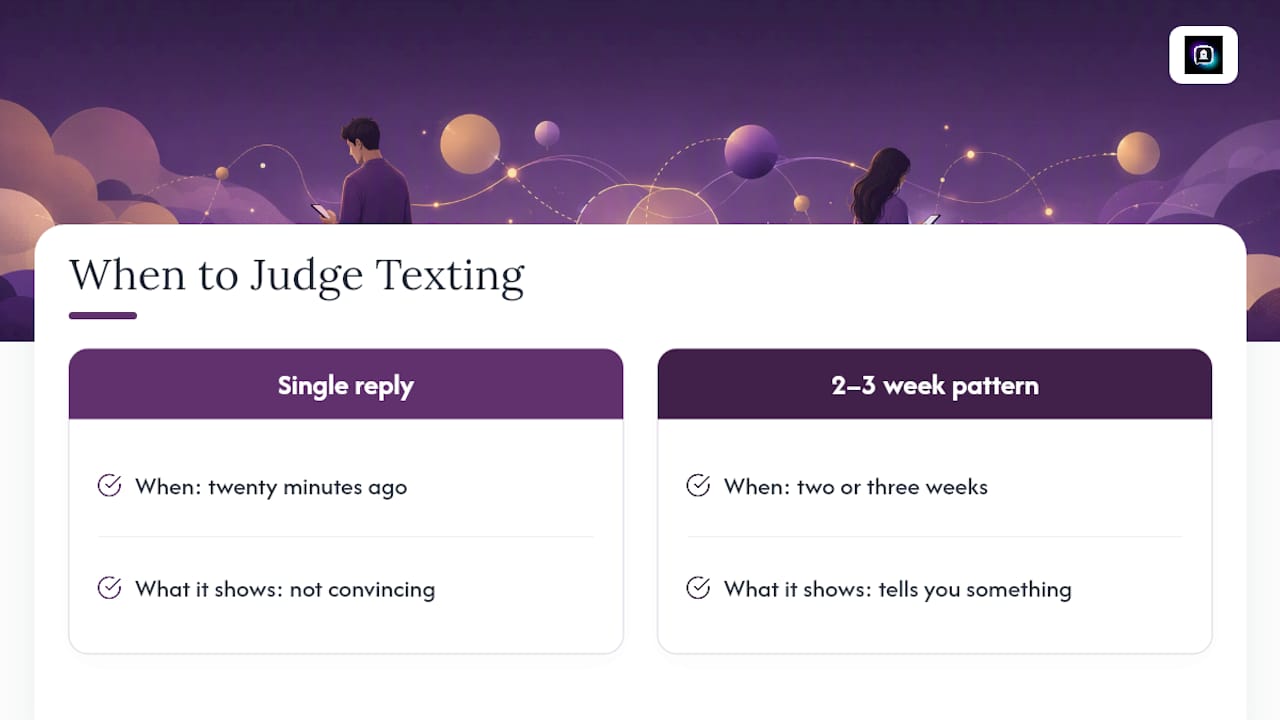
I've never been convinced that one clipped reply means much of anything. What actually tells you something is the shape of things over two or three weeks, not the message you got twenty minutes ago.
Get Clarity on a Confusing Text Thread
Rereading the same "K" for the tenth time trying to decode what it means wastes energy you could spend just knowing. Ghosttextai analyzes the actual conversation, not just your gut feeling.
Upload a screenshot or paste the thread, and Ghosttextai flags the tone shifts, points out whether replies are getting shorter over time, and drafts a reply suited to the situation, whether that's a playful pivot or a direct check-in. It's free to try on a few conversations before you decide if you want unlimited reads. If you're stuck staring at a dry reply right now, try analyzing your conversation and get a clearer read than another round of guessing with friends.
Sources
- What does dry texting mean?- About Words - Cambridge Dictionary blog
- Take It From a Dry Texter: Short Messages Don’t Mean Someone Isn’t Interested | Vogue
- Why Therapists Are Begging People To Stop 'Dry Texting' | Parade
- Dry Texting: What It Is, How to Stop It, and What to Do | Cosmopolitan
- Dry texting - Wikipedia