
Texting etiquette is the set of unwritten social norms that guide respectful, clear, and timely communication through text messages. Without vocal tone, facial expressions, or body language, a perfectly innocent message can land as cold, sarcastic, or demanding. Good texting manners close that gap. The core elements are simple: be kind, respond within a reasonable window, use language your recipient will understand, and respect the other person's time and emotional bandwidth. When you get these right, texting strengthens relationships instead of straining them.
- Kindness and empathy come first. Assume good intent before you assume offense.
- Timely responses matter, but "timely" does not mean instant. Context determines the window.
- Clear, explicit language beats hints, sarcasm, or vague shorthand.
- Respecting boundaries means knowing when not to text, not just how.
- Appropriate timing keeps your messages from feeling like intrusions.
Table of Contents
- What is texting etiquette, and why does it matter in 2026?
- The core texting rules everyone should follow
- Why texting so often causes misunderstandings
- Ghosting: what it is and why it damages relationships
- Why spelling and grammar still matter in texts
- Why "K" is not a neutral response
- Kindness and empathy make texting work
- How to read and respect others' texting preferences
- Key Takeaways
What is texting etiquette, and why does it matter in 2026?
Texting is now the default communication channel for most personal relationships in the United States, which makes the rules around it more consequential than ever. Nick Leighton, host of the etiquette podcast Were You Raised by Wolves?, puts it plainly: "Let's not waste people's time" and "let's be mindful of their feelings" are the two principles that have never changed, regardless of the medium.
The problem is that text strips away roughly half of what makes communication work. You lose pitch, pace, and expression. A one-word reply that sounds breezy in person reads as dismissive on a screen. Clear, direct language is not just a courtesy in texting. It is the only reliable substitute for everything the medium removes.
SMS communication etiquette also matters because the expectations around it are genuinely unclear to a lot of people. Generational gaps, cultural differences, and individual preferences mean that what feels normal to one person feels rude to another. Knowing the widely accepted norms gives you a baseline to work from and the awareness to adjust when someone operates differently.
The core texting rules everyone should follow
Good texting manners are not complicated, but they do require some deliberate thought. Here are the commandments that hold up across nearly every personal texting situation.
-
Text during reasonable hours. Acceptable texting hours are generally 8:00 AM to 9:00 PM in the recipient's time zone. Outside that window, you are risking a disrupted sleep or an interrupted morning, neither of which sets a good tone.
-
Respond within 24 hours for personal texts. Etiquette guidelines suggest replying to personal texts within 24 hours, though a response within a few hours during the day does more to maintain rapport. You do not owe anyone an instant reply, but leaving someone hanging for days without acknowledgment is its own kind of rudeness.
-
Never deliver bad news by text. Breakups, deaths, serious health updates, and major conflicts all require a voice call or an in-person conversation. The Emily Post Institute is direct on this: texting is inappropriate for sensitive or complex topics. A screen cannot hold the weight of those moments.
-
Keep texts reasonably short. If your message requires three scrolls to read, it probably belongs in a phone call. Long texts put an unfair burden on the reader and often bury the actual point.
-
Use clear, explicit language. Sarcasm is nearly impossible to read in text without vocal cues. If you mean something, say it plainly. Vague hints and irony are where most texting misunderstandings are born.
-
Use abbreviations and emojis thoughtfully. With close friends, "lol" and a string of emojis are fine. With a parent, a new acquaintance, or anyone who has shown they prefer plain language, dial it back. Match the register of the person you are texting.
-
Introduce yourself when texting someone new. If the recipient does not have your number saved, start with your name and context to avoid confusion and increase the chance of a reply. "Hi, this is Jordan from the Tuesday book club" does more work than you think.
-
Do not text while distracted, angry, or in the middle of something important. Texts sent in frustration or half-attention tend to be the ones you regret. If you are angry, wait. If you are in a conversation with someone in front of you, put the phone down.
-
Avoid all-caps. Typing in all capitals reads as shouting. Even if you are excited, it can feel aggressive to the person on the other end.
-
Respect group chat dynamics. Think before you send in a group thread. Erica Dhawan, author of Digital Body Language, advises asking yourself "Is this relevant?" before adding to a thread. A reaction emoji often does the job better than a "haha" that pings twelve people. Personal conflicts belong in a private message, not the group.
-
Know when to switch to a call. If a text exchange has gone back and forth more than a few times without resolution, or if the topic is emotionally charged, suggest a call. Texting is not the right tool for every job.
-
Do not send a string of single-word texts. Sending five separate messages instead of one complete thought fragments the conversation and floods the other person's notifications.
-
Avoid texting in social settings where it signals disengagement. Checking your phone repeatedly during a meal or a face-to-face conversation tells the person in front of you that they are less important than whoever is on the screen.
-
Name your pause when you need space. Rather than going silent, a quick "I'm slammed right now, I'll get back to you later" is far more considerate than leaving someone to wonder. This is one of the most underused tools in texting etiquette.
Pro Tip: Before sending a text you are unsure about, read it aloud as if you are the recipient hearing it for the first time. If it sounds cold, abrupt, or confusing, rewrite it.
Why texting so often causes misunderstandings
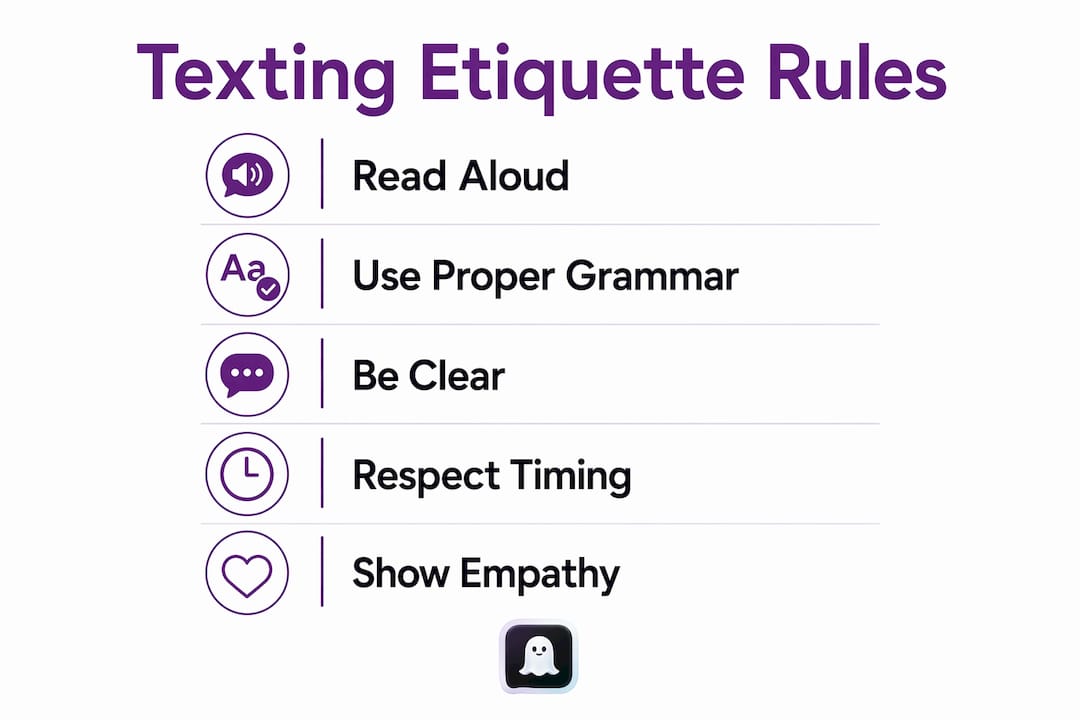
Tone is the first casualty of text messaging. Without facial expressions or vocal inflection, even a neutral message can read as irritated, dismissive, or passive-aggressive. A period at the end of "Fine." lands differently than "Fine!" and neither one sounds the way you might intend it in person.

The modern expectation of constant availability makes this worse. Erica Dhawan writes that we are essentially like emergency room doctors triaging messages based on urgency and life demands. A text from a day care teacher about a sick child gets answered immediately. A funny video from a friend can wait until the evening. That is not rudeness. That is reality.
The culture of constant connectivity creates a false urgency that pressures people into feeling they owe an instant reply to every message. Normalizing the idea that silence often reflects triaging, not rejection, reduces a lot of unnecessary anxiety on both sides of a conversation.
A few things worth keeping in mind:
- Delayed replies usually mean the person is busy, not that they are upset with you.
- Texting is asynchronous by design. It was never meant to replicate a real-time conversation.
- Naming your pause when you are overwhelmed is more considerate than going quiet without explanation.
- Setting boundaries around your availability protects the quality of your relationships, not just your own peace.
If you regularly find yourself second-guessing what someone's message actually means, tools like Ghosttextai can analyze tone, intent, and emotional signals in a conversation so you are not left guessing.
Ghosting: what it is and why it damages relationships
Ghosting is the practice of cutting off contact without explanation, letting messages go unanswered indefinitely and leaving the other person with no closure. In texting, it usually looks like a conversation that simply stops, with one person reading messages and never responding again.
It feels easier than an awkward conversation, but the cost is real. The person on the receiving end is left to fill the silence with their own interpretations, which are almost always worse than the truth. Ghosting removes the other person's ability to understand what happened or move on cleanly.
The alternative is not complicated. A short, honest message, "I don't think we're a good fit, but I wish you well," takes thirty seconds and gives the other person something to work with. For longer or more established relationships, a phone call is more appropriate. Texting etiquette does not require you to stay in every conversation, but it does ask you to exit them with basic respect.
Why spelling and grammar still matter in texts
Autocorrect has made careless texting easier, and it has also made it more embarrassing. A message riddled with typos or autocorrect errors can obscure your meaning entirely, and in some contexts it signals that you did not think the message was worth a second look before sending.

You do not need to write texts like formal emails. Casual language, contractions, and sentence fragments are all fine in personal conversations. What matters is that your message is readable and that the words you meant to send are actually the words that arrived. A quick reread before hitting send catches most problems. For anything emotionally significant, that extra two seconds is worth it.
Why "K" is not a neutral response
Single-letter replies like "K" have a reputation for a reason. In the absence of tone, brevity reads as coldness. "K" in response to a thoughtful message or a genuine question signals that you either did not read it carefully or did not think it deserved more than a keystroke.
"Okay" is warmer. "Sounds good!" is warmer still. The difference in effort is minimal, but the difference in how it lands is not. If you genuinely are in a rush and cannot respond properly, a quick "Got it, talk later" acknowledges the message without the curt dismissal that "K" carries. Dry texting, the habit of sending consistently short, low-effort replies, can signal disinterest even when none is intended, and over time it tends to erode the other person's willingness to reach out.
Kindness and empathy make texting work
The best texting etiquette advice is also the most obvious: treat the person on the other end like a person. That means giving them the benefit of the doubt when a message reads oddly, checking in when someone seems off, and not using text as a place to vent frustration at someone who cannot respond in real time.
Empathy in texting also means being aware of what the other person is carrying. If a friend just went through something hard, a check-in text costs nothing and means a lot. If someone has been slow to respond, the kind assumption is that they are busy, not that they are avoiding you. Small gestures, a warm opener, a genuine question, a "thinking of you," do more to maintain a relationship than any number of perfectly worded messages. For practical guidance on clear communication strategies that translate well to personal texting, the principles of tone awareness and explicit language apply just as much outside the office.
How to read and respect others' texting preferences
Not everyone texts the same way, and good texting manners include recognizing that. Some people respond quickly and expect the same. Others check their phone twice a day and consider that perfectly normal. Some prefer long, conversational messages. Others want short and direct. Neither style is wrong.
The way to figure out someone's preferences is to pay attention. If someone consistently takes a day to reply, stop expecting an hour. If someone always uses full sentences, match that register. If a friend has mentioned they find group chats overwhelming, think twice before adding them to one. Erica Dhawan's advice to use your phone's mute and archive features applies here too: managing group chats thoughtfully is part of respecting the people in them.
When someone's texting behavior genuinely confuses you, whether the tone seems off, the replies feel distant, or you cannot tell if they are upset, it is worth asking directly rather than spiraling into interpretation. A simple "Hey, is everything okay?" does more than a week of rereading the same three messages. If you want a second perspective on what a conversation might actually mean, Ghosttextai reads tone and intent so you can respond with clarity instead of anxiety.
Key Takeaways
Good texting etiquette comes down to one thing: treating the person on the other end with the same consideration you would give them face to face.
| Point | Details |
|---|---|
| Respect appropriate hours | Text between 8:00 AM and 9:00 PM in the recipient's time zone to avoid intrusion. |
| Respond within 24 hours | Personal texts warrant a reply within a day; a few hours during the workday maintains rapport. |
| Use clear, explicit language | Sarcasm and vague hints misfire in text; say what you mean plainly to avoid misreadings. |
| Name your pause, don't ghost | A brief "I'm busy, I'll get back to you" is more respectful than unexplained silence. |
| Match the other person's style | Pay attention to how someone texts and adjust your register, pace, and length accordingly. |