
The fastest way to end a text conversation is to say you need to go, then follow it with a short, warm sign-off instead of just trailing off. Skip the excuses and the slow fade. Psychologist Dr. Joel Frank notes that clear closure signals respect, while Parade's roundup of therapist-approved phrases confirms abrupt endings do the most damage. An AI coach like Ghost Text can even help you find the right tone before you hit send. Three you can copy right now:
- "This was fun, I've gotta run. Talk soon!"
- "Heading out, catch you later."
- "I need to step away, take care."
Key Takeaways
Polite text closure works because it pairs a brief, honest reason with a warm sign-off, never silence and never a bare one-word reply.
| Point | Details |
|---|---|
| State the reason, then exit | Name why you're going in one clause, then close with a warm or neutral line. |
| Match tone to context | Dating, family, and professional chats each call for a different register of sign-off. |
| Never ghost | Silence reads as dismissal; even a short "gotta go" beats no reply at all. |
| Offer a concrete follow-up only if real | Vague promises to reconnect confuse more than a clean, no-promise goodbye. |
| Ghost Text for tone-matched exits | The AI coach suggests context-specific sign-offs and flags when a firmer boundary line is needed. |
Table of Contents
- Copy-and-Paste Lines to End a Text by Situation
- How Do You Pick the Right Way to End a Text?
- What Do You Say When You Need to Set a Firm Boundary?
- Mistakes That Make a Text Exit Feel Worse
- Why a Polite Closing Line Actually Matters
- When Should You Offer to Continue the Conversation Later?
- How Do You Smoothly Shift a Text Toward Ending?
- Does Text Etiquette Change Across Cultures?
- Get Tone-Matched Exit Lines From Ghost Text
- Frequently Asked Questions
- Sources
Copy-and-Paste Lines to End a Text by Situation
Context changes everything about how a sign-off lands. A line that feels natural with your sister might read as cold to someone you just started dating. Sorting templates by relationship type takes the guesswork out of it.
Dating and early-stage chats
- Casual: "This was great, I've gotta head out. Talk soon 😊"
- Slightly formal: "I need to run for now, but I enjoyed this. Looking forward to next time."
- Flirty: "Okay, I really have to go before I keep texting you all night. Bye for now 😉"
A single emoji here softens the exit without diluting interest. Skip the emoji if you want the tone to stay neutral or you're not sure the interest is mutual yet.
Casual friends
- "Gotta jump off, catch you later!"
- "Running to a meeting, talk later this week?"
- "I'm out, but let's finish this convo this weekend."
Family
- "Love you, gotta go make dinner. Call you tomorrow."
- "Heading into a thing, talk soon!"
- "I've gotta run, but this made my day. Bye for now."
Professional or coworker chats
- "Thanks for the update, I'll follow up tomorrow."
- "Heading into a call, let's circle back this afternoon."
- "Got it, noted. I'll respond by end of day."
Etiquette experts at Mic recommend stating plainly that you're wrapping up and naming when you'll reconnect. That one addition, a rough timeframe, does more to soften an exit than any extra sentence of explanation.
Group chats
- "Muting for now, catch up later!"
- "Gotta step away from this one, will read up later."
- A thumbs-up or heart reaction instead of a reply works fine when a text doesn't need a response at all.
Pro Tip: In group chats, a reaction emoji often communicates closure better than a message. It says "seen and acknowledged" without adding another notification to a thread that's already too long.
How Do You Pick the Right Way to End a Text?
Choosing the right exit takes about ten seconds if you run through a short mental checklist instead of overthinking the wording.
- Name your outcome. Are you trying to keep the connection warm, pause it for now, or end contact? Each goal points to a different tone.
- Match tone to that outcome. Warm phrasing ("talk soon!") keeps rapport alive. Neutral phrasing ("heading out, catch you later") signals a pause without commitment. Direct phrasing works when you need a firmer stop.
- Pick a reason and a moment. A brief, honest reason beats a vague excuse every time, and timing matters: ending mid-conversation feels more natural than waiting through five one-word replies.
Pro Tip: A thumbs-up reaction or a single "😊" can close a conversation without any words at all, but save the nonverbal exit for chats where the other person expects a low-effort reply. Anything that needs clarity, like declining plans, deserves an actual sentence.
What Do You Say When You Need to Set a Firm Boundary?
Sometimes a soft sign-off isn't enough, especially with someone who keeps pushing after you've tried to wrap things up. These moments call for shorter, more direct language:
- "I don't want to continue this conversation."
- "Please stop texting me."
- "I've said what I needed to. I'm done here."
Firm doesn't mean cruel. State the boundary once, then stop responding to follow-up messages that try to reopen the conversation. Healthline's guidance on boundary-setting frames this as basic self-protection, not rudeness.
If someone won't stop after a clear boundary, block or report the contact rather than engaging further. If any message feels threatening, treat it as a safety issue and reach out to someone you trust or the appropriate authorities.
Mistakes That Make a Text Exit Feel Worse
Ghosting tops the list of what not to do. So does replying with a bare "k" after a real conversation. Both leave the other person guessing, which does more relational damage than a slightly awkward goodbye ever would.
- Bad: No reply at all after several messages. Better: "Sorry, got pulled into something. Talk later!"
- Bad: A flat "ok." Better: "Got it, thanks. Catch you tomorrow."
- Bad: An aggressive sign-off for a minor annoyance. Better: A neutral, brief close that doesn't escalate.
- Bad: Over-explaining with three paragraphs of justification. Better: One honest sentence.
Parade's research notes that abrupt endings or silence read as the most dismissive option available, even worse than an imperfect goodbye.
Why a Polite Closing Line Actually Matters
Effective conversation closure is a sign of respect for the other person's time and attention. Abrupt endings, or ignoring a final message entirely, tend to leave the recipient feeling dismissed or unimportant, which can quietly erode trust in the relationship.
That's the core finding behind Dr. Joel Frank take on conversational closure, and it lines up with what Dr. Gina Radice-Vella and other relationship-focused psychologists have long argued: the ending of a conversation shapes how the whole exchange gets remembered.
Ghost Text applies that same logic to real-time messaging. Upload a screenshot or paste a conversation, and it reads tone, intent, and emotional signals before suggesting a reply that fits the moment. That's useful in a few specific spots:
- Wrapping up a dating conversation without sounding cold or overeager.
- Setting a family boundary firmly but without triggering a bigger conflict.
- Closing out a professional thread with the right level of formality.
When Should You Offer to Continue the Conversation Later?
Not every ending needs to be final. If you want to keep a connection open, the fix is simple: pair your exit with a specific, low-pressure plan to pick things back up.

Vague promises ("we should talk soon") tend to fizzle because they carry no commitment. Specific ones work better: "I'll text you tomorrow after my shift" or "Let's finish this Saturday, I'm free most of the afternoon." The wikiHow breakdown of texting exits points out that a concrete follow-up plan, even a loose one, reduces the chance the other person reads your exit as disinterest.
This matters most in dating contexts, where an unexplained pause can easily get misread as rejection. If you're into someone but genuinely need to go, naming a next touchpoint removes the ambiguity. It matters less in professional threads, where "I'll follow up tomorrow" is often assumed rather than stated.
Skip the follow-up offer when you don't actually intend to continue the conversation. A promise you don't plan to keep causes more confusion than a clean, no-promises goodbye. If the relationship is winding down naturally, a plain "take care" without a future plan is often the more honest move.
How Do You Smoothly Shift a Text Toward Ending?

A conversation rarely needs to stop cold. A transitional phrase can signal the wind-down a message or two before the actual goodbye, which gives the other person time to adjust rather than feeling cut off.
Useful transition lines include:
- "This has been great, one more thing before I go."
- "I should probably let you get back to your day."
- "Before I run, just wanted to say [specific thing]."
- "Okay, last thought and then I'll let you go."
These work because they frame the ending as a natural pause rather than an abrupt stop. They also give you room to land one final, meaningful point, a compliment, a plan, a thank-you, before the conversation closes. That closing note tends to be what people remember most.
In workplace threads, the transition often looks more procedural: "Let's pick this up in tomorrow's stand-up" or "I'll send a summary and we can close the loop there." The same async-first thinking Atlassian applies to declining meetings applies just as well to wrapping up a text thread that's run its course.
Does Text Etiquette Change Across Cultures?
Texting norms shift more than people expect, even within English-speaking regions. In parts of the U.S. and Canada, a fast, casual sign-off is standard and rarely seen as rude. In many parts of Latin America and Southern Europe, texts tend to run warmer and longer, and a clipped ending can come across as cold even when that's not the intent.
Response-time expectations vary too. USA Today's reporting on texting norms found that what counts as an acceptable delay before replying, and before ending a chat, differs by age group and region, with younger texters generally more comfortable with abrupt, low-ceremony exits.
Generational differences show up constantly in dating contexts specifically. Older daters often expect a fuller goodbye, something closer to how a phone call would end. Younger daters are frequently fine with a quick "gtg, ttyl." Neither approach is wrong, but mismatched expectations are where most "why did they end it like that?" confusion comes from. When you're texting someone from a different background or generation, erring toward a slightly warmer, more explicit sign-off is the safer bet.
A quick note on keeping it simple
Honest, short exits beat clever ones almost every time. Say what's true, keep it brief, and let kindness do the work instead of a clever line trying to cover for one.
Get Tone-Matched Exit Lines From Ghost Text
Picking the right words gets harder the more the relationship matters, which is exactly when a wrong tone costs the most. Ghost Text reads the conversation you're actually in, not a generic template, and suggests an exit line that fits the tone, history, and stakes of that specific chat.
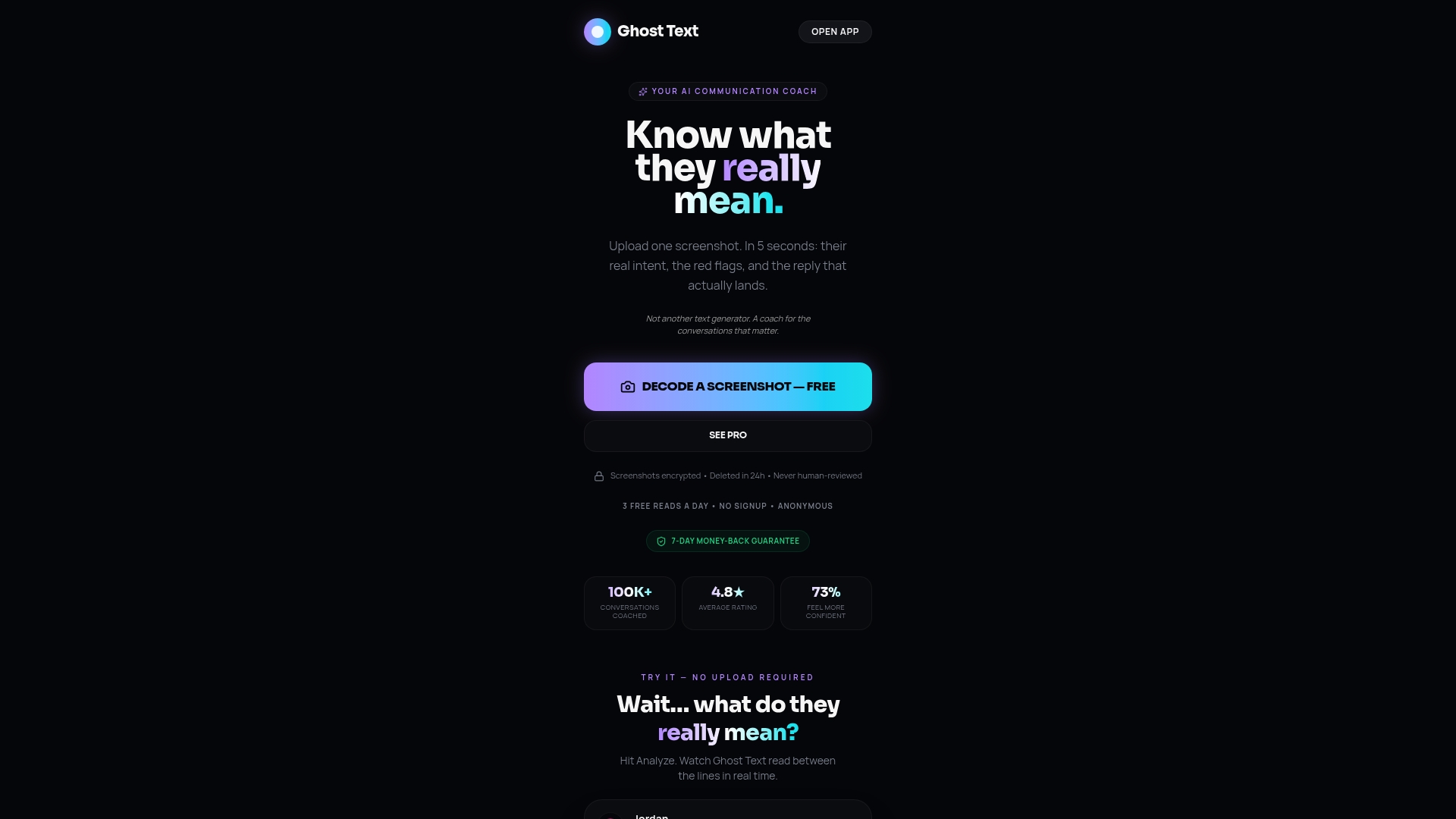
A few things it does well for this exact problem:
- Tone tuning that adjusts a sign-off from flirty to neutral to firm depending on what you tell it about the situation.
- Red-flag detection that flags when a conversation calls for a boundary-setting exit instead of a warm one.
- Ready-to-send suggested replies you can copy directly, no rewriting required.
If you've ever sent a goodbye text and immediately wondered if it landed wrong, that's the exact gap Ghost Text is built to close. Try the free tier at Ghost Text and paste in your next tricky conversation before you hit send.
Frequently Asked Questions
What's a simple way to end a text conversation without seeming rude? State that you need to go, then add a short warm line like "talk soon!" Naming the reason briefly, even something as small as "heading into a meeting," prevents the ending from feeling abrupt.
Is it okay to end a conversation with just an emoji? In low-stakes chats or group threads, a reaction emoji can work fine as an acknowledgment. For anything that needs clarity, like declining plans or setting a boundary, use words instead.
How do I decline a meeting request over text? Be brief and offer an alternative when you can, such as a written summary or a different time. Indeed's career guide on declining meetings recommends framing the decline around your time and priorities rather than over-apologizing.
What should I avoid when ending a text with someone I'm dating? Avoid vague fades and one-word replies. If you're interested, name a rough time to reconnect. If you're not, a clear, kind closing line is better than silence.
When is it okay to just stop responding? Almost never in a personal relationship. If someone is being disrespectful or unsafe, a firm boundary statement followed by blocking is more appropriate than silently disappearing.
Sources
- 14 Best Phrases to End a Text, According to Psychologists - Parade
- How to end a text conversation without being rude - Mic
- How to End a Text Conversation - wikiHow
- How to decline a meeting - Indeed Career Guide
- How to decline any meeting - Atlassian Blog