
Gaslighting texts are messages that habitually deny your reality, minimize your feelings, or shift blame to make you doubt yourself. The APA defines gaslighting as a manipulation tactic that causes someone to question their own perceptions — and when it happens over text, the written record is both a weapon and your best evidence. If you're reading this because something in your messages feels off, here's what to do right now:
- Save the messages. Screenshot everything before it disappears.
- Step away from the thread. You don't have to reply immediately.
- Tell one trusted person what's happening. Isolation is part of the pattern.
- Contact support if you feel unsafe. The National Domestic Violence Hotline is available 24/7 at 1-800-799-7233.
Resources like HelpGuide and the Cleveland Clinic confirm that documenting communications and affirming your own reality are the two most protective steps you can take before anything else.
Key Takeaways
Gaslighting texts follow identifiable patterns — denial, invalidation, guilt-shifting — and the most protective steps are documenting the messages, limiting engagement, and reaching out to a trusted person or professional.
| Point | Details |
|---|---|
| Definition | Gaslighting texts deny your reality, minimize feelings, or shift blame to make you doubt yourself. |
| Most common phrases | "I never said that," "You're overreacting," and "You're too sensitive" are the most frequent tactics. |
| Preserve evidence first | Screenshot with timestamps, export the chat, and store copies off-device before anything else. |
| Respond briefly or not at all | Short, factual replies or disengagement protect you better than prolonged debate. |
| Ghosttextai | Paste your conversation into Ghosttextai to flag red flag patterns and generate calm, boundary-setting replies. |
Table of Contents
- Common gaslighting texts: 20+ phrases and how to reply
- How gaslighting in texts looks different from face-to-face manipulation
- How to respond to gaslighting texts without getting pulled in
- How to preserve message evidence safely
- When to get help: red flags and U.S. safety resources
- How an AI communication coach can help you read manipulative texts
- What I've learned about gaslighting over text
- Ghosttextai helps you see what your messages actually say
- Sources
Common gaslighting texts: 20+ phrases and how to reply
One Love Foundation's research identifies denial and emotional invalidation as the core tactics in gaslighting over text. The phrases below are the ones that show up most often. Each entry explains what the phrase does, shows what it looks like in a real message, and gives you a short, copyable reply.
1. "You're overreacting." Dismisses your emotional response as disproportionate so you stop raising the issue. Message: "Wow, you're overreacting again. It was nothing." Reply: "My reaction is proportionate to what happened. I'm not going to debate that."
2. "I never said that." Flat denial of something you clearly remember, designed to make you question your memory. Message: "I never said I'd be there. You made that up." Reply: "I have the message from Tuesday. I'm not confused about this."
3. "You're too sensitive." Reframes your legitimate hurt as a personal flaw, shifting focus from their behavior to yours. Message: "You're way too sensitive. Normal people don't get upset over this." Reply: "Calling me sensitive doesn't change what was said."
4. "It was just a joke." Retroactively labels a harmful comment as humor to avoid accountability. Message: "Relax, it was a joke. You have no sense of humor." Reply: "It didn't land as a joke. I'd like an actual apology."
5. "You're being paranoid." Pathologizes your concern so you feel irrational for noticing a pattern. Message: "You're being paranoid. I'm not hiding anything." Reply: "I'm asking a direct question. A direct answer would help."
6. "You always do this." Turns a specific complaint into a character attack, making you defend yourself instead of the issue. Message: "You always start drama over nothing." Reply: "I'm talking about one specific thing that happened, not a pattern."
7. "That's not what happened." Rewrites a shared event without offering any alternative account, leaving you with nothing to push back on. Message: "That's not what happened at all. You're remembering it wrong." Reply: "We can disagree about this. I know what I experienced."
8. "You're crazy." The most direct form of reality denial — labels your perception as a mental health problem. Message: "You're acting crazy right now. Seriously." Reply: "I'm not going to engage when the conversation goes here."
9. "Nobody else has a problem with me." Uses social proof to isolate you and suggest the issue is yours alone. Message: "Everyone else thinks you're the problem, not me." Reply: "What other people think doesn't change what happened between us."
10. "You're imagining things." Similar to paranoid-framing, but softer — implies you're confused rather than wrong. Message: "You're imagining things again. This is getting old." Reply: "I'm not imagining it. I'd like to talk about this calmly."
11. "I was just trying to help." Reframes harmful behavior as good intentions, making you feel guilty for being upset. Message: "I was just trying to help you and this is what I get?" Reply: "The impact matters, even when the intention was good."
12. "You're the one who's abusive." DARVO — Deny, Attack, Reverse Victim and Offender. Flips the dynamic entirely. Message: "You're literally abusing me right now by saying this." Reply: "I'm not going to accept that framing. I'm describing what happened to me."
13. "You need help." Suggests you have a mental health problem that explains away your concerns. Message: "You seriously need therapy. Something is wrong with you." Reply: "Suggesting I need help doesn't address what I brought up."
14. "I don't remember it that way." Softer than flat denial, but still invalidates your account without offering any alternative. Message: "I honestly don't remember it that way at all." Reply: "We remember it differently. Here's what I have in writing."
15. "You're making me look bad." Shifts focus from the behavior to your act of naming it, making you feel responsible for their reputation. Message: "Stop telling people things. You're making me look bad." Reply: "I have a right to talk to people I trust about my experience."
16. "Why do you always have to bring up the past?" Shuts down pattern recognition by framing accountability as grudge-holding. Message: "Why do you always drag up old stuff? Let it go." Reply: "This is relevant context. I'm not going to pretend it didn't happen."
17. "You're the only one who has a problem with this." Isolates your perspective and implies your reaction is uniquely unreasonable. Message: "Literally no one else thinks this is a big deal." Reply: "I'm not asking about other people. I'm telling you how I feel."
18. "I can't believe you'd think that of me." Weaponizes hurt feelings to make you feel guilty for having a legitimate concern. Message: "Wow. I can't believe you'd actually accuse me of that." Reply: "I'm not accusing you. I'm asking a question and I'd like an answer."
19. "You're twisting my words." Accuses you of misrepresenting them, even when you're quoting directly. Message: "You're twisting everything I said. That's not what I meant." Reply: "I can share the exact message. I'm not twisting anything."
20. "You're so dramatic." Diminishes the seriousness of your concern by framing you as performative. Message: "You're being so dramatic about this. Calm down." Reply: "I'm speaking calmly. I'd like the same in return."
21. "I already apologized. Why are you still upset?" Uses a prior apology (often hollow) to shut down any further discussion. Message: "I said sorry. What more do you want from me?" Reply: "An apology doesn't automatically end the conversation."
22. "You're reading into things." Suggests your interpretation is the problem, not the message itself. Message: "You're reading way too much into what I said." Reply: "I'm taking the words at face value. That's not reading into anything."
How gaslighting in texts looks different from face-to-face manipulation
Text messages create a specific environment that makes psychological manipulation harder to catch in the moment. When someone speaks to you in person, tone, body language, and timing are all visible. In a text thread, you only have words — and those words can be crafted, delayed, and revised.
Texting-specific dynamics that enable gaslighting:
- Asynchronous timing. A gaslighter can wait hours before responding, then send a message designed to catch you off-guard when your guard is down.
- Edited or deleted messages. Some platforms allow message edits or deletions. A manipulator can alter what they said and then deny the original wording ever existed.
- Rereadability. They can re-read your messages repeatedly to find angles to exploit, while you're responding in real time without that advantage.
- Group texts and mutual contacts. Gaslighting sometimes spills into group threads where the manipulator performs reasonableness in front of others, making you look like the unreasonable one.
- Screenshot manipulation. Cropped or out-of-context screenshots can be shared with others to shift the narrative.
Patterns that signal systematic manipulation, not just defensiveness:
- Denial: Flat refusal to acknowledge something they said or did, even when you have proof.
- Minimization: Acknowledging something happened but insisting it was trivial ("You're making a mountain out of a molehill").
- Diversion: Changing the subject when you raise a concern, often by attacking your character instead.
- Guilt-shifting: Turning your complaint into evidence that you're the problem.
- Stonewalling: Going silent for hours or days after you raise something, then resuming as if nothing happened.
- Love-bomb-to-devalue cycles: Flooding you with affection and compliments, then withdrawing or criticizing — a cycle that keeps you off-balance and seeking approval.
Escalation sequence example 1:
You: "Hey, you said you'd call at 8. I waited for an hour." Them: "I never said 8. You always do this — you make things up and then get mad at me." You: "I have the text right here." Them: "You're twisting it. I said 'around 8.' That's not a promise. You're so dramatic." You: "I'm just telling you how I felt." Them: "And I'm telling you that you're the problem here. I'm done with this conversation."
Escalation sequence example 2:
You: "That comment you made in front of your friends really hurt me." Them: "It was a joke. Everyone laughed. You're the only one who has a problem." You: "It wasn't funny to me." Them: "You need to lighten up. Honestly, you're exhausting to be around sometimes." You: "I'm trying to talk to you about something that mattered to me." Them: "And I'm trying to tell you that you're overreacting. Why do you always have to make things weird?"
Both sequences follow the same structure: your concern is raised, then denied, then turned back on you.
Pro Tip: Keep a simple log. For each incident, note the date, the platform, and a one-line description of what was said. Then save a screenshot. A pattern becomes undeniable when you can see it across weeks or months.
How to respond to gaslighting texts without getting pulled in
HelpGuide's guidance is clear: gaslighters typically deny responsibility rather than resolve conflict, which means prolonged debate rarely helps. The goal of your response isn't to win the argument. It's to protect your reality, limit engagement, and preserve your evidence.
The core principle: brief, factual, and disengaging. The longer the thread, the more material a gaslighter has to work with.
Six copyable scripts:
- Calm boundary: "I hear you. We see this differently. I'm not going to keep going in circles."
- Evidence-forward: "I have the message from [date]. I'm not confused about what was said."
- Redirect: "I'm not going to discuss my character. I want to talk about what happened."
- Won't debate: "I'm not going to argue about whether my feelings are valid."
- Pause: "I need some time before I respond to this. I'll come back to it."
- Safety affirmation: "I know what I experienced. I don't need you to confirm it."
Decision checklist:
| Action | When to use | Why it helps |
|---|---|---|
| Reply briefly | When you need to set a boundary or document your position | Keeps the record factual without escalating |
| Pause | When you feel confused, flooded, or pressured to respond fast | Breaks the real-time manipulation cycle |
| Document | Every time a denial or invalidation occurs | Builds a pattern record for yourself or a counselor |
| Block or mute | When messages are escalating, threatening, or relentless | Stops the cycle and protects your mental state |
| Seek help | When you feel unsafe, isolated, or unable to trust yourself | Gaslighting's goal is to erode self-trust — outside support counters that |
Warning: If a message contains threats, coercion, or pressure to stay silent, do not negotiate. Screenshot it and contact the National Domestic Violence Hotline or a trusted person immediately. Safety comes before any reply.
Time's reporting on expert reply strategies confirms that neutral, calm restatements ("We remember that differently") are more effective than defensive or emotional responses — not because they change the gaslighter's behavior, but because they protect your clarity and keep the record clean.
How to preserve message evidence safely
Written messages are double-edged: they can disprove a gaslighter's denials, but their permanence also lets a manipulator craft carefully worded, deniable messages over time. Medical News Today's guidance on gaslighting recommends copying messages to a trusted off-device location so evidence survives even if local copies are deleted.
Step-by-step preservation checklist:
- Screenshot immediately. Capture the full conversation, including timestamps and the sender's name or number visible in the frame.
- Export the chat. Most messaging apps (iMessage, WhatsApp, Android Messages) have a built-in export or backup function. Use it.
- Forward to a secure account. Email screenshots to a personal email account the other person doesn't have access to — ideally one created specifically for this purpose.
- Back up to secure cloud storage. Google Drive, iCloud, or Dropbox with a strong, unique password. Enable two-factor authentication.
- Send copies to a trusted contact. A friend or family member can hold copies independently, so they survive a device search or deletion.
- Note context in writing. For each screenshot, add a brief note: date, what was happening before the message, and how it made you feel. This context is useful for therapists and advocates.
If the person may be monitoring your device:
- Use a separate device — a friend's phone, a library computer, or a secondary device they don't know about.
- Keep files in an encrypted folder (apps like Folder Lock on Android or the built-in Files app with hidden folders on iOS).
- Use a PIN or biometric lock on any account holding evidence.
- Avoid saving files under obvious names.
Pro Tip: If you're using WhatsApp, go to Settings > Chats > Chat Backup and back up to Google Drive or iCloud. For iMessage, your phone's iCloud backup includes messages — just make sure the backup account is one only you control.
Legal and advocacy value: Preserved messages with visible timestamps can support conversations with therapists, domestic violence advocates, and, when relevant, law enforcement. Scholarly clinical literature notes that tracking frequency and types of manipulative messages over time can be clinically useful for both survivors and the professionals supporting them.

Preservation method comparison:
| Method | Ease | Safety notes |
|---|---|---|
| Screenshots | Very easy | Store off-device; visible on shared accounts |
| Chat export | Moderate | Creates a full record; password-protect the file |
| Email to self | Easy | Use a private account the other person can't access |
| Secure cloud backup | Moderate | Enable two-factor authentication |
| Trusted contact | Easy | Ensures evidence survives device loss or deletion |
When to get help: red flags and U.S. safety resources
Gaslighting rarely exists in isolation. Cleveland Clinic's health guidance notes that gaslighting's mental-health consequences include anxiety, depression, and eroded self-trust — and when it's part of a broader pattern of coercive control, the risk escalates.
Red flags that mean you should get help now:
- Messages that include threats of physical harm, even framed as "jokes"
- Pressure to stay silent or threats of consequences if you tell anyone
- Financial control communicated through texts (demands, threats, monitoring)
- Monitoring your location, contacts, or device activity
- Escalating frequency or intensity of manipulative messages
- Isolation from friends or family, coordinated through texts
- Any message that makes you feel physically unsafe
Action checklist:
- Call 911 if you are in immediate danger.
- Contact the National Domestic Violence Hotline at 1-800-799-7233 or text START to 88788. Available 24/7, confidential, and staffed by trained advocates.
- Preserve your evidence using the steps above before reaching out, if it's safe to do so.
- Create a safety plan with an advocate — the Hotline can walk you through this.
- Reach out to a licensed therapist experienced in relationship abuse. ChoosingTherapy is a directory that helps connect people with clinicians who specialize in this area.
U.S. resources and what each one offers:
- National Domestic Violence Hotline (thehotline.org): Crisis intervention, safety planning, and referrals. Call or text 24/7.
- HelpGuide (helpguide.org): Practical, clinician-reviewed guidance on recognizing and responding to gaslighting.
- Cleveland Clinic (health.clevelandclinic.org): Medical and mental-health context for gaslighting's effects and recovery steps.
- APA (dictionary.apa.org): Clinical definition and professional framing of gaslighting as psychological manipulation.
- OneLove Foundation (joinonelove.org): Education on healthy vs. unhealthy relationship patterns, with text-specific gaslighting examples.
How an AI communication coach can help you read manipulative texts
Spotting gaslighting in real time is genuinely hard. When you're inside the conversation, the self-doubt the tactic creates makes it difficult to see the pattern clearly. An AI communication coach like Ghosttextai is built for exactly this gap: you upload a screenshot or paste a conversation, and it surfaces what's actually happening in the language.
Core capabilities relevant to gaslighting:
- Tone and intent analysis: Identifies whether a message is dismissive, hostile, manipulative, or deflecting — without you having to name it yourself.
- Red flag detection: Flags repeated denial patterns, emotional invalidation phrases, and guilt-shifting language across a conversation.
- Suggested reply generation: Produces calm, boundary-setting replies tailored to the specific message, so you don't have to draft them under pressure.
- Conversation summary exports: Generates a summary of the exchange that you can share with a therapist or advocate.
Three concrete use cases:
- You've saved six months of texts and want to know if the denial pattern is real. Paste the thread into Ghosttextai and ask it to identify recurring invalidation phrases. The pattern becomes visible in seconds rather than hours of rereading.
- You need to set a boundary but don't trust yourself to write it calmly right now. Ghosttextai generates a neutral, firm reply based on the specific message — no escalation, no emotional language that could be used against you.
- You have a therapy appointment next week and want to walk in with something concrete. Export the conversation summary Ghosttextai produces and bring it to your session. It gives your therapist a structured starting point.
Privacy and limits: AI can surface patterns and reduce the guesswork, but it doesn't replace a safety plan, a trained advocate, or a licensed therapist. Avoid uploading images that contain sensitive personal information (addresses, financial details, identifying photos of others) without understanding the platform's privacy policy. For immediate safety concerns, contact the National Domestic Violence Hotline — not an app.
For a broader look at how dark psychology shows up in text conversations, including tactics beyond gaslighting, that resource goes deeper into the mechanics of digital manipulation.
What I've learned about gaslighting over text
Reading a gaslighting text for the first time is disorienting in a specific way. The words are right there on your screen — you can reread them — and yet somehow you still end up wondering if you're the problem. That's not confusion. That's the tactic working exactly as intended.
What helped most wasn't finding the perfect reply. It was writing down what happened, in my own words, before I responded. That one step — just naming the event for myself — interrupted the self-doubt long enough to see the pattern. The messages didn't change. My ability to read them did.
If you're in that place right now, your experience is real. The confusion you feel is a symptom of the manipulation, not evidence that you're wrong. Use the documentation steps in this article, tell one person you trust, and reach out to a professional if the pattern is ongoing. You don't have to figure this out alone.
Ghosttextai helps you see what your messages actually say
Reading a manipulative text thread clearly, when you're the one being targeted, is one of the hardest things to do. Ghosttextai gives you an outside perspective in seconds: paste a conversation or upload a screenshot, and it tells you what the tone, intent, and emotional signals actually are — including red flags you might have talked yourself out of noticing.
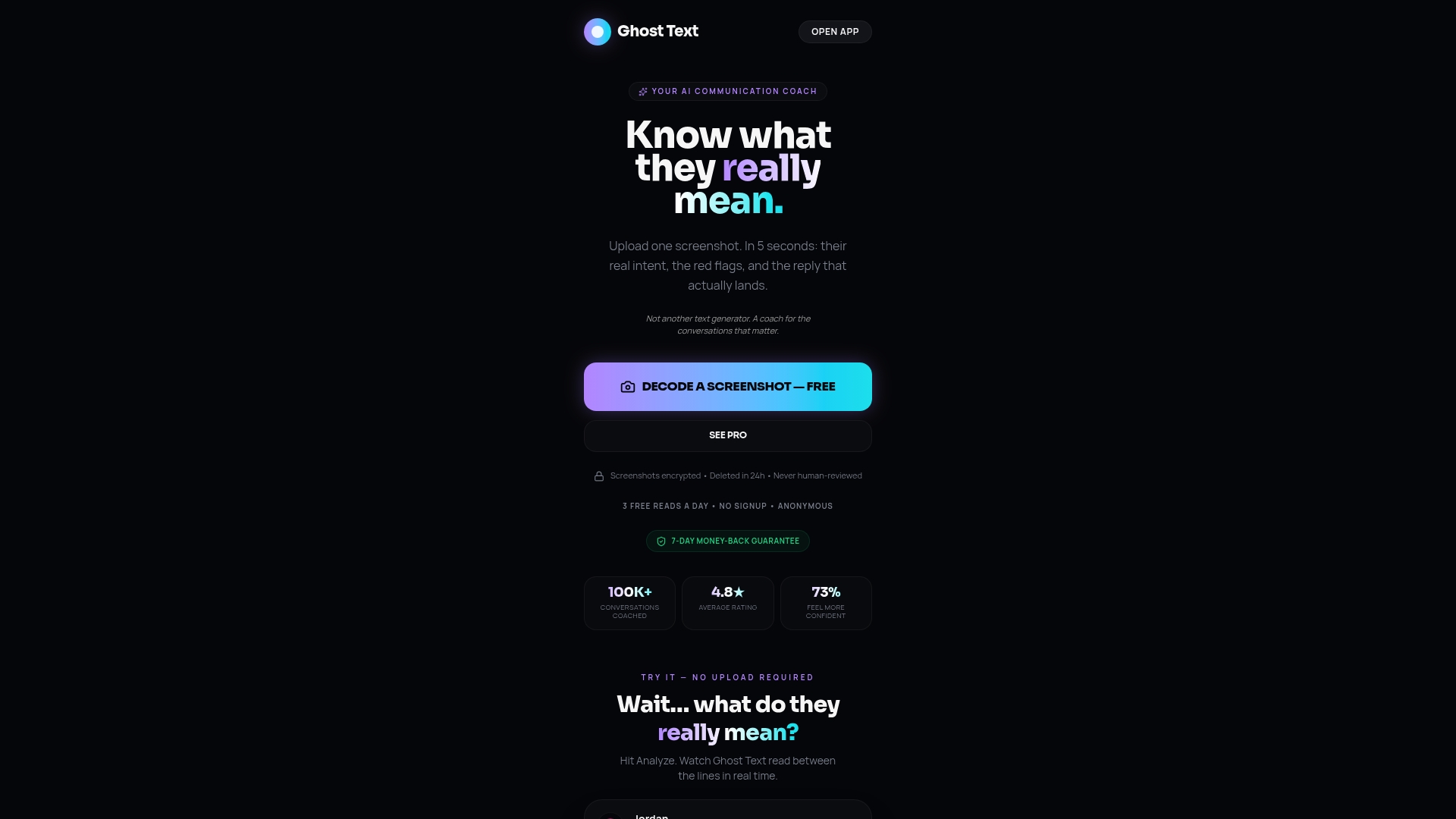
For someone dealing with gaslighting texts specifically, that means: repeated denial patterns flagged across a long thread, emotional invalidation phrases identified by name, and calm boundary-setting replies generated for the exact message in front of you. You can export a conversation summary to bring to a therapist or advocate, so your first session starts with evidence rather than memory.
Ghosttextai is a helper, not a substitute for professional support or emergency services. But if you've saved your messages and you want to understand what they're telling you before your next step, start with a free read at Ghosttextai. The first analysis costs nothing.
Sources
- The Signs of Gaslighting via Text - One Love Foundation
- Gaslighting: Turning Off the Gas on Your Gaslighter - HelpGuide
- gaslight - APA Dictionary of Psychology
- Gaslighting: What it is and how to respond - Cleveland Clinic Health Essentials
- PMC review article on gaslighting and psychological impact
This article provides general information, not professional mental-health or legal advice. If you are in danger or experiencing abuse, contact the National Domestic Violence Hotline or call 911. For ongoing support, consult a licensed mental-health professional.