
When a sensitive text lands in your inbox, the best first move is simple: pause, identify what the sender actually needs, then reply with one short line. That line does one of three things.
- Validates the feeling: "That sounds really hard, and I'm glad you told me."
- Answers the ask: "Yes, I can talk tonight — what time works for you?"
- Sets a boundary: "I want to respond thoughtfully. Can I get back to you in an hour?"
Nothing else. No wall of text, no defensive explanation, no immediate fix. One clear line, then stop. If the message contains any language about self-harm, suicide, or immediate danger, skip the framework entirely and call or text the Crisis Text Line (text HOME to 741741) or call 988 (Suicide and Crisis Lifeline) right now.
Pro Tip: Before you type a single word, ask yourself: does this person want advice, or do they need to vent? Asking that question first saves you from writing a three-paragraph solution to a problem they didn't ask you to solve.
Key Takeaways
Replying well to a sensitive text comes down to one discipline: understand the message before you respond to it.
| Point | Details |
|---|---|
| Pause before replying | A ~20-minute wait before responding to anger reduces reactive escalation. |
| Triage intent first | Identify whether the message is a question, venting, accusation, or disclosure before drafting. |
| Validate before solving | Naming the sender's feeling reduces distress and de-escalates faster than offering solutions. |
| Move off text when needed | Text removes roughly 65% of emotional signal; voice or in-person is better for real repair. |
| Ghosttextai reads the message for you | Paste or screenshot any conversation to get tone analysis, red-flag detection, and a suggested reply. |
Table of Contents
- How to reply to sensitive texts: the five-question triage
- A three-part framework for any sensitive reply
- Validation phrases that actually help
- Ready-to-use templates for common sensitive scenarios
- When to reply now, wait, or move the conversation
- How to spot manipulation and red flags in texts
- Scripts for setting limits and ending threads cleanly
- Why the pause-validate-next-step approach actually works
- Ghosttextai helps you read the message before you reply
- Sources
How to reply to sensitive texts: the five-question triage
Before you draft anything, run through these five checks. They take about thirty seconds and prevent most of the damage that comes from replying too fast.
- Urgency. Does the message contain any language about self-harm, suicidal thoughts, or immediate physical danger? If yes, stop and connect the person with professional help before anything else. The 988 Lifeline and Crisis Text Line are both free and available 24/7.
- Sender and context. Who sent this, and what's been happening between you lately? A sharp message from a partner after a rough week reads differently than the same words from a coworker you barely know. Time of day matters too — a 2 AM text usually signals higher emotional intensity than a midday one.
- Intent. Is this a question, a venting session, an accusation, or a disclosure? Misreading intent is the single most common reason sensitive replies go sideways. A person venting doesn't want a solution. A person asking a direct question doesn't want a therapy session.
- Your readiness. Are you calm enough to write something you won't regret? If you're angry, hurt, or anxious, a 20-minute cooling-off pause before replying is one of the most consistently recommended tactics in communication coaching. Adrenaline makes you reactive; waiting lets you be deliberate.
- Privacy. Has the sender shared something deeply personal? Some disclosures — mental health struggles, relationship confessions, family crises — deserve a private channel, not a text thread that might be screenshotted or shared.
Research consistently shows that text strips out most of the emotional signal present in face-to-face conversation. That's not a small gap. It means the message you're reading is already missing most of the tone, facial expression, and body language that would tell you exactly how the sender felt when they wrote it. Triage helps you fill that gap with context instead of assumption.
A three-part framework for any sensitive reply
Most good responses to difficult messages follow the same shape: Answer → Validate → Next step. You don't always need all three parts, but knowing the structure keeps you from skipping the one that matters most.
- Answer first, if there's a question or request. Leading with the answer reduces back-and-forth and signals respect for the sender's time. Don't bury the response under two paragraphs of preamble.
- Validate the feeling. Acknowledge what the person is experiencing before you explain, defend, or problem-solve. This is the step most people skip, and it's the one that does the most work.
- Offer a clear next step or boundary. End with something concrete: a time to talk, a question, or a simple statement of what you can and can't do right now.
Tone lines are short phrases you add when brevity might read as cold. Examples: "I mean this warmly," or "I'm not dismissing this — I just want to think before I respond properly." One sentence is enough. They signal care without inflating the message.
Pro Tip: Match the emotional intensity of your reply to the relationship, not just the message. A close friend who texts "I'm not okay" needs more warmth than a colleague who texts "I'm frustrated with how that meeting went." Same framework, different temperature.

Validation phrases that actually help
Emotional validation means naming and acknowledging what someone feels without immediately trying to fix it, argue with it, or minimize it. It's not agreement. It's recognition.
Mild validation (for everyday frustration or low-stakes venting):
- "That sounds frustrating."
- "I get why that bothered you."
- "That makes sense given everything going on."
- "I'd probably feel the same way."
Strong validation (for hurt, grief, or significant conflict):
- "I hear you, and I'm really sorry you're going through this."
- "That sounds genuinely painful, and your feelings make complete sense."
- "I can see why you felt that way. I'm glad you told me."
- "You didn't deserve that."
- "This clearly matters a lot to you, and it matters to me too."
Crisis-level or supportive validation (for mental health disclosures or high distress):
- "Thank you for trusting me with this. I'm here."
- "I'm not going anywhere. What do you need right now?"
- "You reached out, and that took courage. I'm glad you did."
- "I care about you and I want to make sure you're safe."
What not to say:
- "Calm down." (Dismisses the feeling entirely.)
- "You're overreacting." (Invalidates without engaging.)
- "Just think positive." (Minimizes real distress.)
- "Here's what you should do..." (Skips validation and jumps to fixing.)
- "I know exactly how you feel." (Redirects to your experience, not theirs.)
Pro Tip: Read your reply out loud before you send it. Try it in two different tones — warm and flat. If the flat version sounds dismissive, add a tone line. If the warm version sounds patronizing, trim it. Your ear catches what your eyes miss.
Ready-to-use templates for common sensitive scenarios
These are plug-and-play starting points. Adjust the warmth and formality to fit the relationship.
- Criticism (partner/close friend): "I hear that you're frustrated with me, and I want to understand better. Can we talk tonight so I can really listen?"
- Criticism (professional/acquaintance): "Thanks for being direct. I want to think about what you've said and respond properly. Can I follow up tomorrow?"
- Accusation: "I can see this is really upsetting you. I don't want to defend myself over text — can we talk so I can actually hear you out?"
- 'You're too sensitive': "I hear you. I'm going to take a beat before I respond to this one."
- Apology (receiving one): "I appreciate you saying that. It means a lot. I'm still processing, but I'm glad you reached out."
- Confession or disclosure: "Thank you for telling me. That couldn't have been easy. I'm here."
- Mental health disclosure: "I'm really glad you told me. You don't have to go through this alone. What would help most right now?"
- Anger: "I can tell you're really upset, and I want to hear you out properly. Give me 20 minutes and I'll call you."
- Passive-aggression: "I want to make sure I'm understanding you correctly. Can you tell me directly what's bothering you?" (Translate the hint privately; ask for clarity rather than interrogating intent.)
- Setting a limit: "I care about this conversation, but I'm not in a good place to respond well right now. Can we pick this up tomorrow?"
- Boundary push-back: "I understand you're frustrated. My answer is still the same."
- Crisis language in a message: "I'm worried about you. Are you safe right now? I'm here and I want to help you get support."
When to move off text: If the exchange has gone more than four or five messages without resolution, or if the emotional intensity is rising, move to a call. Two scripts: "This is too important for text — can I call you in five minutes?" or "I want to give this the attention it deserves. Voice or in-person would help me do that."
When to reply now, wait, or move the conversation
Timing is a decision, not a default. Replying immediately to a charged message often signals reactivity, not care.
| Situation | Recommended timing | Why it matters |
|---|---|---|
| Routine emotional check-in | Within a few hours | Delay reads as indifference |
| Anger or accusation | Wait ~20 minutes | Lets adrenaline drop; reduces reactive wording |
| Mental health disclosure | Reply within minutes, briefly | Silence feels like rejection |
| Complex conflict | Sleep on it | Morning clarity changes the tone significantly |
| Crisis language | Immediately, then call | Text alone is insufficient for safety |
Voice adds back tone, pace, and breath. In-person adds everything else. For anything involving real conflict, grief, or a significant disclosure, text is the wrong medium for resolution. It's fine for acknowledgment; it's poor for repair.
Dos and don'ts for pacing:
- Do send a brief acknowledgment ("Got your message — I want to respond properly, give me a bit") if you need time.
- Don't double-text escalating messages if you get no reply. One message, then wait.
- Do match your response speed to the emotional stakes. Fast for crisis, measured for conflict.
- Don't use "read receipts on, no reply" as a power move. It escalates.
How to spot manipulation and red flags in texts
The online disinhibition effect is real: people say things over text they would never say face to face. That lowers the bar for cruelty, manipulation, and threats. Knowing the difference between high-emotion venting and a genuine pattern of harm protects you.
Red-flag checklist:
- Gaslighting: "That never happened," "You're imagining things," "You're crazy."
- Repeated passive-aggression: Plausible deniability built into every message ("I'm fine, whatever").
- Threats: Any message that implies harm to you, themselves, or others as leverage.
- Self-harm pressure: Using their own distress to control your behavior ("If you leave, I'll hurt myself").
- Urgent financial or blackmail requests: Sudden urgency, secrecy, and pressure to act fast.
- Isolation language: Repeated attempts to cut you off from friends or family via text.
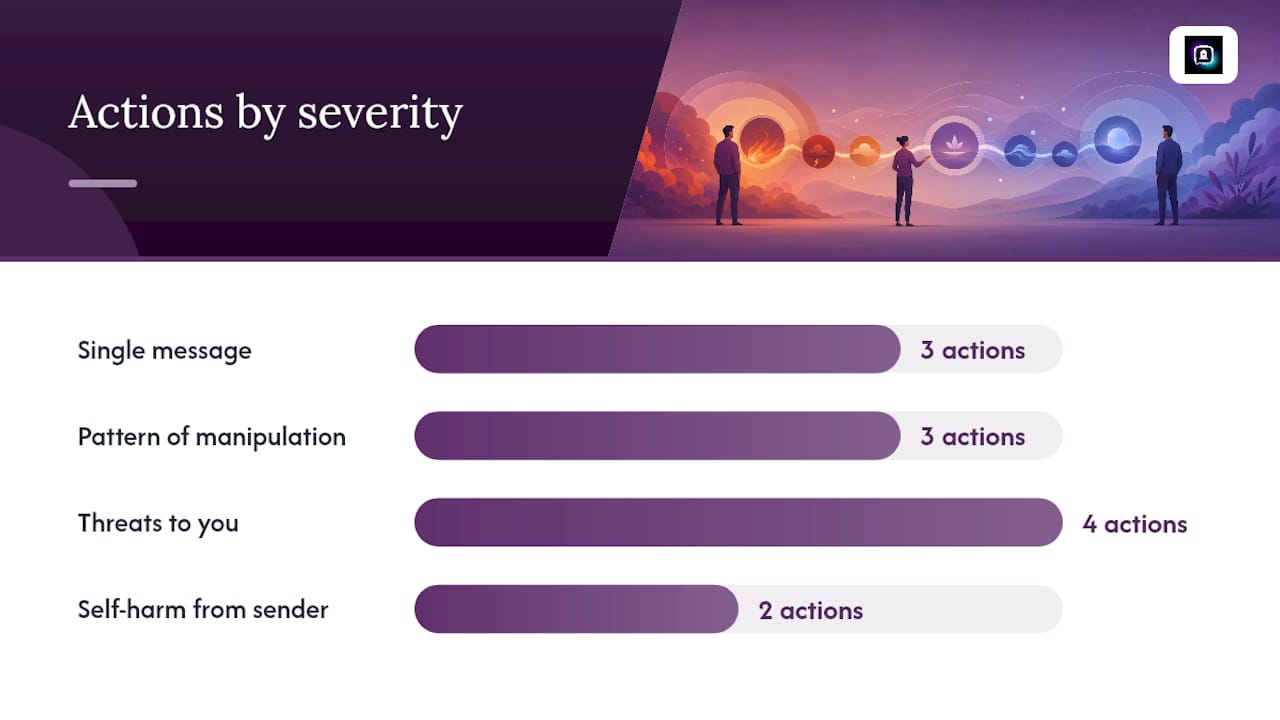
Action steps by severity:
- Single concerning message: Pause. Don't reply immediately. Screenshot and save it.
- Pattern of manipulation: Document the thread. Set a firm boundary (scripts in the next section). Tell someone you trust.
- Threats or self-harm language directed at you: Stop engaging. Contact a trusted person or, if there's immediate danger, call 911. The National Domestic Violence Hotline (1-800-799-7233) offers 24/7 support.
- Self-harm language from the sender: Take it seriously. Text HOME to 741741 or call 988 and ask for guidance on how to help.
Pro Tip: Sarcasm and all-caps are consistently misread in text. If a message reads as threatening but uses a joking tone, trust the content over the framing. Abusive patterns often hide behind "I was just kidding."
To preserve evidence, take a screenshot that shows the sender's name, the timestamp, and the full message. Don't delete the thread.
Scripts for setting limits and ending threads cleanly
Boundaries in text don't require long explanations. Short is more effective.
- Soft redirect: "I want to keep talking about this, but I need a break right now. Can we pick this up tomorrow?" Use when: the conversation is getting heated but the relationship is worth preserving.
- Firm limit: "I'm not going to continue this conversation over text. If you want to talk, I'm available by phone." Use when: the thread is going in circles or escalating.
- Final pause: "I need some space from this conversation. I'll reach out when I'm ready." Use when: the exchange has become harmful or you need time to think.
- Boundary push-back: If the other person keeps texting after a firm limit, one response: "I've said what I need to say. I'm stepping away now." Then stop replying.
- Privacy note: Don't argue about tone in text. If someone says "that came across wrong," acknowledge it briefly and move to voice. Tone debates over text almost always make things worse.
Why the pause-validate-next-step approach actually works
The framework in this guide isn't a communication trick. It reflects something well-documented in psychology: people who feel heard are less likely to escalate, and more likely to engage constructively. Validation doesn't mean you agree. It means you've registered that the other person's experience is real to them. That single shift, from defending to acknowledging, changes the trajectory of most difficult conversations.
Text is a genuinely limited medium for emotional work. The gap it creates, all that missing tone and context, is where misunderstandings breed. The tactics here, pausing, triaging intent, validating before solving, moving off text when it matters, are all ways of compensating for what the medium strips out. They work because they're designed around the medium's actual constraints, not an idealized version of it.
Ghosttextai helps you read the message before you reply
Reading a sensitive text clearly is harder than it sounds. Ghosttextai is an AI-powered communication coach that analyzes the tone, intent, and emotional signals in any conversation before you write a single word back. Paste a message or upload a screenshot and you get instant insight: what the sender likely means, whether there are red flags, and a suggested reply matched to your relationship and tone preference.
For anyone who second-guesses their reads, Ghosttextai surfaces what's actually in the message so you can respond with confidence rather than anxiety. It's not a replacement for human judgment or professional support when a situation is serious, but for the everyday sensitive text that leaves you staring at your phone, it gives you a clear starting point. Try Ghosttextai free and see what the message is really saying.
Sources
- Texting Guidelines (John Suler)
- Strengthening relationships through emotional validation
- How to respond to a text: tips and examples for every situation
- Effective Strategies for Emotional Text Response
- How to respond to an angry text without making it worse | DeftBrain
Crisis resources (US):