
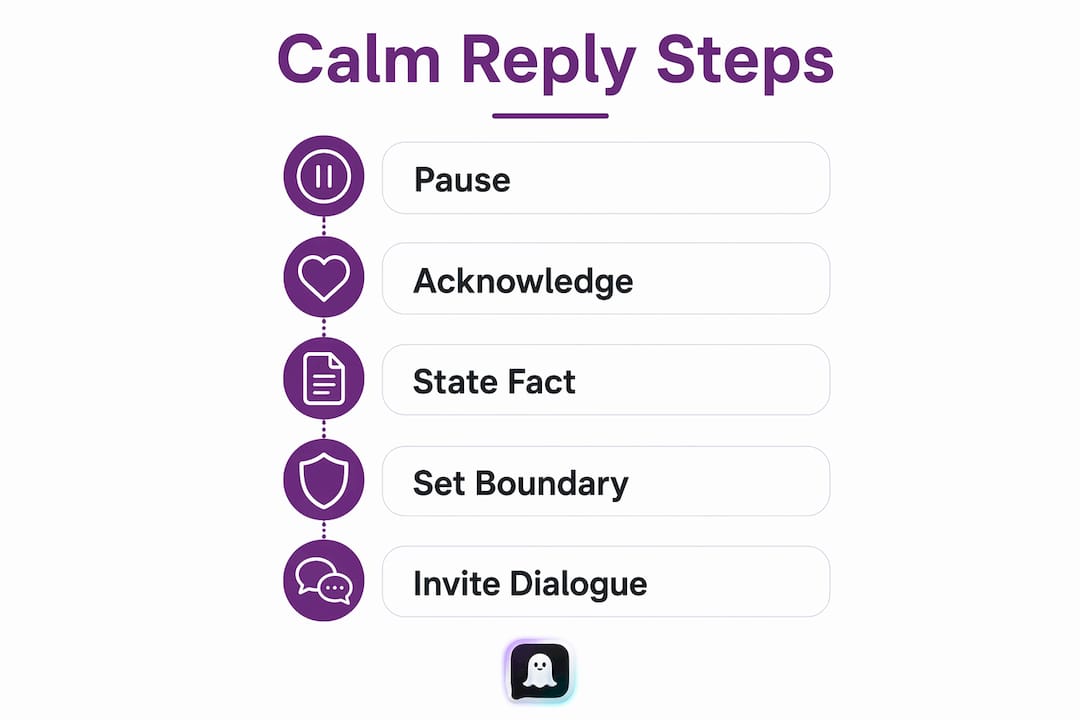
The fastest way to stop escalation is a reply that acknowledges the feeling, states one fact or next step, and closes the thread. That's the whole playbook in one sentence. The BIFF framework from the High Conflict Institute formalizes it: Brief, Informative, Friendly, Firm. Here is a copyable line you can use right now:
Paste it, fill in the brackets, and send. You haven't conceded anything, you haven't escalated, and you've bought yourself time to think. Ghosttextai can analyze the original message and suggest a version tailored to your exact situation if you need it.
- Acknowledge the feeling ("I hear you")
- State one fact or next step (not a defense)
- Close or move the channel ("I'll follow up by Friday")
Table of Contents
- How to respond to a difficult message: should you reply right now?
- What is the BIFF method and how do you use it?
- Copyable scripts for work, family, friends, and dating
- Techniques that actually reduce defensiveness
- When should you move the conversation off text?
- When to stop engaging and protect yourself
- How to repair the relationship after the first reply
- How Ghosttextai helps you draft calmer replies
- Key Takeaways
- The case for de-escalation over rebuttal
- Ghosttextai gives you a calm reply before you send the wrong one
- Useful sources and further reading
How to respond to a difficult message: should you reply right now?
Before you type a word, ask one question: does this message require action in the next hour? If the answer is no, wait.
Wait-rule heuristics give you a practical framework: 20 minutes for immediate anger, at least one hour for mild upset, and overnight for anything that genuinely distresses you. Emotional activation fades. Your first draft almost never will.
- Is there a real deadline, legal issue, or safety concern? If yes, reply or escalate now.
- Is the message purely venting with no actionable request? If yes, silence or a brief placeholder is often the right call.
- Are you still feeling reactive? If yes, wait. Set a timer if you need to.
A placeholder buys time without ignoring the sender: "Got your message. I need a little time to respond thoughtfully — I'll get back to you by [time]." That one line prevents the sender from assuming you're ignoring them while you collect yourself.
Pro Tip: Before you draft anything, read the message once more and ask: "What is the core need underneath this?" A message that reads as an attack often masks fear or feeling unimportant. Responding to the need de-escalates faster than correcting the surface complaint.
What is the BIFF method and how do you use it?
BIFF is the most widely recognized standard for de-escalating hostile written communication. A single-paragraph BIFF reply of 3–5 sentences is often enough even when the original message ran several paragraphs. Brevity removes the "hooks" the other person could argue with.
| BIFF Element | What to include | What to avoid |
|---|---|---|
| Brief | 3–5 sentences max | Long explanations, point-by-point rebuttals |
| Informative | One or two verifiable facts | Opinions, emotions, character judgments |
| Friendly | Neutral greeting, one empathy phrase | Sarcasm, cold formality, passive aggression |
| Firm | A clear closing statement or next step | Open-ended questions that invite more debate |
BIFF works because it gives the other person nothing to grab onto. No personal attacks, no emotional hooks, no open questions that invite a counter-argument. The reply lands and the thread stops.
BIFF has limits. When a message contains a legal threat, a harassment claim, or a safety risk, a brief friendly reply is not enough. In those cases, document first (see the safety section below), loop in HR or legal counsel, and let professionals guide your response.
Pro Tip: Write your BIFF draft, then read it aloud. If anything sounds sarcastic or defensive when spoken, rewrite that sentence. Silent reading misses tone issues that your ear catches immediately.
Copyable scripts for work, family, friends, and dating
Short replies outperform long ones in almost every difficult conversation. Keep your response to 1–3 sentences. These templates are ready to paste and adapt.
Workplace email (frustrated colleague or manager)
- "Thanks for flagging this. To clarify: [one fact]. I'm available [time] to talk through next steps if that would help."
- Use when: a coworker sends an accusatory email or a manager expresses frustration in writing. The four-part structure of acknowledge, clarify, offer a path, invite dialogue keeps professional replies on track.
Angry coworker text
- "I hear that you're frustrated. Here's what I know: [fact]. Let's connect [today/tomorrow] to sort this out."
- Use when: the message is emotional but there's a real work issue underneath. Avoid when the message contains personal attacks — document those instead.
Upset partner or family member
- "I can see this really bothered you, and I want to understand it better. Can we talk tonight?"
- Use when: the message is emotionally charged but the relationship matters. Adapt the timing to what's realistic. For conflict resolution in friendships or family, moving to voice quickly usually helps more than extended texting.
Defensive friend
- "I didn't mean for it to land that way. I'd like to hear your side when you're ready."
- Use when: a friend has misread your intent. Don't over-explain. One sentence of ownership, one invitation.
Difficult customer or client message
- "Thank you for reaching out. I understand this hasn't met your expectations. Here's what I can do: [specific step]. I'll follow up by [date]."
- Use when: a customer is angry but the complaint has merit. When the complaint is unfair or abusive, state your boundary once and close: "I'm glad to help when the conversation stays respectful."
Techniques that actually reduce defensiveness
The most effective de-escalation moves are structural, not just tonal. Three techniques consistently lower the other person's guard.
Third-story framing describes the conflict as a neutral observer would see it, not from your position. Instead of "You accused me of not caring," try: "It sounds like we both saw this situation differently and that created some frustration." Third-story approaches from the Program on Negotiation at Harvard lower defensiveness because neither person is cast as the villain. The problem becomes something you're both looking at, not something one of you caused.

Acknowledgment without concession is the move most people miss. You can validate someone's feelings without accepting blame.
That sentence validates the feeling ("I can see why"), protects your position ("wasn't my intent"), and opens a factual conversation. It is not an apology. It does not concede fault. Keeping those two things separate is what keeps communication open while protecting your boundaries.
Phrases that backfire: "I'm sorry you felt that way" reads as an admission of guilt and can be used against you by high-conflict personalities. "You're overreacting" triggers defensiveness immediately. Sarcasm in text is almost always misread as contempt. Cut all three.
Pro Tip: If you're writing to someone who tends toward high-conflict responses, avoid any sentence that ends with a question. Open questions invite more messages. Close with a statement instead.
When should you move the conversation off text?
If an issue can't be resolved in one or two messages, the most effective next step is a phone call or in-person conversation. Text strips out tone, facial expression, and pacing. Every ambiguous word gets read in the worst possible light.
Watch for these signals that text is failing:
- Messages are getting longer and angrier with each exchange
- The same point keeps being repeated without resolution
- Tone is being misread repeatedly despite your attempts to clarify
- There's a factual dispute that needs real-time back-and-forth
Scripts to request a channel switch without escalating the thread:
- "This is important to me and I don't want it to get lost in text. Can we talk for 10 minutes today?"
- "I think a quick call would clear this up faster than messages. When works for you?"
If the other person refuses to switch channels, set a boundary: "I'm happy to continue this conversation by phone or in person. I'm going to step back from the text thread for now." Then follow through. Continuing to text after that statement undermines the boundary.
Channel-switching also signals seriousness. Moving to voice or in-person tells the other person you're invested in resolution, not just winning the text exchange. That shift alone often softens the tone before the conversation even starts. For team settings, structured channel-switching practices can formalize when to escalate from text to live conversation.

When to stop engaging and protect yourself
Some messages don't need a reply. They need documentation.
"Hostile written messages are often emotional venting rather than requests. Non-response or a brief neutral acknowledgment can prevent prolonged escalation when engagement only feeds the venting." — High Conflict Institute
Safety and documentation checklist:
- Screenshot the message with the timestamp visible
- Save copies in a second location (email to yourself, cloud folder)
- Note the date, time, platform, and any witnesses
- Notify your manager, HR, or platform support if the message involves threats, harassment, or doxxing
- Block or restrict the sender if the messages continue after you've set a clear boundary
Red flags that warrant no reply: explicit threats, repeated unwanted contact after you've asked them to stop, sharing your private information publicly, or messages that describe physical harm. These go to HR, platform reporting tools, or law enforcement, not to your drafts folder. For patterns that look like manipulation rather than conflict, dark psychology texting is worth understanding before you respond.
If you need to acknowledge receipt without engaging, use a neutral one-liner: "I've received your message and I'm reviewing it." That's it. No emotion, no defense, no invitation to continue.
Pro Tip: Never delete messages you might need as evidence. Even if the content is upsetting, preserve the original thread before blocking or archiving.
How to repair the relationship after the first reply
De-escalation buys time. Repair requires a follow-up, and timing matters. Difficult planned conversations benefit from preparation: identify the core issue, anticipate reactions, and open with empathy rather than a recap of grievances.
Wait until the emotional temperature has dropped on both sides. For most conflicts, that means at least 24 hours after the initial exchange. Then reach out with curiosity, not a verdict.
- Acknowledge your part. Even if the other person escalated, own what you could have done differently. Specificity matters: "I could have responded sooner" lands better than "I'm sorry for everything."
- Name the next step clearly. Don't leave the repair open-ended. "Can we talk Thursday at 7?" is better than "We should talk sometime."
- Send a short follow-up message. "I've had time to think about our conversation. I'd like to understand your perspective better. Would you be open to a call this week?"
- Don't re-litigate. The follow-up is not the place to revisit old accusations or correct the record. Save that for the actual conversation, and even then, lead with listening.
Dos: be specific about next steps, acknowledge the other person's experience, and invite dialogue without demanding it. Don'ts: send a wall of text explaining your position, bring up past conflicts, or send the follow-up when you're still frustrated.
How Ghosttextai helps you draft calmer replies
An AI message coach doesn't replace your judgment. It gives you a second read before you send something you'll regret.
Ghosttextai's practical workflow fits directly into the BIFF approach:
- Pause and paste the message into Ghosttextai
- Read the tone and intent analysis — is this venting, a real request, or a red flag?
- Review the suggested BIFF-style reply and adjust for your voice
- Read your draft aloud before sending
- Send or schedule based on the wait rule
The red-flag detection feature flags harassment patterns, manipulative language, and safety risks you might miss when you're emotionally activated. The interest meter and tone customization let you match your reply to the relationship — more formal for a manager, warmer for a friend. For anyone who wants to understand what a message really means before responding, Ghosttextai functions as a private, on-demand communication coach. You can also explore AI communication coach alternatives if you want to compare approaches before committing.
Pro Tip: Use Ghosttextai's suggested reply as a first draft, not a final answer. Read it, adjust the phrasing to sound like you, then send. The goal is a reply that's calm and yours.
Key Takeaways
Responding to a difficult message well comes down to one sequence: pause, acknowledge the feeling, state one fact or next step, then close or move the channel.
| Point | Details |
|---|---|
| Use the wait rule | Wait a sufficient time for mild upset and longer for highly distressing messages before drafting. |
| Apply BIFF | Keep replies to 3–5 sentences: Brief, Informative, Friendly, and Firm. |
| Acknowledge without conceding | Validate the other person's feeling without accepting blame to keep communication open. |
| Move off text when stuck | If two messages haven't resolved it, request a call or in-person conversation. |
| Use Ghosttextai for live help | Paste the message into Ghosttextai for tone analysis, red-flag detection, and a tailored BIFF-style reply. |
The case for de-escalation over rebuttal
Most people's instinct when they receive a hostile message is to correct the record. That instinct is almost always wrong. Rebuttal invites counter-rebuttal. A point-by-point defense gives the other person a new list of things to argue with. The BIFF approach works precisely because it removes that material.
What I find more interesting is how rarely people distinguish between acknowledgment and concession. Validating someone's frustration is not the same as agreeing with their version of events. That distinction is where most message conflicts get stuck. The sender wants to feel heard. The receiver is so focused on being right that they skip the acknowledgment entirely, and the thread spirals. Third-story framing and reflective language aren't soft skills. They're structural tools that change the shape of the conversation before the other person has a chance to escalate further.
The other thing worth saying plainly: silence is a legitimate reply. Not every hostile message deserves engagement. High-conflict personalities, in particular, are often fed by response. A brief neutral acknowledgment or no reply at all can be the most protective choice you make.
Ghosttextai gives you a calm reply before you send the wrong one
Reading a difficult message when you're already activated is the worst time to decide how to respond. Ghosttextai reads it first. Paste the conversation or upload a screenshot and you get an instant breakdown of tone, intent, and emotional signals, plus a suggested reply built around the BIFF framework and calibrated to your relationship context.
The free tier lets you analyze conversations and see suggested replies without a subscription. Ghost Text Pro unlocks unlimited reads, advanced red-flag detection, and premium reply personas for dating, professional, and family contexts. No guessing what the message really means. No sending something you'll regret at 11 PM.
Try Ghosttextai now and get your first message analysis free.
Useful sources and further reading
These are the primary references behind the guidance in this article. Each one goes deeper on a specific aspect of difficult message handling.
| Source | Topic | Where to use it |
|---|---|---|
| High Conflict Institute — BIFF Response | BIFF framework, hostile email, high-conflict personalities | Build longer BIFF replies; understand high-conflict patterns |
| Program on Negotiation, Harvard | Third-story framing, acknowledgment vs. concession | Prepare for planned difficult conversations |
| DeftBrain — Angry Text Guide | Wait rule, channel-switching, scripts | Immediate de-escalation and timing decisions |
| Berkeley Executive Education | Preparation, empathy, repair conversations | Follow-up and relationship repair planning |
| Psychology Today — BIFF Emails | Short reply rationale, escalation prevention | Justify keeping replies to one paragraph |
To build longer replies or train yourself on these techniques, start with the High Conflict Institute's BIFF examples and the Harvard PON's third-story guidance. Both are free to read and give you phrasing you can adapt directly.