
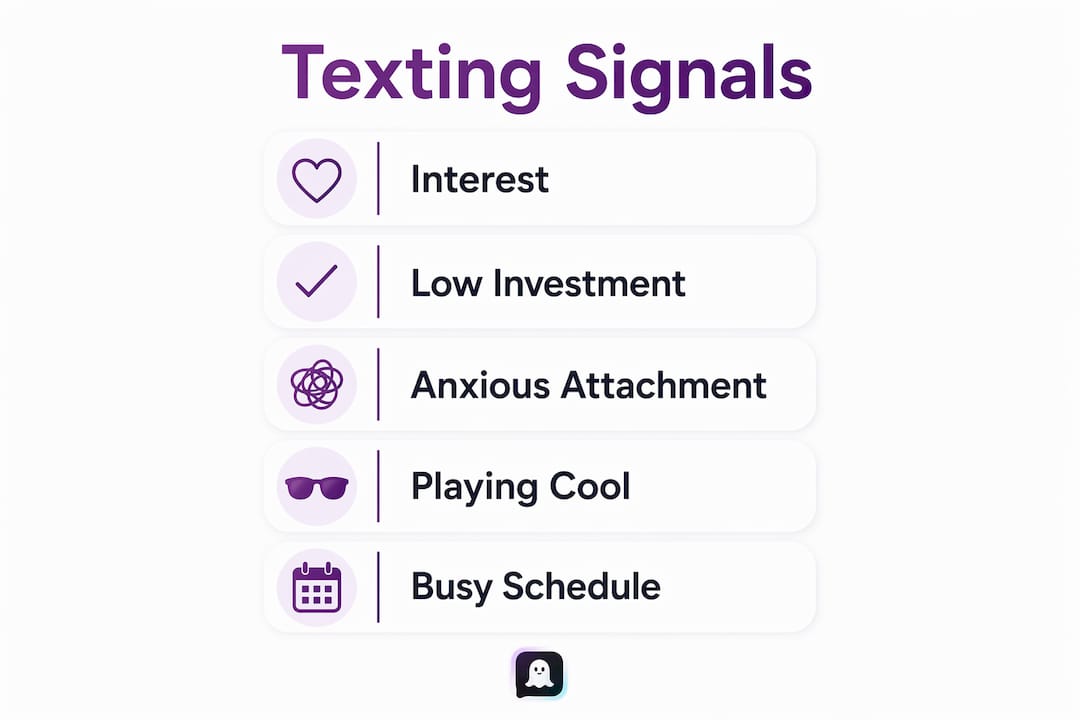
A guy's texting behavior almost always signals one of five things: genuine interest, low investment, anxious attachment, deliberate "playing cool," or disrespect. Fast replies paired with concrete plans point to real interest. Short, sporadic messages with no follow-through usually mean low investment or avoidance. Late-night texts that never turn into daytime plans are a classic signal of someone keeping you at arm's length.
The key is reading patterns across five to seven exchanges, not reacting to a single message. Attachment theory gives a useful frame here: securely attached men text consistently and move toward plans; anxiously attached men over-text then panic when you don't reply fast; avoidant men go quiet precisely when things get closer. A 2026 SAGE study by Teichmann et al. found that the timing of a post-date text, not just its content, measurably shifts how interested the recipient feels. That finding alone should tell you that the when matters as much as the what.
Pro Tip: Before you assign a motive to any single text, track the full pattern: who initiates, how long replies take, and whether he moves toward plans. One slow reply means nothing. Five in a row means something.
Table of Contents
- What common texting behaviors actually signal in dating
- Why men text the way they do: the psychology behind the patterns
- Does texting actually build attachment in men?
- Texting red flags: how serious each one is and what to do
- Practical rules for how often to text, who initiates, and when to move offline
- Copy-paste templates by goal
- What to do when a text leaves you confused
- When to stop interpreting and move on
- What the research actually says about texting and perception
- Key Takeaways
- A note on reading between the lines
- Ghosttextai reads the conversation so you don't have to guess
- Useful sources
What common texting behaviors actually signal in dating
Most confusion comes from reading individual messages instead of cataloging behavior over time. Here is a quick reference for the patterns that show up most often.
- Delayed replies (hours, then bursts): Often signals busyness or avoidance, not disinterest. Context matters: a delayed reply followed by a long, engaged message is different from a delayed reply that's two words.
- One-word answers ("yeah," "lol," "k"): Low investment or discomfort with text-based conversation. Some men genuinely prefer calls or in-person talk; others are simply checked out.
- Late-night texts only: He's keeping you in a specific mental category. Daytime texts signal he thinks about you outside of convenience.
- Heavy emoji use: Research from Frontiers shows men who use friendly emojis (a smiling face, not hearts) are often perceived as more likable than women using the same emoji. A guy who uses emojis at all is usually signaling warmth or playfulness.
- Double-texting: He's engaged enough to follow up. That's a positive signal unless the double texts are pressure-based ("why aren't you answering?").
- Hot-cold cycles: Intense contact followed by days of silence. This is the most misread pattern in dating. It feels like interest because the "hot" phase is so engaging, but the cold phase is the real data.
- Asking questions in every message: He's actively maintaining the conversation. Men who are interested ask questions; men who are not let threads die.
- Sending memes or articles: Low-stakes way of saying "I thought of you." Often an early-stage interest signal from men who aren't comfortable with direct expression.
- Short, clipped texts with periods: Frontiers research on punctuation found that a period after a one-word text ("Fine.") reads as cold or final. It's a prosodic cue, not just grammar.
- Texting first consistently: One of the clearest interest signals. Men who initiate regularly are investing attention.
- Long gaps after you've been physical: Often signals he's recalibrating or pulling back. Worth noting but not worth spiraling over until the pattern repeats.
- Responding to everything except direct questions: A deflection pattern. He's engaged on his terms, not yours.
"How couples texted was more important to the satisfaction of the relationship than how frequently they texted." — Leora Trub, PhD, Pace University, APA 2018
Pro Tip: Before you assign a meaning, check reciprocity. Are you always the one asking questions? Are his replies shorter than yours? Asymmetry in length and initiation is more telling than any single message.
Why men text the way they do: the psychology behind the patterns
Understanding the why behind texting behavior saves you from misreading neutral signals as rejection, or worse, missing real red flags.

Attachment style is the biggest driver. Securely attached men text in a way that mirrors how they feel: consistent, warm, and oriented toward plans. Anxiously attached men over-communicate when they feel uncertain, then go quiet when they feel reassured. Avoidant men pull back when emotional closeness increases, which is why a great date is sometimes followed by radio silence. None of this is personal. It's a deeply ingrained pattern that predates you.
Busyness is real, but it's also a filter. A genuinely busy man will still find two minutes to send a message if he's interested. The "I've been so busy" explanation is sometimes true and sometimes a soft way of saying "you're not a priority right now." The distinction shows up in whether he circles back and makes a plan.
Cultural and generational norms shape expectations. UCLA research found measurable differences in how men and women use text: men tend toward direct, concise messages while women use more expressive language and emojis. A man who texts in short sentences isn't necessarily cold. He may simply be texting the way most men in his peer group do.
"Playing cool" is a learned strategy. Some men genuinely believe that responding too fast signals desperation. This is a dating script, not a personality trait. The tell is consistency: a man playing cool will still initiate, still ask questions, and still move toward plans. A man who is actually disinterested won't do any of those things.
Does texting actually build attachment in men?
The short answer: texting can build real attachment, but only when it's paired with in-person follow-through. On its own, it mostly mimics intimacy.
Research from Lustdr makes the point clearly: texting is a single-channel medium. It strips out tone of voice, body language, and physical presence. Emotional escalation over text can feel intense, but it often creates a lopsided dynamic where one person is more invested than the situation warrants.
Signals that texting is building real attachment:
- He references things you said in previous conversations (he's actually reading and retaining)
- He moves from text to plans consistently, not just occasionally
- He shares something vulnerable and then follows up on it in person
- His texting frequency stays consistent rather than spiking and dropping
- He texts at normal hours, not just late at night
Signals that look like attachment but aren't:
- Rapid emotional escalation ("I've never felt this way about anyone") with no in-person plans
- Long, intense text conversations that never convert to calls or dates
- He texts constantly for a week, then disappears for three days with no explanation
- He shares personal details early but deflects when you ask to meet
- Compliments that feel disproportionate to how well he actually knows you
The difference between real attachment and text-based pseudo-intimacy usually becomes clear within the first three to four weeks. If the intensity of the texts isn't matched by real-world investment, you're likely dealing with the latter.
Texting red flags: how serious each one is and what to do
Three red flags deserve an immediate response, not a wait-and-see approach.
First: love-bombing. Constant, overwhelming affection early on, "you're the only one who gets me" after two conversations, declarations of deep feeling before you've met more than once. This is a manipulation pattern, not genuine connection. The recommended step is to slow down deliberately and watch whether his intensity drops when you don't match it.
Second: hot-cold cycling. Intense contact, then silence, then intense contact again. This keeps you in a state of low-level anxiety that can feel like excitement. It's not. Recognizing this pattern requires looking at the full arc of contact, not just the "hot" phase. The step here is to name it directly: "I notice you go quiet after we make plans. Is something going on?"
Third: gaslighting over text. He says something hurtful, you respond, and he tells you that you're "too sensitive" or "reading into it." Screenshots are your friend here. Trust what you read, not his reframe of it.
"Dark texting behaviors such as manipulative phrasing, gaslighting, and love-bombing can be identified through pattern analysis rather than single messages." — Ghosttextai blog on dark psychology texting
Here's a quick severity reference:
| Red Flag | Severity | Recommended Next Step |
|---|---|---|
| One-word replies consistently | Low | Mirror his energy; stop over-investing |
| Ignoring direct questions | Medium | Ask once directly; if it continues, note the pattern |
| Hot-cold cycling | High | Name it with a specific example; watch his response |
| Love-bombing | High | Slow down; test whether intensity drops when you don't match it |
| Gaslighting over text | High | Screenshot, trust your read, consider pausing contact |
| Repeated no-shows after plans | High | One direct conversation; if it repeats, you have your answer |
There's a real difference between annoying habits (slow replies, bad grammar, no punctuation) and manipulative patterns. Annoying habits are consistent and don't target your self-perception. Manipulation shifts your sense of reality. If you're regularly second-guessing what you read or apologizing for reactions that seem reasonable, that's worth talking to someone about, whether a trusted friend or a counselor. If you're also worried about deceptive behavior beyond texting, that's a separate but related concern worth addressing directly.
Practical rules for how often to text, who initiates, and when to move offline
A few decision rules that hold up across most early-dating scenarios:
First week after matching: Mirror his frequency. If he sends one message a day, send one. If he's sending several, match that. Texting too much early on creates a momentum problem: you build a text relationship instead of a real one.
After a first date: The Teichmann et al. SAGE study found that texting the next morning produced the strongest relationship intentions, higher than texting immediately after the date or waiting two days. Women in the study showed greater sensitivity to this timing. A next-morning text hits the sweet spot between eager and indifferent.
Who texts first: Whoever has something genuine to say. The "never text first" rule is a relic. That said, if you're always the one initiating, that asymmetry is data.

When to move to a call or date: After three to five good text exchanges, suggest something concrete. Conversations that stay on text indefinitely tend to stall. A direct ask reduces ambiguity for both of you.
Sample phrasing that works:
- "This is a better conversation than most. Want to grab coffee this week?"
- "I'd rather hear your voice on this one. Free for a quick call Thursday?"
- "I keep meaning to ask — are you free Saturday?"
Short, direct, low-pressure. The goal is to move the conversation somewhere it can actually go somewhere.
Copy-paste templates by goal
Use these as starting points, not scripts. Swap in a specific detail (his name, something he mentioned) and they'll land better.
Reopen after silence
- "Hey, it's been quiet. Still interested in [thing you discussed]?"
- "No pressure, but I was thinking about what you said about [topic]. Still want to talk more?"
- "Checking in. Hope things are good on your end."
Move to a date
- "I'd rather do this in person. Are you free this week?"
- "We've been texting long enough. Coffee on Saturday?"
- "Pick a day. I'll make it easy."
Call out mixed signals
- "You go quiet after we make plans. I'd rather know where things stand than keep guessing."
- "I've noticed a pattern. You're warm, then silent. What's actually going on?"
Clarify intent
- "I like talking to you, but I want to make sure we're on the same page about what this is."
- "Are you looking for something casual, or are you open to something more?"
Bow out gracefully
- "I think we want different things. I'm going to step back. Take care."
- "This isn't working for me. Wishing you well."
Pro Tip: Change one specific detail per template, whether it's a reference to something he said or a day that actually works for you. Generic messages get generic responses.
What to do when a text leaves you confused
When a message is genuinely ambiguous, the move is simple: check the pattern, then choose one of three responses. Mirror, ask, or step back.
Step 1: Check the pattern. Is this ambiguity new, or is it consistent? A single confusing message from someone who's been clear and consistent is probably just a bad text day. A fifth confusing message in a row is a pattern.
Step 2: Choose your response.
- Mirror: Match his energy without over-explaining. If he's being vague, be brief. This often prompts him to clarify on his own.
- Ask: Name what you noticed without accusation. "That message read a little cold to me. Everything okay?" is a question, not an attack.
- Step back: If the ambiguity is chronic and asking hasn't helped, reduce your investment. Stop initiating for a few days and see what he does.
Example replies for each path:
Mirror:
- "Got it." (Short, neutral, no over-explanation)
- "Sounds good." (Matches his energy without escalating)
Ask:
- "I wasn't sure how to read that. Did you mean [X] or [Y]?"
- "That felt a little off. Did something happen?"
Step back:
- Don't send anything. Wait 48 hours and observe whether he reaches out.
- "I'm going to give us both some space for a bit."
Unanswered messages and read receipts create open loops that amplify anxiety. Most of the time, silence is ambiguous, not a verdict. Avoid passive-aggressive replies ("fine, whatever") or accusatory ones ("you always do this"). Both close off the conversation before you have real information.
When to stop interpreting and move on
Try twice to get clarity. If the pattern doesn't change, pause.
The heuristic is straightforward: send one direct message asking where things stand. If you get a clear, engaged response, great. If you get deflection or silence, send one more. If that also goes nowhere, you have enough information. You don't need a formal explanation to make a decision about your own time.
Final check message (if you want closure):
"I've noticed things have gotten quiet. I'd rather know if you're not feeling it than keep wondering. No hard feelings either way."
Move-on message (if you're done):
"I think we're on different pages. I'm going to move on. Hope things go well for you."
Send it and don't wait by the phone. The act of sending it is for you, not for his response.
Pro Tip: After being ghosted, the most useful thing you can do is give yourself a 48-hour rule: no checking his profile, no re-reading old threads. Rumination extends the emotional cost without adding any new information. Do something that requires your full attention instead.
What the research actually says about texting and perception
The strongest empirical finding in this space comes from Teichmann et al.'s 2026 SAGE study: in an experiment, texting the morning after a first date produced higher relationship intentions than texting immediately or waiting two days. The effect followed an inverted-U curve, and women showed greater sensitivity to timing than men. Practically, this means the "next morning" window is worth knowing about.
| Timing of post-date text | Effect on relationship intentions |
|---|---|
| Immediately after the date | Lower than next morning |
| Next morning | Strongest relationship intentions |
| Two days later | Lower than next morning |
Three cognitive traps make texts feel worse than they are:
- Confirmation bias: If you already suspect he's losing interest, you'll read neutral messages as confirmation. A short reply becomes "proof" even when it's just a busy afternoon.
- Attribution error: You assume his behavior is about you when it's often about him. A slow reply during a work crunch isn't a statement about your value.
- Intolerance of uncertainty: The Psychology Today piece on read receipts explains how the gap between "seen" and "replied" triggers repeated checking and worst-case thinking. The anxiety is real; the conclusion it leads to usually isn't.
AI tools like Ghosttextai can help here by surfacing patterns across a full conversation thread rather than one message at a time. That's a more reliable way to assess tone and intent than reading a single text in isolation.
Key Takeaways
The psychology of texting a guy comes down to one rule: read patterns across multiple exchanges, not individual messages, and move toward in-person plans before over-investing in a text-only connection.
| Point | Details |
|---|---|
| Patterns beat single messages | Track initiation, reply length, and follow-through across 5–7 exchanges before drawing conclusions. |
| Timing matters after a date | A next-morning text produces the strongest relationship intentions, according to Teichmann et al.'s 2026 SAGE study. |
| Attachment style drives behavior | Secure men text consistently; avoidant men pull back when closeness increases; anxious men over-text then go quiet. |
| Red flags need naming | Hot-cold cycling, love-bombing, and gaslighting require a direct response, not a wait-and-see approach. |
| Ghosttextai helps verify patterns | Paste a conversation into Ghosttextai to get tone analysis, red-flag detection, and reply suggestions before you respond. |
A note on reading between the lines
The conventional advice about texting in dating tends to focus on tactics: wait this long, use this emoji, never double-text. That framing misses the actual problem. Most people aren't confused about tactics. They're confused because they're trying to decode a person's emotional state through a medium that strips out almost every signal that makes emotional states readable.
Text is a low-bandwidth channel. It was designed for logistics, not intimacy. When you use it to assess whether someone is genuinely interested, you're working with maybe 20% of the information you'd have in a five-minute face-to-face conversation. The anxiety that comes from staring at a read receipt isn't irrational. It's a predictable response to genuine informational scarcity.
What actually helps isn't more sophisticated text analysis. It's moving conversations offline faster, setting a lower threshold for asking direct questions, and being willing to accept ambiguous answers as data rather than problems to solve. A man who makes you feel like you need to decode his texts probably isn't communicating clearly on purpose. That's worth knowing sooner rather than later.
Ghosttextai reads the conversation so you don't have to guess
You've spent time learning to read the patterns. Ghosttextai does the pattern work in seconds.
Paste a conversation or upload a screenshot and Ghosttextai returns a plain-English breakdown of tone, intent, and emotional signals, plus specific red flags if they're present. It's built for exactly the situations this article covers: the ambiguous reply, the hot-cold thread, the message that reads fine but feels off.
- Tone and intent analysis: Know whether a message reads as warm, distant, or evasive before you respond.
- Red-flag detection: Ghosttextai flags manipulation patterns, love-bombing language, and inconsistency across the thread.
- Reply suggestions: Get three reply options with different tones (direct, warm, neutral) so you can choose what fits.
Free reads are available with no commitment. Try Ghosttextai and find out what his texts actually mean.
Useful sources
- Teichmann et al., SAGE 2026: The timing study behind the "next morning" heuristic. Essential reading for anyone who's ever agonized over when to send a post-date text.
- Frontiers, 2025 — punctuation and pauses: Explains why "Fine." reads differently than "Fine" and how formatting functions as emotional tone in text.
- Psychology Today — seen receipts and anxiety: Practical breakdown of why unanswered messages trigger rumination and how to reframe the uncertainty.
- Lustdr — texting psychology in dating: Accessible analysis of how texting mimics intimacy and when it helps versus hurts early dating.
- UCLA — gender differences in texting: Useful context for why men and women often have different texting defaults and how that creates mismatched expectations.
- APA 2018 — couples and texting: Research showing that texting style compatibility matters more to relationship satisfaction than frequency.
- Frontiers — sender gender and emoji interpretation: Explains why a man using a friendly emoji reads differently than a woman using the same one, and what that means for interpreting his messages.
- Ghosttextai — dark psychology texting: Practical guide to identifying manipulative texting patterns through behavioral analysis rather than gut feeling.