
A slow fade is when someone gradually pulls back their communication and effort until the relationship quietly dies, with no real conversation and no clean ending. It's not an accident. It's a pattern, and once you see it, you'll notice it everywhere: the reply that used to come in ten minutes now takes two days, the plans that used to get made now dissolve into "we should hang out soon."
If this sounds like your situation, here's the one-line move: send a single direct message asking where things stand, then stop chasing if the response doesn't come with genuine effort to reconnect.
Three signs tend to show up together when someone is slow fading you:
- Replies get slower, week over week, with no explanation offered
- Messages shrink from paragraphs to one word ("lol," "yeah," "haha")
- The other person stops suggesting plans and stops confirming the ones you propose
Key Takeaways
A slow fade is a one-sided, gradual withdrawal of effort and contact, and the healthiest response is one clear message followed by real self-care, not more chasing.
| Point | Details |
|---|---|
| Definition | A slow fade means someone gradually reduces contact and investment without ever addressing it directly. |
| Top signs | Slower replies, shrinking message length, and plans that keep getting floated but never confirmed. |
| Timeline | Casual fades often resolve in two to four weeks, longer relationships can stretch across months. |
| Recommended action | Send one direct closing message, then stop initiating if there's no genuine effort to repair the gap. |
| Get clarity fast | Ghosttextai analyzes the actual thread and flags tone shifts and mixed signals before you respond. |
Table of Contents
- What a slow fade actually looks like in practice
- Slow fade vs. ghosting vs. breadcrumbing: what's the real difference?
- Signs you're being slow faded, message by message
- Why people slow fade instead of just saying it's over
- How to respond when you suspect a slow fade
- The emotional toll of a slow fade, and how to cope
- When it's probably not a slow fade
- Why honest endings are worth protecting
- Get help decoding the message before you hit send
- Frequently asked questions about slow fade meaning
- Sources
What a slow fade actually looks like in practice
The term covers a few overlapping behaviors, and people use them almost interchangeably even though they're not identical. Getting the vocabulary right matters, because it changes how you should respond.
Soft ghosting is the most common flavor. The person keeps replying, but with less and less investment: short answers, longer delays, no follow up questions. Soft ghosting is distinct from full ghosting because contact never fully stops, it just becomes hollow.
Fizzling describes the same downward drift but with a softer connotation, more "this ran out of steam" than "this person is avoiding me." Gradual withdrawal is the broader clinical term, covering any steady reduction in emotional or physical availability, whether or not messaging stops entirely.
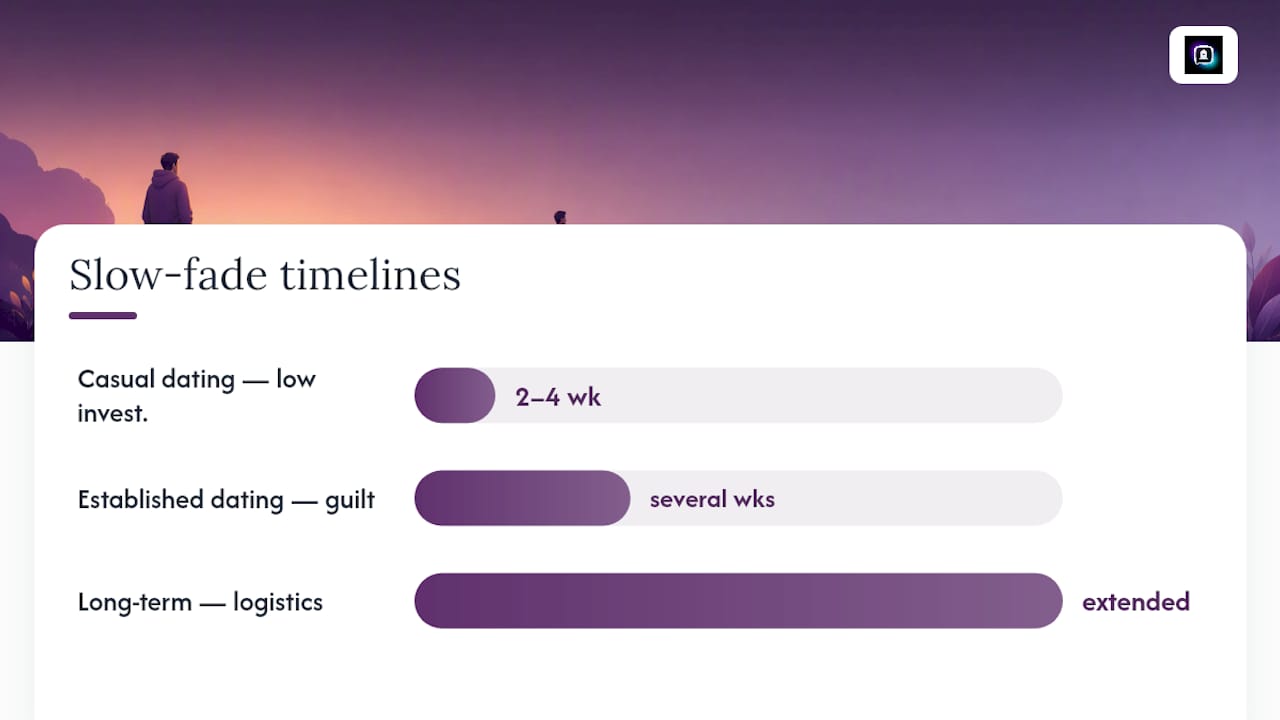
Timelines vary depending on how established the connection was. In casual dating, a slow fade often plays out in two to four weeks. In longer relationships, the same pattern can stretch across months, since there's more shared history to unwind and more guilt keeping the fading person from making a clean break.
| Relationship stage | Typical fade timeline | What drives the pace |
|---|---|---|
| Casual dating (a few dates in) | A few weeks | Low investment makes disengaging easy |
| Established dating relationship | Several weeks to a few months | Shared history and guilt slow the withdrawal |
| Long-term or cohabiting relationship | Extended periods | Logistics and emotional entanglement delay the exit |
Not every slowdown is a slow fade, though. Genuine life changes, a new job, a family emergency, a packed exam season, can produce identical symptoms without any intent to disengage. The real distinguishing factor is direction: a slow fade is one-sided and avoidant, while natural drifting usually comes with some acknowledgment ("sorry, work has been insane") even if the acknowledgment itself is delayed.
Slow fade vs. ghosting vs. breadcrumbing: what's the real difference?
These three terms get thrown around as synonyms, but they describe distinct patterns of disengagement, and knowing which one you're dealing with tells you something about the other person's intent.
| Dimension | Ghosting | Slow fade / soft ghosting | Breadcrumbing |
|---|---|---|---|
| Abruptness | Sudden, total stop | Gradual, incremental | Inconsistent, on and off |
| Contact reduction | Immediate, complete | Steady decline over weeks | Sporadic bursts, no pattern |
| Emotional clarity for recipient | Low but arguably clearer (something clearly ended) | Very low, high ambiguity | Extremely low, false hope persists |
| Typical duration | Instant | Weeks to months | Can drag on indefinitely |
A few real-world snippets show the difference in tone:
- Ghosting: silence. No reply to your last three texts, no read receipt, nothing.
- Slow fade / soft ghosting: "haha yeah maybe this weekend" (sent two days late, never followed up).
- Breadcrumbing: "miss you 😊" out of nowhere, then radio silence again for three weeks.
Of the three, the slow fade often produces the most ambiguous loss. Ghosting is brutal but at least unambiguous. A slow fade leaves you interpreting every delayed reply as either "they're busy" or "they're done," and that unresolved uncertainty is exactly what makes it psychologically harder to shake than an abrupt disappearance.
Signs you're being slow faded, message by message
Here's what the pattern looks like when you track it over a few weeks rather than a single bad day.
Watch for these behavioral shifts:
- Reply times that keep stretching: hours become half a day, then a full day, then two
- Answers that get shorter and shorter, with punctuation and enthusiasm disappearing first
- Plans that get floated but never confirmed, or confirmed and then "something came up"
- A drop in questions about your life, your day, anything that shows curiosity
The tone shift usually shows up in the texts themselves before you consciously notice it:
- Early on: "omg tell me everything, how did the interview go??"
- Weeks later: "oh nice, glad it went ok"
- Even later: "yeah for sure" (in response to an actual question you asked)
Before you decide to act, run through a short checklist: Has this pattern held for at least two to three weeks? Are you the one initiating most conversations now? Have plans been canceled or avoided more than once without a real reason? If you're answering yes to most of these, you're probably not imagining it. Ghosttextai's breakdown of red flags in dating messages walks through more of these tone shifts if you want a closer look at specific wording.
Why people slow fade instead of just saying it's over
Nobody slow fades because they enjoy the process. It's almost always a workaround for a conversation they don't know how to have, or don't want to have.
The most common motives:
- Conflict avoidance. Ending things directly means facing a reaction, and some people would rather disappear in slow motion than sit through that.
- Guilt. Especially in relationships that were meaningful for a while, ghosting outright feels cruel, so fading feels like a kinder middle ground, even though it usually isn't.
- Uncertainty about their own feelings. Some people fade because they genuinely don't know what they want yet, and stalling feels safer than committing to an answer.
- Reduced interest without a clear trigger. Attraction or investment can fade on its own, and the person doesn't have a clean reason to point to, so they just... pull back.
- Being overwhelmed. Work, family, or other relationships can eat up the bandwidth someone would otherwise spend on you, and rather than say that, they just go quiet.
- Emotional immaturity. Some people have never learned how to end things directly and default to avoidance because it's the only exit strategy they know.
There's also a strong link between this behavior and avoidant attachment styles. People with avoidant tendencies tend to withdraw under emotional pressure rather than lean into it, and a slow fade is often the path of least resistance for someone who finds direct confrontation genuinely distressing rather than just inconvenient.
Pro Tip: Try to hold the motive and the impact as two separate things. Understanding why someone fades can explain their behavior without excusing how it left you feeling. You can extend some empathy toward their avoidance and still decide it's not something you're willing to keep absorbing.
How to respond when you suspect a slow fade
The instinct to send five follow up texts trying to figure out what went wrong is understandable, but it rarely gets you clarity. It usually just extends the ambiguity. Here's a sequence that clinicians tend to recommend instead.
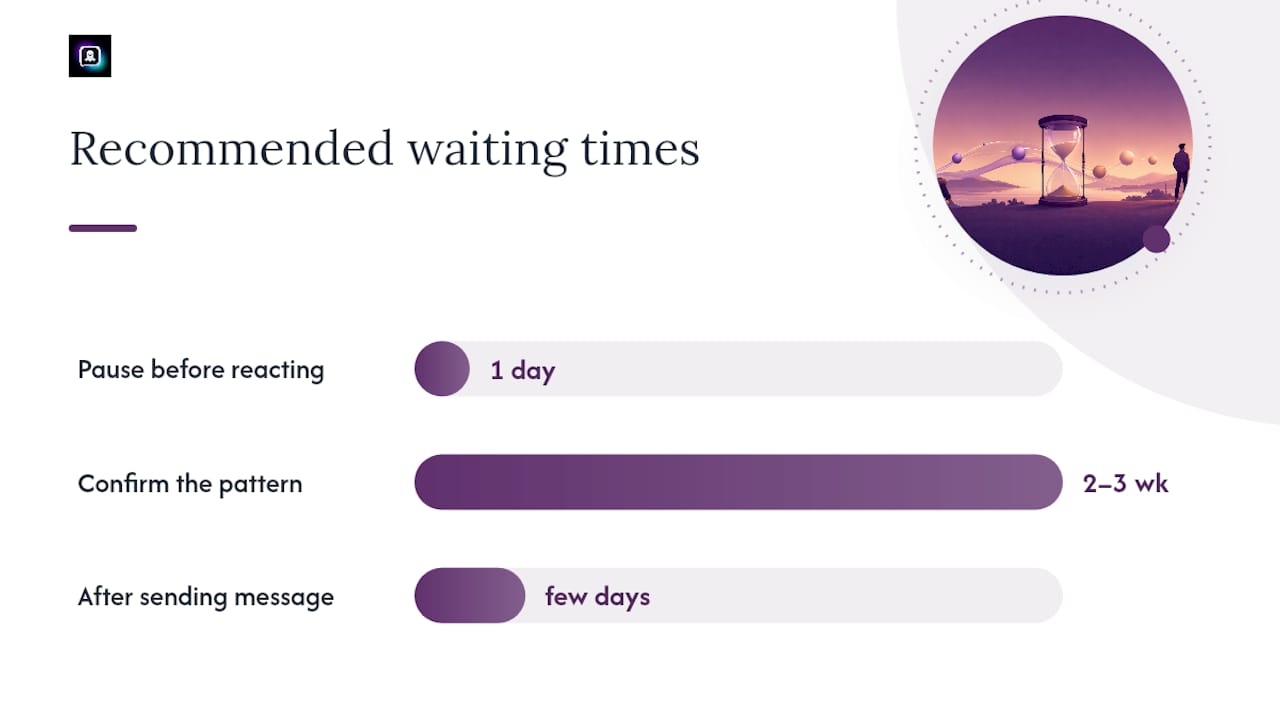
- Pause before reacting. Give yourself a day to notice the pattern clearly rather than responding to the first slow reply in a panic.
- Send one direct message that closes the loop. Ask plainly where things stand, not seven times, once.
- Watch what happens next, not what they say. A real answer paired with effort to reconnect is meaningful. A vague reply followed by more silence tells you what you need to know.
- Stop initiating if there's no genuine repair. Clinicians recommend against repeated chasing; one clear message is enough, and continuing to reach out rarely changes the outcome.
- Redirect your energy toward yourself. Put the effort you were spending on decoding texts into something that actually restores you.
A few short scripts you can adapt, depending on the tone you want to strike:
- Neutral: "Hey, I've noticed things have slowed down between us. Just want to check, are you still interested in keeping this going?"
- Kind: "No pressure either way, but I'd rather know where you're at than keep guessing. Totally okay if things have changed."
- Boundary setting: "I need clearer communication to keep investing here. If that's not something you want right now, that's fine, just let me know."
On timing: don't send this after one slow reply. Give the pattern two to three weeks to confirm itself before you send the closing message. Direct, compassionate honesty works better than a passive aggressive test message, and it gives you an actual answer instead of another data point to obsess over.
Pro Tip: Send your closing message on a day you're feeling steady, not right after a fresh disappointment. The tone lands better when you're not writing from a place of hurt.
Once you've sent it, give it a few days, not weeks, before you consider the silence itself an answer.
The emotional toll of a slow fade, and how to cope
Psychologists use the term "ambiguous loss" for grief that has no clear ending, no funeral, no closure, just an open question that never gets answered. A slow fade is a textbook example, and it's part of why fading out can feel worse than being ghosted outright: the gradual decline keeps hope alive just long enough to make the eventual loss hurt more.
Being on the receiving end of this threatens some pretty basic psychological needs, control, meaning, a sense of belonging, and that's exactly why it can feel disproportionately heavy for what, on paper, was often a short-term connection. Coping strategies clinicians point to include limiting how often you check their social media, setting a firm boundary on how many times you'll reach out, and leaning on people who actually show up for you.
Practical steps that help:
- Mute or unfollow if checking their activity keeps reopening the wound
- Set a personal rule: no more than one attempt to reconnect, then you let it rest
- Keep a normal routine, sleep, movement, meals, even when your head is elsewhere
- Talk it through with a friend rather than replaying the texts alone at 1 a.m.
If the rumination doesn't ease up after a few weeks, or if it's bleeding into your sleep, appetite, or ability to function day to day, that's worth bringing to a therapist rather than trying to push through solo. Peer support, whether that's a close friend or a support community, can also do a lot of the work that endless solo overthinking can't.
When it's probably not a slow fade
Before you write someone off, it's worth ruling out a few less dramatic explanations. Reduced contact doesn't automatically mean intentional withdrawal.
Common alternative explanations:
- A genuinely demanding stretch at work or school that's eating every spare hour
- A phone issue, app glitch, or missed notification (more common than people assume)
- Mutual, low-stakes drift where neither person was that invested to begin with
- A family emergency or mental health crisis they're not ready to explain yet
A couple of quick examples: someone studying for board exams might go quiet for two weeks and then reappear with a genuine apology and real effort to reconnect. That's not a fade, that's bandwidth. Compare that to someone whose replies keep shrinking over a month with zero acknowledgment of the shift, that's the pattern worth naming.
The fastest way to tell the difference is to watch what happens after you reach out. Someone who's just busy tends to circle back with explanation and effort. Someone who's fading tends to respond with the same low energy that started the drift in the first place, or not respond at all. It's also worth being honest about your own side of things. In some cases, both people have quietly cooled off, and a meaningful share of these situations turn out to be mutual rather than one-sided.
Why honest endings are worth protecting
The thing that strikes me most about slow fades is how avoidable the pain usually is. Nobody's asking for a dramatic breakup speech, most people just want a sentence. "I don't think this is working for me" costs the sender almost nothing and saves the other person weeks of guessing.
Choosing clarity, whether you're the one stepping back or the one asking for it, isn't about being blunt for its own sake. It's about respecting the other person enough to give them something to actually respond to. If you're on the receiving end of a fade, sending one direct message and then letting go isn't giving up. It's refusing to spend your emotional energy on a question someone else should have answered honestly in the first place.
Get help decoding the message before you hit send
If you're staring at a text thread trying to figure out whether what you're seeing is a slow fade, a busy week, or something else entirely, you don't have to untangle it alone. Ghosttextai reads the actual conversation, tone shifts, response delays, and effort level included, and tells you what's really going on before you fire off a reply you'll regret.
Upload the screenshots or paste the thread, and Ghosttextai's communication coach flags the mixed signals, points out real red flags versus normal busyness, and drafts a suggested reply that matches the tone you actually want, neutral, warm, or boundary setting. If you'd rather see how to phrase a closing message before you use one of the scripts above, the tool can tighten the wording for your specific situation. Start by pasting in your conversation at Ghosttextai and see what the analysis turns up before you send another message into the void.
Frequently asked questions about slow fade meaning
What does "slow fade" mean in dating? It means someone is gradually reducing how often and how much they communicate, without ever saying the relationship is over. The person doesn't disappear outright, they just show up less and less until there's nothing left.
How is a slow fade different from soft ghosting? They're closely related. Soft ghosting is essentially the messaging pattern of a slow fade: short, delayed replies and avoided plans while some contact continues. Most people use the terms interchangeably.
Am I being ghosted or just experiencing a slow fade? Ghosting is a sudden, complete stop in contact. A slow fade is the gradual version, replies keep coming but with less effort and enthusiasm each time, until they eventually stop entirely.
How long does a slow fade usually take? In casual dating, it tends to play out over two to four weeks. In more established relationships, it can stretch across several months as both the guilt and the shared history slow the exit down.
Should I confront someone who's slow fading me? Sending one clear, calm message asking where things stand is a reasonable step. What you shouldn't do is send that message repeatedly hoping for a different answer. One direct ask, then let their response, or lack of one, guide what you do next.
Sources
- Haunted: The trend toward ghosting
- What Is Soft Ghosting and Why Do People Do It?
- How to cope with being ghosted
- Why fading out of a relationship can be worse than ghosting