
Breadcrumbing texts are short, sporadic messages designed to keep you emotionally available without any real commitment. The single best immediate action: send one clear boundary text, then stop initiating contact if nothing changes. According to the Cleveland Clinic and Healthline, the behavior runs on intermittent reinforcement, the same psychological mechanism that makes slot machines hard to walk away from. Sporadic rewards are harder to quit than consistent ones, which is exactly why a string of vague "hey, thinking of you 😊" texts can feel more gripping than a real relationship.
Two copy-ready lines you can adapt right now:
- Boundary text: "I like talking to you, but I need plans that actually happen. If that's not something you're up to, I understand."
- Disengage text: "I'm going to step back. Take care."
Verdict: If you've seen the pattern multiple times, ask once for a concrete plan. If they evade or go vague, disengage. That's the expert consensus.
Key Takeaways
Breadcrumbing texts are intermittent, low-commitment messages that exploit intermittent reinforcement to keep you emotionally available — the pattern is identifiable, and the exit strategy is straightforward.
| Point | Details |
|---|---|
| Identify the pattern first | Three instances of vague plans or inconsistent contact is enough to call it breadcrumbing, not a coincidence. |
| Run the conversion test | Reply once with two specific available times; two evasions confirm the pattern per Simply Psychology's diagnostic. |
| Set one clear boundary | State what you need in one calm, non-accusatory message — then watch whether behavior changes. |
| Disengage if nothing shifts | Stop initiating contact; every reply to a crumb reinforces the behavior, per Verywell Mind. |
| Ghosttextai for pattern clarity | Paste your conversation into Ghosttextai to get an objective read on tone, red flags, and draft replies. |
Table of Contents
- What breadcrumbing texts are — and how they differ from ghosting
- Signs you're being breadcrumbed, with real text examples
- Why people breadcrumb — the psychology behind it
- Exactly how to respond to breadcrumbing texts
- How breadcrumbing shows up across different relationships
- When an AI conversation coach helps — and when therapy does
- Emotional-safety signs and when to get professional support
- The part no one says out loud
- Ghosttextai can help you read the pattern clearly
- Sources
What breadcrumbing texts are — and how they differ from ghosting
Breadcrumbing is a manipulation pattern where someone drops occasional morsels of attention, a text here, a story reaction there, a vague "we should hang out soon," without ever following through. The goal, conscious or not, is to keep you interested and available while they invest nothing real.
The key mechanism is intermittent reinforcement: unpredictable rewards create stronger behavioral attachment than steady ones. A person who texts you randomly every few days is, neurologically speaking, harder to stop thinking about than one who texts you reliably every morning. Simply Psychology explains that this is why breadcrumbing can be more psychologically sticky than ghosting — at least ghosting gives you a clear ending to grieve.
| Behavior | What it looks like | Emotional impact |
|---|---|---|
| Ghosting | Complete disappearance, no contact | Confusion, then grief — a clear ending |
| Breadcrumbing | Sporadic texts, likes, vague plans | Prolonged hope, self-doubt, no closure |
A few things worth knowing before we go further:
- Breadcrumbing can be intentional (keeping options open) or unintentional (avoidant attachment, poor self-awareness).
- It appears in romantic relationships, but clinicians also document it in workplaces (vague promises of promotion) and families (conditional attention).
- The harm to the recipient is similar regardless of the breadcrumber's intent.
Signs you're being breadcrumbed, with real text examples
The clearest signal is a consistent gap between words and actions. One late reply is nothing. A pattern of them is data.
Core red flags checklist:
- Replies are inconsistent — warm one day, silent for a week
- Plans are always vague: "we should do that sometime" with no date attached
- Contact is mostly microcommunication: a reaction to your story, a meme, a one-word reply
- Messages arrive late at night but rarely during the day
- They're available in texts but unavailable in real life
- Warm stretches are followed by long silences, then another warm message
Real-style example texts that signal breadcrumbing:
- "hey stranger 😏" — at 11:47 PM, after nine days of silence
- "we really need to catch up soon!" — said for the third month in a row, no date proposed
- A long, emotionally warm paragraph about missing you, followed by three days of no reply when you respond warmly
- "thinking about you lol" — no follow-up when you ask how they're doing
- A like on your Instagram story, then silence when you DM back
Situationships and ex-partners are especially common sources of these crumbs. The emotional history makes each message feel more significant than it is.
Pro Tip: Repeated instances of the same pattern (vague plan, no follow-through; late-night text, gone by morning) are enough to call it a pattern, not a coincidence. At that point, run the conversion test: reply once with two specific, low-effort options — "I'm free Saturday afternoon or Sunday evening, which works for you?" — and watch what happens. Genuine interest picks one. Breadcrumbing evades or goes vague.

Simply Psychology's conversion-test diagnostic recommends scoring two evasions as confirmation. You don't need ten data points. Two clear dodges tell you what you need to know.
Why people breadcrumb — the psychology behind it
Most breadcrumbers aren't sitting down and plotting. The behavior usually comes from one of a few psychological places, and CNN's reporting on expert perspectives makes clear that intent doesn't change the advice: label the behavior, set a boundary, and stop rewarding the crumbs.
Common drivers:
- Avoidant attachment: They want connection but pull back when it gets real. Crumbs let them feel close without the vulnerability of commitment.
- Validation-seeking: Each reply from you confirms they're desirable. They're not pursuing you — they're collecting proof of their own worth.
- Indecision: They genuinely don't know what they want, so they keep you warm while they figure it out. The cost of that indecision lands entirely on you.
- Narcissistic patterns or low self-esteem: Keeping multiple people on a low simmer requires minimal effort and provides maximum ego supply.
The downstream effects on recipients are real. Clinical summaries link breadcrumbing to lower life satisfaction, increased loneliness, and reduced self-esteem compared with clearer relationship endings. The ambiguity is the injury. When there's no clean ending, there's no clean grief — just a slow drain.
Exactly how to respond to breadcrumbing texts
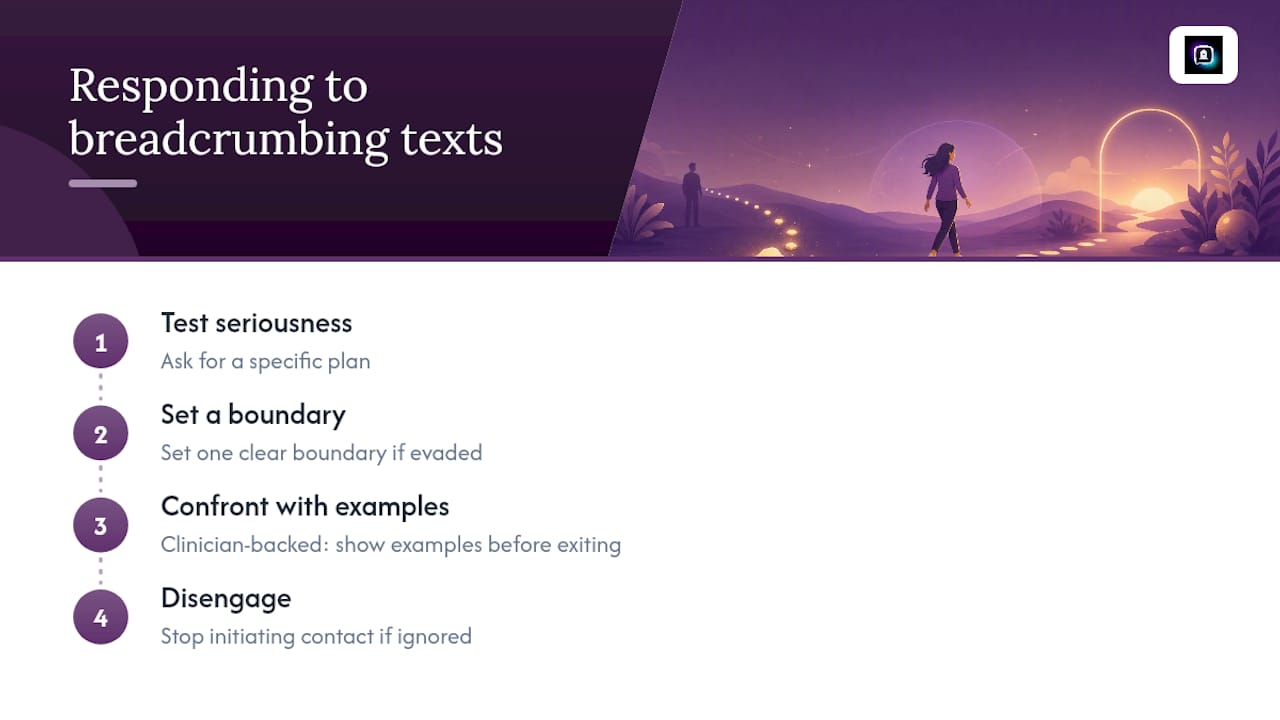
The decision flow is short: test seriousness once with a specific plan request. If they evade, set one clear boundary. If nothing changes, disengage and stop initiating. Prevention's clinician-backed guidance recommends direct confrontation with examples before exiting — not because the breadcrumber deserves an explanation, but because you deserve to know you tried.
Script 1: The conversion test
Use this first, before anything else.
"Hey — I'd love to actually make plans. I'm free [Day 1] or [Day 2]. Which works for you?"
Short, low-pressure, specific. Their response tells you everything. A genuine "Saturday works!" is a green light. "Maybe soon, things are just crazy right now" is a crumb.
Script 2: The boundary text
Use this after one or two evasions.
"I like talking to you, but I need something more consistent than this. If you're not in a place for that, I get it — but I can't keep things open-ended."
Keep it calm and non-accusatory. You're stating a need, not filing a complaint.
Script 3: The disengage text
Use this when the boundary has been stated and ignored.
"I'm going to step back from this. Take care of yourself."
One sentence. No door left open. No "maybe in the future." Verywell Mind is clear: stop reinforcing crumbs. Every reply to a late-night "hey stranger" teaches them the strategy works.
Script 4: The late-night-only reply
"I notice I only hear from you late at night. I'm not really available for that kind of contact. Hope you're well."
Script 5: The "I need consistency" message
"I've enjoyed our conversations, but the inconsistency is hard for me. I need to know if this is going somewhere or not."
Situational guidance:
- Test once with a concrete plan. If they pick a day, great. If they deflect, test once more.
- After two evasions, move to the boundary text — don't repeat the test indefinitely.
- Match your investment to theirs. If they send a one-liner, don't send three paragraphs back.
- Stop initiating contact entirely if the boundary text is met with another crumb.
Pro Tip: Before sending any of these, save screenshots of the conversation pattern separately. If you ever need to explain the situation to a therapist or trusted friend, having the actual texts is far more useful than trying to reconstruct the timeline from memory. Use the scripts as drafts, not declarations — read them once before sending and adjust the tone to sound like you.
For more on AI-generated reply drafts and how to use them without losing your own voice, that's worth a look before you hit send.
How breadcrumbing shows up across different relationships
The behavior looks different depending on the context, and the right response shifts accordingly.
Dating apps and early-stage dating:
Story reactions, sporadic DMs, and occasional likes without any move toward meeting in person. App culture makes this frictionless — a reaction costs nothing and signals just enough interest to keep you checking your phone. The fix here is simple: if someone hasn't suggested a real meeting after a few exchanges, stop investing.
Situationships:
Vague future plans are the currency here. "We should go to that place sometime" repeated across months, with warmth but no follow-through. The emotional intimacy can feel real, which makes the lack of commitment more confusing. The conversion test is especially useful in situationships because it forces a concrete answer.
Committed relationships:
Sporadic displays of affection without sustained effort — a thoughtful gesture once a month surrounded by emotional unavailability. This version is more damaging because the relationship label creates an expectation of consistency that isn't being met. Direct conversation is the first step; couples therapy is worth considering if the pattern is entrenched.
Workplace and family:
A manager who praises your work but never follows through on the promised promotion. A parent who shows up warmly at holidays but is absent the rest of the year. These contexts require different tactics: document workplace promises in writing, and in family dynamics, lower expectations rather than confronting directly unless the relationship can sustain it.
A note on safety: When breadcrumbing overlaps with gaslighting, controlling behavior, or any pattern that makes you feel unsafe, the priority shifts from boundary-setting to safety planning. If you're unsure whether what you're experiencing crosses into emotional abuse, contact the National Domestic Violence Hotline at 1-800-799-7233. Workplace breadcrumbing that involves harassment should be documented and reported to HR.
When an AI conversation coach helps — and when therapy does
One of the hardest parts of being breadcrumbed is the self-doubt. You re-read the same texts twenty times trying to figure out if you're overreacting. An objective pattern report cuts through that.
Here's what that looks like in practice: you paste a conversation thread into an AI coach, and instead of interpreting individual messages, it shows you the pattern. How often are you initiating versus them? How long are the gaps between their replies? Are the warm messages always followed by silence? Seeing frequency and initiation ratios laid out removes the guesswork. Medical News Today notes that objective analysis tools can reduce over-interpretation, though they aren't a substitute for clinical care when emotional harm is significant.
When an AI communication coach helps:
- Spotting patterns across a long conversation thread you're too close to read clearly
- Getting a neutral, non-accusatory draft reply when you're tempted to send something emotionally reactive
- Reducing the compulsive re-reading loop by getting an outside read on tone and intent
- Identifying red flags you've normalized over time
When therapy is the right call:
- The breadcrumbing has triggered persistent anxiety, depression, or obsessive checking
- You recognize a pattern of accepting crumbs across multiple relationships
- You're experiencing self-harm thoughts or a significant drop in daily functioning
- The situation involves manipulation that's escalating toward emotional abuse
Pro Tip: Use AI-generated reply suggestions as drafts, not final sends. Read them, adjust the tone to match your voice, and never use them to escalate a conflict. The goal is clarity and dignity, not a perfectly worded argument.
For a broader look at AI communication coach tools and what they can realistically do, that comparison is worth reading before you commit to any one approach.
Emotional-safety signs and when to get professional support
Some signs that it's time to bring in outside support, not just a better reply script:
- You're checking your phone compulsively, multiple times per hour, waiting for a message
- You feel persistent sadness, low self-worth, or anxiety that doesn't lift between conversations
- You've stopped making plans with friends because you're keeping yourself available
- You're having thoughts of self-harm or feel genuinely hopeless about relationships
- The person's behavior has escalated from inconsistency to manipulation, threats, or control
Immediate steps if you recognize these signs:
- Pause contact with the person, even temporarily
- Tell one trusted friend or family member what's been happening
- Schedule a session with a licensed therapist, particularly one familiar with attachment or relationship patterns
- If safety is at risk, contact the National Domestic Violence Hotline (1-800-799-7233) or text START to 88788
Therapy isn't just crisis management. It's where you unlearn the patterns that made crumbs feel like enough. The Psychology Today therapist finder is a practical starting point for finding someone in your area. Peer support communities on platforms like Reddit's r/relationship_advice can also provide perspective, though they're no substitute for clinical guidance.
The part no one says out loud
Feeling confused by breadcrumbing texts isn't a sign that you're naive or needy. It's a sign that you're human and that the behavior was designed, consciously or not, to keep you guessing. The shame people feel about being strung along is misplaced. You didn't misread the situation; the situation was built to be misread.
The confusion, the self-blame, the "maybe I'm reading too much into it" spiral — all of it is a normal response to an abnormal communication pattern. You deserve clarity. One test message is a reasonable experiment. Stepping away when the pattern holds is not giving up; it's protecting your time and emotional energy for someone who will actually use it.
Ghosttextai can help you read the pattern clearly
If you've been re-reading the same thread for the third time tonight trying to figure out what it means, that's exactly the problem Ghosttextai was built to solve. Paste your conversation or upload a screenshot, and you get an instant read on tone, intent, emotional signals, and red flags in the text — without the spiral of second-guessing yourself.

Ghosttextai also generates contextually tailored reply suggestions, so instead of agonizing over what to say, you start with a solid draft and adjust it to your voice. The free tier covers a few conversations; Ghost Text Pro unlocks unlimited reads, advanced red flag detection, and an interest meter that shows you where you actually stand. Your data is handled per Ghosttextai's privacy terms, and you're always in control of what you share.
If you're ready to stop guessing what those texts really mean, try a pattern check at Ghosttextai and get clarity in minutes.
Sources
- What Is Breadcrumbing? How To Handle
- Breadcrumbing: What It Is and How to Deal
- Breadcrumbing: What it means and examples in dating or relationships | CNN
- Breadcrumbing: The Psychology of Being Strung Along (2026) | Simply Psychology
- Breadcrumbing: What Is Breadcrumbing?