
Hot and cold texting is a pattern of alternating warmth and distance in messages, and it usually signals one of three things: mismatched interest, a fear-of-intimacy response, or a deliberate attention tactic. The right immediate move is the same regardless of cause. Stop chasing, keep your own texting tone consistent, and ask one direct clarification question if the pattern repeats past a couple of cycles.
TL;DR:
- Hot and cold texting often results from attachment styles, fear of intimacy, or deliberate manipulation, with each requiring a different response approach.
- Repeated cold phases lasting more than three cycles with no acknowledgment or repair indicate entrenched patterns that warrant walking away.
- Testing reactions with neutral questions and giving space can help distinguish genuine disinterest or life circumstances from manipulation.
- Maintaining a consistent and neutral tone, setting boundaries, and observing responses can prevent emotional exhaustion and clarify intentions.
- External tools like Ghost Text can analyze conversation patterns to help interpret tone shifts, red flags, and underlying motives more accurately.
Table of Contents
- What Hot and Cold Texting Actually Looks Like
- Why People Actually Go Hot and Cold
- Three Quick Tests to Read Their Real Intent
- How to Reply: Seven Practical Strategies
- When to Walk Away From the Pattern
- How Ghost Text Helps You Read Mixed Signals
- The Emotional Toll of Living in the Cycle
- Dating, Friendships, and Work: The Pattern Changes by Context
- Talking About It Without Making It Worse
- Getting Outside Help When the Pattern Won't Break
- A Habit Worth Building
- Get a Clearer Read Before You Reply
- Sources
What Hot and Cold Texting Actually Looks Like
The phrase itself is old. To blow hot and cold means to swing between interest and indifference toward the same person, and it has described flaky affection long before smartphones existed. Texting just gives the pattern a paper trail you can scroll back through and torment yourself with at 1 a.m.
The shape is usually predictable once you know what to look for. A warm burst of texts, sometimes several in an hour, gets followed by a stretch of silence. Then a shallow reply shows up, one word or a thumbs up emoji, followed eventually by another warm burst that resets the cycle. The whole thing repeats often enough that you start organizing your day around whether today is a "hot" day or a "cold" one.
A few named patterns show up inside that cycle:
- Breadcrumbing: sending just enough attention (a like, a "hey stranger," a meme) to keep you hooked without ever escalating toward a real plan or commitment.
- Dry texting: replies that are technically responsive but emotionally empty, think "lol yeah" to a question you spent five minutes thinking about.
- Intermittent reinforcement: unpredictable timing and intensity of attention, the same mechanism that makes slot machines addictive, applied to a phone screen.
- Push-pull: one message pulls you closer ("I miss talking to you"), the next pushes you away (going quiet for two days), and the whiplash itself becomes the hook.
Here is what it reads like in practice. Monday: "Can't stop thinking about our conversation last night, you're different from anyone I've talked to." Tuesday through Thursday: nothing. Friday, when you finally text first: "haha yeah my week has been crazy." Saturday: a long, warm message again, like Tuesday through Thursday never happened. If that rhythm feels familiar, you are not imagining it.
Why People Actually Go Hot and Cold
Most people assume hot-and-cold texting is either pure interest or pure manipulation. It is rarely that clean. The behavior usually comes from one of three sources, and telling them apart changes how you should respond.
Attachment style is the biggest predictor. Someone with an avoidant attachment style tends to want connection but panics when it gets close, so they text frequently but keep the content shallow, plenty of contact, almost no depth. Simply Psychology's research on avoidant attachment describes this exact pattern: lots of messages, very little vulnerability, and a retreat the moment the conversation turns emotionally real. Someone with an anxious attachment style shows the opposite problem. They overtext when they feel secure and go quiet or read-and-ignore when they feel insecure, which from your side looks identical to disinterest but is actually a self-protective freeze.
Fear of intimacy drives a lot of the "cold" phases specifically. According to Charlie Health's explanation of fear of intimacy, withdrawal often kicks in exactly when a relationship starts feeling real, and it operates as an unconscious defense rather than a calculated move. That distinction matters for how you interpret a sudden cold streak. Someone who just had a great date and then disappeared for four days may not be losing interest; they may be scared by how much they liked it.
Then there is the deliberate version. Some people go cold on purpose because unpredictability works. Intermittent rewards create stronger emotional pull than steady attention does, the same mechanism behind why unpredictable texting keeps people hooked, and some dating "coaches" openly teach manufactured unavailability as a seduction technique. The burned haystack method is one example: engineered scarcity designed to make you chase harder. It can work in the short term. It also tends to produce relationships built on performance rather than actual compatibility.
A pattern worth knowing: intermittent, unpredictable attention creates a stronger emotional fixation than steady, reliable attention does. That is not a character flaw in you. It is how reward systems respond to uncertainty, and it is exactly why hot-and-cold texting feels so hard to walk away from even when you know it is not good for you.
Situational factors matter too, and they get overlooked constantly. Someone juggling a demanding job, a family crisis, or genuinely bad phone habits might text erratically for reasons that have nothing to do with you. Someone dating multiple people at once will naturally divide attention unevenly, and you might be catching the low end of that rotation without knowing it exists. Research on texting compatibility also finds that mismatched texting frequency between two otherwise compatible people creates friction that has nothing to do with feelings and everything to do with communication style.
So how do you tell anxious withdrawal from manipulation? Anxious or fear-driven withdrawal usually comes with some acknowledgment eventually, an apology, an explanation, a visible effort to reconnect. Manipulative hot-and-cold rarely offers repair. It just resets the cycle and waits for you to chase.
Three Quick Tests to Read Their Real Intent
You do not need a psychology degree to get useful data here. You need three small experiments and the patience to actually watch what happens.
- Ask a neutral logistical question. Something low-stakes like "want to grab coffee Thursday?" removes emotional loading and just tests whether they show up for planning. A fast, clear answer (even a "no, but how about Saturday") is a good sign. A vague non-answer repeats the pattern.
- Give space and watch the reaction. Stop initiating for four or five days. Interested people notice absence and say something about it. People running a breadcrumbing pattern often do not notice at all, because your chasing was never the point.
- Name the pattern once, calmly, and watch for repair. A simple "I've noticed we go through pretty intense stretches and then really quiet ones, what's going on there?" gives them one clean chance to explain or adjust. Some dating advice frames this directly: a single honest question does more diagnostic work than weeks of silent guessing.
Watch for these signals once you run the tests:
- Low interest or manipulation: cold phases that get longer each cycle, zero acknowledgment of the pattern, excuses that never turn into actual behavior change.
- Life stress or genuine incompatibility: specific context for the silence ("work has been insane"), a consistent pattern of apologizing or checking back in, effort that scales up once things calm down.
A useful field rule from eharmony's dating advice: if the cold stretches lengthen across three full cycles and no repair or explanation ever shows up, treat the pattern as fixed. People rarely fix on their own what they have never once acknowledged.
How to Reply: Seven Practical Strategies
Once you recognize the pattern, the harder part is knowing what to actually type. These seven approaches cover most situations, from mild inconsistency to outright manipulation.
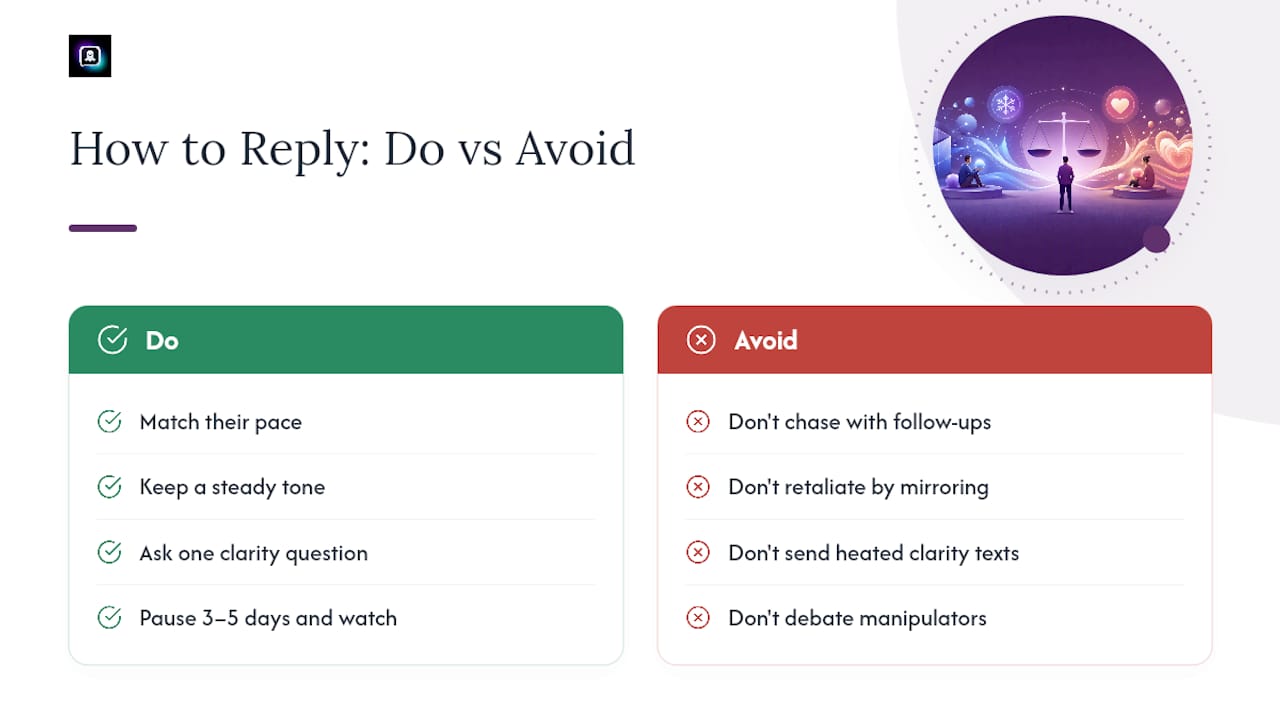
1. Stop the chase. Every follow-up text after silence teaches the other person that disappearing gets rewarded with more of your attention. Break the loop by simply matching their pace instead of closing the gap. If they went quiet for three days, you do not need to send three check-in texts to bridge it.
2. Keep your tone level regardless of theirs. Their hot-and-cold swings do not need to become yours. A short, steady message like "Hey! Been a minute, hope your week's going well" works whether they were warm or cold last time. Consistency on your end is information for them and stability for you.
3. Ask for clarity directly. Skip the guessing games with something neutral: "I've noticed our texting goes in waves, are you looking for something casual or more consistent?" This works best once, not as a recurring script. A short, confident message paired with one clarity question tends to lower emotional escalation while still producing a real answer.
4. Set a boundary when the pattern repeats. "I like talking to you, but I need more consistency than this to keep investing time" is not an ultimatum, it is information. If nothing changes after that conversation, that is your answer.
5. Mirror energy sparingly, not as a punishment. Matching a short reply with a short reply is fine occasionally. Matching every cold stretch with your own cold stretch as revenge just turns two people into a standoff. Use mirroring to test, not to retaliate.
6. Pause and observe. Give three to five days of no contact after a cold stretch. Watch whether they notice, ask what happened, or apologize. If nothing comes, you have your data point.
7. Exit cleanly when it is manipulation. "I'm not looking for this kind of back and forth, take care" ends things without a debate. You do not owe an explanation to someone who never offered you consistency.
Pro Tip: Before sending a clarity question, draft it and wait an hour before hitting send. Clarity questions written in the heat of frustration tend to read as accusations instead of genuine asks, and tone matters more than wording here.
Reading tone correctly before you reply matters more than most people admit. If you consistently misjudge whether a message is warm, neutral, or dismissive, that guessing itself feeds the anxiety loop, which is part of why decoding text tone as its own skill is worth building deliberately, and why over-texting early on can backfire even when your intentions are good.
When to Walk Away From the Pattern
Not every hot-and-cold rhythm deserves patience. Some checklist points make the decision easier than your emotions will.
- Frequency: has the cold phase happened three or more times with no real change in behavior?
- Repair attempts: does the other person ever acknowledge the gap, apologize, or explain, or does every warm return act like the silence never happened?
- Emotional cost: are you checking your phone compulsively, rehearsing conversations, or feeling anxious for hours after a cold reply?
- Timeline: has this been going on for more than six to eight weeks without stabilizing in either direction?
If you answered yes to most of those, the pattern is likely entrenched rather than situational. People capable of change usually show some movement within a month or two once the issue is named directly. Beyond that window, you are managing a stable behavior, not weathering a rough patch.
Walking away does not require a dramatic confrontation. A short, clean message and then muting notifications is enough. Afterward, resist the urge to review the conversation looking for signs you missed. There usually were signs. You are not slow for missing them in real time; unpredictable attention is built to be missed.
How Ghost Text Helps You Read Mixed Signals
Reading tone from a phone screen is genuinely hard, texting strips out the voice inflection and facial expression that usually tell you whether "fine" means fine or means something else entirely. Ghost Text analyzes conversations you paste or screenshot and flags tone, intent, and emotional signals, including patterns like escalating cold phases or shallow-but-frequent contact that mirror the avoidant pattern.
The value shows up specifically in pattern recognition across many messages, not just one confusing text. It is easy to overread a single dry reply and just as easy to miss a slow trend of shrinking effort when you are living inside the conversation day by day. An outside read can catch that drift faster than memory alone.
Ghost Text is not a substitute for an actual conversation with the person texting you. It helps you show up to that conversation with a clearer read on what has actually been happening, not a replacement for having it.
The Emotional Toll of Living in the Cycle
Hot-and-cold texting does measurable damage beyond the immediate frustration of a confusing reply. The unpredictability itself is the problem, not just the cold stretches. Your brain treats uncertain reward the way it treats a gambling machine, which means checking your phone stops being a choice and starts being a compulsion.
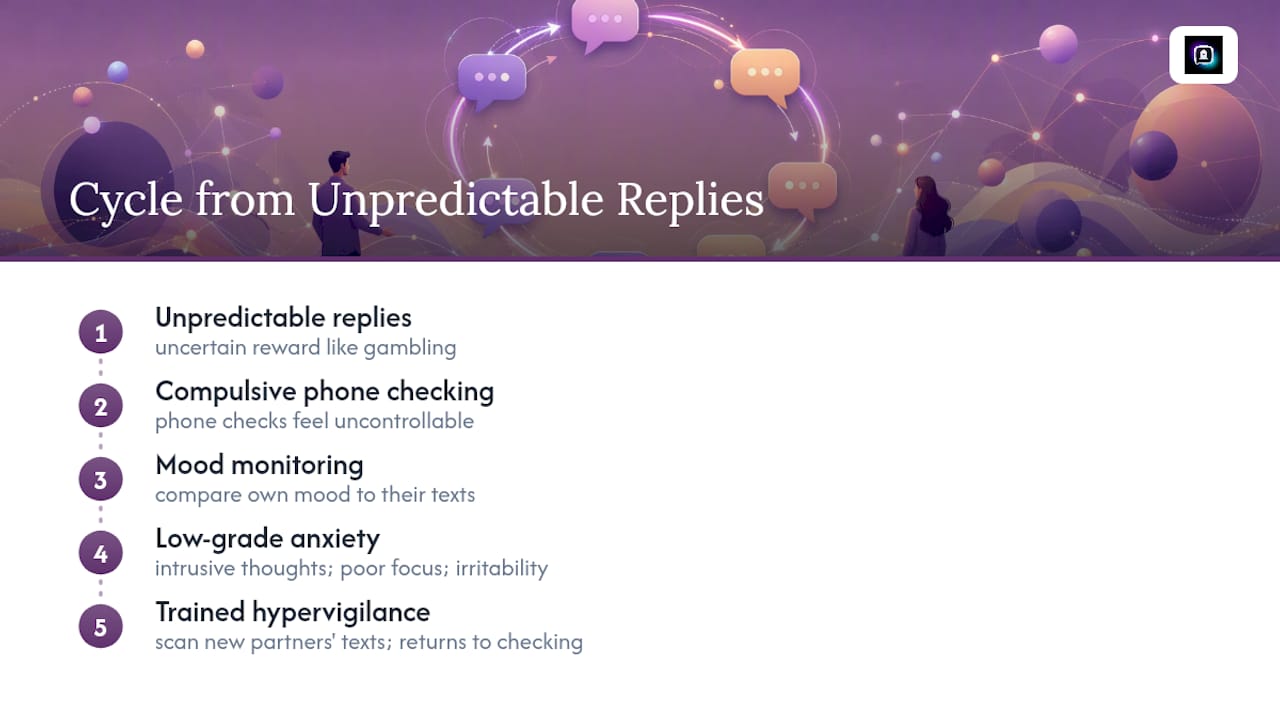
That constant scanning produces a specific kind of exhaustion. You are not just waiting for a reply, you are monitoring your own mood against someone else's texting behavior, which means a stranger's Tuesday afternoon can decide whether your Tuesday afternoon feels good or terrible. Over weeks or months, that dependency can look a lot like low-grade anxiety: intrusive thoughts about the relationship, trouble concentrating, a spike in irritability that has nothing to do with anything else going on in your life.
There is also a slower cost that shows up after the relationship ends, whether by breakup or by fading out. People who spend months adjusting their emotional state to someone else's inconsistency often report a lingering hypervigilance in the next relationship, an instinct to scan new partners' texts for the same warning signs even when those signs are not there. That is a trained response, not a personality trait, and it fades with time and, often, with a healthier relationship as a counterexample.
If the anxiety around checking your phone starts interfering with sleep, work, or other relationships, that is no longer just a dating problem. It is worth naming as a mental health concern on its own.
Dating, Friendships, and Work: The Pattern Changes by Context
Hot-and-cold texting is not exclusively a dating phenomenon, though dating is where it gets the most attention and does the most damage. The mechanics shift depending on the relationship.
In dating, the stakes are highest because ambiguity gets tangled up with romantic hope. A cold stretch from someone you are dating triggers questions about your own attractiveness and worth, which is exactly why it hurts more than the same behavior from, say, a coworker.
In friendships, hot-and-cold usually reads as lower intensity but longer-running. A friend who goes quiet for weeks and then reappears warmly is often navigating a busy season of life rather than testing your interest, and friendships tend to tolerate irregular contact better than romantic ties do, because there is no exclusivity or commitment question riding on every reply.
In work relationships, inconsistent texting from a manager or colleague usually has nothing to do with personal feelings at all and everything to do with workload, hierarchy, or communication habits that were never about you specifically. Reading workplace silence through a romantic lens (assuming a slow reply means you have done something wrong) is one of the more common overreads people make, and it is worth catching that instinct early.
The common thread across all three: the less personal the context, the less you should assume intent, and the more the silence probably reflects the other person's circumstances rather than a message about you.
Talking About It Without Making It Worse
The instinct when you feel confused is to send a long message explaining exactly how the inconsistency has made you feel. Resist that instinct until you have a clear, short version of it.
Lead with observation, not accusation. "I've noticed we go a few days without talking and then have a great conversation" describes a pattern without assigning blame, and it is much harder to argue with than "you always ignore me." Follow the observation with a specific ask, not a vague complaint: "I'd like a heads up if you're busy instead of just going quiet" gives the other person something concrete to act on.
Timing matters as much as wording. Bringing this up mid-argument or immediately after a cold stretch tends to read as reactive, even when your point is completely fair. A calmer moment, ideally in person or on a call rather than in text, gives the conversation a much better shot at landing as concern instead of criticism.
Expect one of three outcomes: genuine acknowledgment and effort to change, a reasonable explanation you had not considered, or defensiveness and no movement. The third outcome is itself useful information, even though it is the one nobody wants to get.
Getting Outside Help When the Pattern Won't Break
Some hot-and-cold dynamics resolve with a clear conversation. Others do not, and that is a sign worth taking seriously rather than pushing through alone.
A licensed therapist or couples counselor is worth considering when the pattern has repeated for months despite direct conversations, when you notice the anxiety spilling into sleep, appetite, or work performance, or when you recognize your own attachment patterns (constant reassurance seeking, or conversely, pulling away when things get close) showing up as part of the problem. Individual therapy can help even if the other person never joins the conversation, since a lot of the suffering in hot-and-cold dynamics comes from your own nervous system's response to uncertainty, not just from their behavior.
Couples counseling makes more sense once both people are willing to name the pattern and work on it together, which is a meaningfully different situation than one person hoping therapy will fix someone who has shown no interest in changing. If you are the one going cold and you recognize fear of intimacy in yourself, individual therapy focused on attachment work tends to produce more lasting change than trying to force consistency through willpower alone.
The practical entry point is usually a primary care doctor for a referral, an employee assistance program if your workplace offers one, or a directory search through a licensed therapist database. None of that requires the relationship to be in crisis first.
A Habit Worth Building
The trap almost everyone falls into is letting their own mood track someone else's texting rhythm, checking the phone becomes checking your emotional temperature. That habit is exhausting and it rarely produces better information, just more anxiety.
One small fix helps more than it should: build a short non-digital ritual into your day, a walk, a coffee made without your phone nearby, ten minutes of something with your hands. It will not fix someone else's inconsistency. It does interrupt the compulsive checking long enough for you to respond to a text instead of reacting to it.
— DSean
Get a Clearer Read Before You Reply
Some AI communication tools offer an outside perspective a confusing text thread never provides on its own: by analyzing the conversation, they flag tone shifts, intent signals, and red flags across the whole exchange instead of just the message that is currently stressing you out. That matters most in exactly the situations covered here, where one dry reply can send you into an hour of overanalysis that a quick tone check could settle in seconds.

After you visit the Ghost Text landing page, you can paste in a recent exchange or upload a screenshot and get an immediate breakdown of what the tone and pattern actually suggest, along with suggested replies if you want help wording your next message. It works for the dating text you are stuck on right now, and for the family or work conversations where the same guessing games show up in a different context. Start with the conversation that is bothering you most and see what the pattern actually shows.
Sources
- Cambridge English Dictionary — blow hot and cold
- Verywell Mind — Understanding the dynamics of texting in relationships
- Simply Psychology — Avoidant attachment style
- Charlie Health — Fear of intimacy