
In most one-on-one English-language texting, "k" is a clipped shorthand for "okay" — and recipients frequently read it as cold, dismissive, or even passive-aggressive. Merriam-Webster lists "K" as a common texting abbreviation for "okay", but the literal definition is only half the story. A study summarized by Fast Company found that single-letter replies like "k" rank among the most negatively received responses in digital conversations, often signaling emotional distance or disinterest.
Before you react, do three things:
- Check who sent it. A close friend who always texts in shorthand is different from a partner who normally writes paragraphs.
- Check the timing. A fast "k" in a logistics thread reads differently than a slow "k" after you shared something personal.
- Check prior tone. If the conversation was warm and this reply feels like a door closing, that pattern matters more than the letter itself.
If you're genuinely unsure, a low-effort clarifier ("All good?") beats a spiral of assumptions every time.
Key Takeaways
Single-letter replies like "k" are most accurately read as ambiguous, not automatically rude — context, relationship history, and pattern are what determine meaning.
| Point | Details |
|---|---|
| "K" means "okay" | Merriam-Webster confirms it as standard shorthand, but context shapes whether it reads as neutral or cold. |
| Effort asymmetry drives the sting | Choosing one letter over two signals minimal engagement, which recipients often read as deliberate dismissal. |
| Context is the decoder | Check sender history, timing, punctuation, and prior tone before reacting to a single "k." |
| Safer alternatives exist | "kk," "ok," or "okay" all signal more warmth with minimal extra effort; "K." is the most hostile variant. |
| Ghosttextai analyzes the full thread | Paste a conversation to get tone analysis, red flag detection, and tailored reply suggestions across any relationship type. |
Table of Contents
- Why does "k" feel rude or dismissive?
- What does "k" actually mean across different contexts?
- How "kk," "ok," "okay," and punctuation change the tone
- How to decode "k" in your specific conversation
- How to reply when someone texts you "k"
- Quick dos and don'ts when someone texts you "k"
- How an AI communication coach can help you interpret "k"
- The "k" problem is really a context problem
- Ghosttextai reads what "k" actually means in your conversation
- Sources
Why does "k" feel rude or dismissive?
The short answer: it violates effort symmetry. Typing "ok" takes one extra keystroke. Choosing "k" anyway signals, consciously or not, that the sender didn't think the message was worth even that. Fast Company's coverage of the research frames it precisely this way — communication analysts describe the single-letter reply as a form of deliberate minimal engagement.
Text messages strip out everything that softens a blunt response in person: tone of voice, facial expression, a reassuring hand gesture. What's left is the words alone, and when those words are a single letter, the brain fills the gap with the worst plausible interpretation. A University of Toronto study reported by The Star found that abbreviated texts were rated as less sincere and less effortful, which directly correlated with a lower likelihood of getting a response back. Brevity doesn't just feel cold — it measurably reduces engagement.
Context amplifies everything. A "k" arriving thirty seconds after a quick "Can you grab milk?" barely registers. The same letter landing five minutes after you told someone you had a rough day at work? That lands like a slap. Punctuation makes it worse: "K." with a period reads as final and hostile in a way that lowercase "k" doesn't quite reach.
The psychological mechanisms at work:
- Effort asymmetry: One letter signals the sender chose minimal engagement.
- Reciprocity violation: When you invest in a message, a one-letter reply breaks the unspoken social contract of matched effort.
- Paralinguistic void: No tone, no warmth, no context to soften the brevity.
- Boundary signaling: Sometimes "k" is a deliberate conversation-ender, used to withdraw without explaining why.
- Weaponization: After a conflict, "k" can function as a punishing non-answer — a way of saying "I'm done" without saying it.
Pro Tip: If you notice you're sending "k" when you're irritated, that's worth pausing on. The recipient almost certainly reads it as exactly what it is.
What does "k" actually mean across different contexts?
The k text meaning shifts depending on who's sending it and what came before. Here's how the same letter reads in four common relationships:
-
A close friend in a fast thread. You're coordinating plans: "Meet at 7?" They reply "k." Totally fine. Both of you text in shorthand, the stakes are low, and the reply is functionally identical to "yep." No subtext, no drama.
-
A romantic partner after a vulnerable message. You told them you're stressed about a family situation. They reply "k" four minutes later. That's where the GrammarCone explainer nails it: "k" can be innocent in busy contexts but genuinely risky after emotionally significant messages. The mismatch between your investment and their reply is what stings.
-
A coworker on Slack. You sent a detailed project update. They replied "k." Depending on your workplace culture, this might read as dismissive or just rushed. Either way, it's a missed opportunity to confirm they actually read it.
-
A parent. Parents who didn't grow up texting often use "k" without any awareness of the connotation. For them, it's a neutral acknowledgment. Generational context genuinely matters here.
Platform matters too. In a fast-moving group chat, "k" is practically invisible noise. In a one-on-one iMessage thread where someone normally writes in full sentences, it stands out. KnowYourMeme traces "k" back to early online gaming and chat culture, where brevity was a feature, not a slight. That origin helps explain why younger users in certain communities treat it as completely neutral, while others experience it as a cold shoulder.
How "kk," "ok," "okay," and punctuation change the tone
Small changes carry real weight. Here's how the most common variants land:
| Variant | Perceived tone | Best used when |
|---|---|---|
| k | Minimal, often cold | Quick logistics with close friends who share your texting style |
| kk | Friendly, casual warmth | Casual chats; signals you're engaged, not just acknowledging |
| ok | Neutral acknowledgment | Most everyday exchanges; safe default |
| okay | Warm, full effort | Emotional conversations; shows you read and processed |
| K. | Cold, final, hostile | Almost never — this reads as a deliberate shut-down |
| ok 👍 or ok! | Upbeat, positive | When you want to signal enthusiasm or ease |

The pattern is consistent: adding letters, punctuation, or an emoji signals more effort, and more effort signals more care. "Kk" works because the doubled letter reads as playful rather than clipped. "Okay" works because it's the full word, no abbreviation, no ambiguity. "K." is the worst of all worlds — the brevity of "k" plus a period that signals finality.
A few practical notes on choosing:
- Use "ok" as your safe default when you're unsure. It's neutral enough to avoid offense and clear enough to confirm receipt.
- Swap "k" for "kk" with friends who text fast. The warmth difference is noticeable and costs you nothing.
- In any emotionally charged exchange, "okay" or "got it" is the minimum. Anything shorter risks being misread.
- Reserve "K." for never. Even if you're annoyed, that punctuation turns a reply into a statement.
How to decode "k" in your specific conversation
Run through this checklist before you decide how to react. Most of the time, a few of these questions will give you a clear enough answer.
- Who sent it? Is this someone who always texts in shorthand, or someone who normally writes full sentences?
- What was the prior tone? Was the conversation warm, neutral, or already tense?
- How long did it take? An immediate "k" in a logistics thread is different from a delayed "k" after something personal.
- What did you send? A simple yes/no question vs. a long emotional disclosure changes everything.
- What platform are you on? A group chat "k" vs. a one-on-one iMessage "k" carry different weight.
- Is there punctuation? "K." is a different message than "k."
- What's the relationship history? One "k" from someone who's usually warm is noise. A pattern of cold replies is a signal.
If most items point neutral: Let it go. You're probably reading into it.
If multiple items feel off: Follow up with something low-stakes. "Hey, all good?" is enough. You don't need to confront the letter.
Red flags that suggest the "k" is intentional rather than casual:
- A period after the K ("K.")
- Noticeably delayed reply after a personal message
- Clear mismatch with the sender's normal texting style
- Preceded by a conflict or unresolved tension
- Part of a pattern of increasingly short replies
When to escalate beyond text: if the stakes are high (a relationship conversation, a serious work issue) and the "k" leaves you genuinely uncertain, call or ask directly. Texting back and forth trying to decode subtext usually makes things worse. One direct question resolves more than ten analyzed replies. For patterns of manipulative texting behavior, a single "k" is rarely the issue — it's the repeated pattern that signals something worth addressing.
How to reply when someone texts you "k"
Your goal determines your reply. Here are templates grouped by what you're actually trying to accomplish.
When you want to clarify without accusing: Keep it short and genuinely curious. "Hey, all good?" or "Just checking — did that land okay?" works because it opens a door without assigning blame. Avoid "Are you mad at me?" — that puts the sender on the defensive immediately.
When you want to de-escalate: Match their brevity but add warmth. "No worries, talk later" signals you're not rattled and keeps the conversation from stalling. The goal is to lower the temperature, not win the exchange.
When the "k" follows a disagreement and feels like a weapon: Don't mirror it. Sending "k" back is satisfying for about three seconds and then makes everything worse. A boundary-setting reply sounds like: "I can see you need some space. I'm here when you're ready to talk." Short, non-accusatory, and it puts the ball back without escalating.
In a professional context: Avoid "k" entirely in workplace messaging. Effective workplace communication calls for replies that confirm receipt and signal next steps. "Got it, I'll follow up by Thursday" is always better than "k" on Slack or email. If a coworker sends you "k" after a detailed message, a quick "Just want to confirm you got the full update — anything you need from me?" is professional and non-confrontational.
Tailored by relationship:
- Friend: "Lol ok, you good?" keeps it light.
- Partner: "Hey, you seem quiet — everything okay?" shows you noticed without making it an accusation.
- Coworker: "Happy to clarify anything if needed" keeps it professional and moves things forward.
For guidance on crafting replies that match tone and effort, the principle is simple: match the emotional register of the situation, not the brevity of their reply.
Quick dos and don'ts when someone texts you "k"
Do:
- Check context before reacting (sender history, timing, prior tone)
- Choose curiosity over accusation as your first move
- Use a low-effort clarifier if you're genuinely unsure ("All good?")
- Match the channel to the stakes — call if the conversation matters enough
- Notice patterns, not single instances
Don't:
- Fire back with another cold message to "punish" the reply
- Assume the worst without running through the context checklist
- Use "K." yourself as a weapon — it escalates, it doesn't resolve
- Spiral into a long text about why their "k" hurt your feelings (at least not immediately)
- Treat one "k" from a habitual shorthand-texter as a red flag
Pro Tip: Pattern detection matters far more than any single reply. One "k" from someone who texts in shorthand means nothing. Five consecutive minimal replies after a period of warmth means something. Watch the trend, not the letter.
How messaging frequency and warmth interact in close relationships is worth understanding — research on messaging frequency and intimacy shows that it's the consistency of effort over time, not any single message, that shapes how connected people feel.
How an AI communication coach can help you interpret "k"
Sometimes context alone isn't enough. You've run through the checklist, you're still not sure, and the stakes feel high enough that you don't want to guess wrong. That's exactly where a tool like Ghosttextai becomes useful.
Ghosttextai analyzes the full conversation thread, not just the single letter. It reads tone across multiple messages, flags emotional signals and red flags, and gives you a plain-language read on what's likely happening. For a "k" that arrives after a long emotional message, it can tell you whether the surrounding context suggests disengagement, distraction, or something more deliberate.
Specific scenarios where it helps:
- Ambiguous dating texts. You've been texting someone new and their replies are getting shorter. Is it cooling off or just a busy week? Early dating texting dynamics are notoriously hard to read — Ghosttextai gives you a read on the pattern, not just the moment.
- Repeated cold replies from a partner or friend. One "k" is noise. A string of them is a signal. The tool can identify whether a pattern of minimal replies correlates with other emotional withdrawal signals in the thread.
- Workplace clarity checks. When a colleague's reply leaves you unsure whether they understood or agreed, Ghosttextai can suggest a professional follow-up that confirms receipt without sounding anxious.
On privacy: paste only what you're comfortable sharing, and treat AI-generated reply suggestions as a starting point, not a script. The goal is clarity, not automation.
Pro Tip: Use Ghosttextai when you catch yourself reading the same message five times trying to decode it. That loop is the signal that you need an outside read, not more analysis.
The "k" problem is really a context problem
The conventional wisdom says "k" is rude. The more accurate take: "k" is ambiguous, and ambiguity is what makes it dangerous. The letter itself carries no inherent hostility. What carries hostility is the gap between what someone expected and what they received — and that gap is almost always about context, relationship history, and timing, not the letter.
What most articles miss is that the people most bothered by "k" are often the same people who would never send it themselves. That asymmetry is worth sitting with. If your texting style is full sentences and emotional investment, a "k" from someone who texts in shorthand will always feel colder than it is. Calibrating your expectations to the sender's style, not your own, is the single most underrated move in digital communication.
The research on effort and sincerity is real and worth taking seriously. But it describes averages, not individuals. Before you decide what a "k" means, decide what you know about the person who sent it.
Ghosttextai reads what "k" actually means in your conversation
Reading tone in a single letter is genuinely hard. Ghosttextai gives you something better than a gut feeling: a full-thread analysis that surfaces emotional signals, flags patterns of withdrawal or disengagement, and generates reply suggestions calibrated to your relationship type and goal.
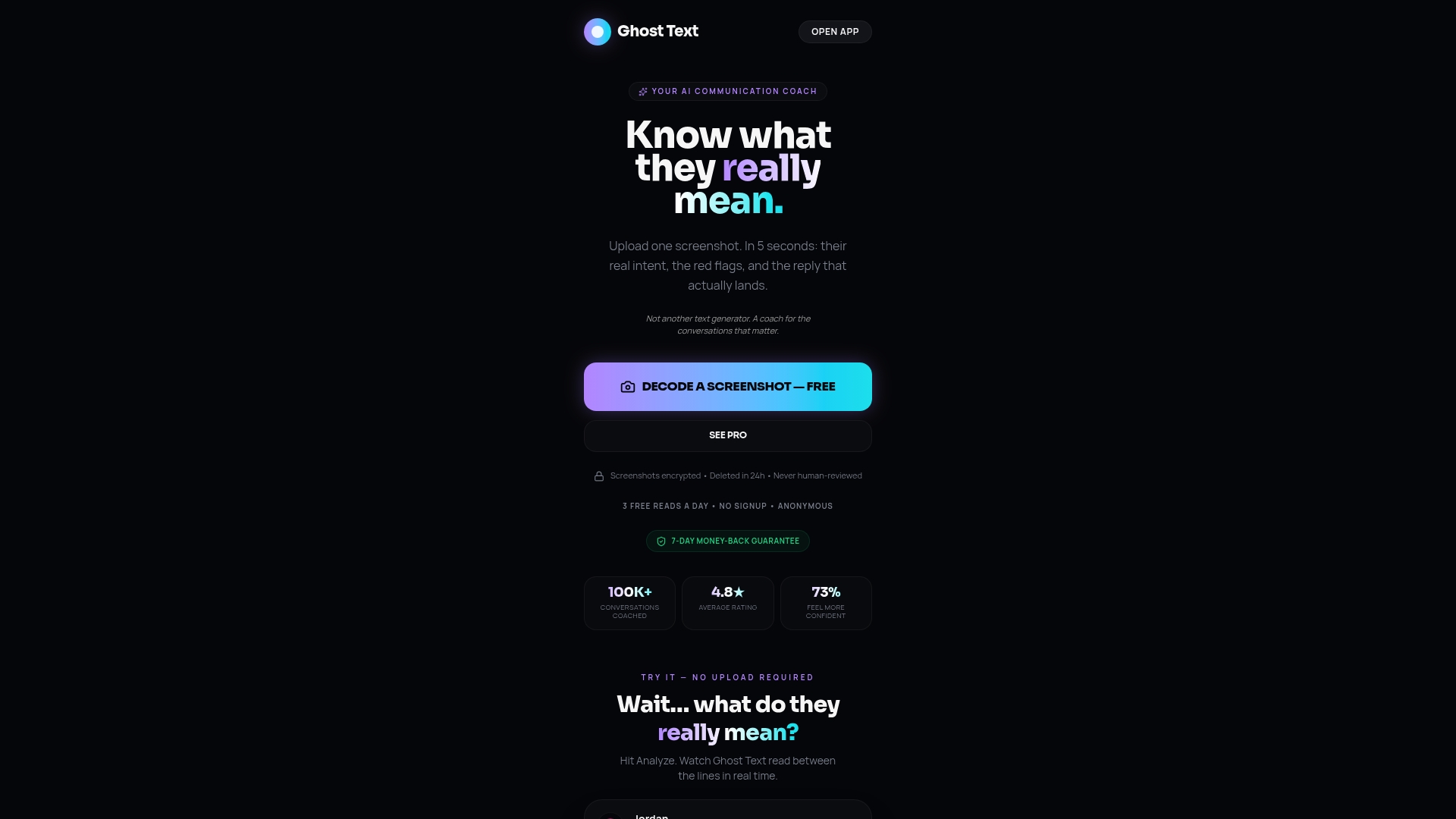
Paste a conversation or upload a screenshot, and Ghosttextai tells you what the tone actually signals — not just what the words say. It works across dating, friendships, family, and workplace threads, with reply suggestions you can adjust by tone and style. The free version covers a handful of reads. Ghost Text Pro unlocks unlimited analyses, advanced red flag detection, and premium reply personas for when the stakes are high enough to get it right.
Sources
- Why 'k' is the most hated text message, according to science
- 93 common texting abbreviations | Merriam‑Webster
- Is texting ‘k’ hurting your relationships? Here’s the truth about those abbreviated chats
- What Does K Mean in Text? And Why It Might Sound Rude