
Text tone meaning is the emotional intent and mood behind a written message, decoded through cues like word choice, punctuation, emoji, and timing rather than tone of voice or facial expression. Texts carry real, consistent signals people can read correctly, but interpretation is never pure math. When something matters, guessing is optional. Tools like Ghost Text and researchers like DSean exist precisely because texts reward a system, not a gut reaction.
TL;DR:
- Most interpretive errors come from inconsistent sender context, punctuation, emoji use, and formatting, which vary user to user.
- Negative emojis tend to carry more weight than positive ones, often overriding the surrounding words' tone.
- A single punctuation mark or reply pattern can signal finality, annoyance, or hesitation, depending on the sender's habits and context.
- Subjective perception often skews tone interpretation more than actual message content, which makes manual judgment or AI tools necessary.
- When ambiguity or escalation arise, switching from text to voice or in-person conversation is usually the most effective solution.
Table of Contents
- What Text Tone Meaning Actually Involves
- How Emoji, Punctuation, and Spacing Change What a Text Means
- Why You and Your Friend Read the Same Text Differently
- Real Text Examples and What They Actually Mean
- When to Stop Texting and Just Call
- Why AI-Assisted Tone Reading Still Needs a Human Check
- Try Ghost Text Before You Send Another Guess
- Sources
What Text Tone Meaning Actually Involves
Reading tone in text messages means combining several layers: what was literally typed, how it was formatted, who sent it, and what happened right before. None of these layers alone tells you the full story.
Here's a fast checklist to run through before you type a response:
- Sender context. What's your history with this person, and did anything happen in the last 24 hours that could color this message?
- Emoji valence. Does the emoji match the words, contradict them, or stand in for them entirely?
- Punctuation signals. A stray period, a string of exclamation points, or ALL CAPS all change the emotional temperature.
- Formatting choices. One-word replies, texts broken into multiple bubbles, or long paragraphs each signal something different about effort and mood.
- Response timing and length. A three-hour delay followed by two words reads differently than an instant, detailed reply.
- Quick word scan. Skim for obviously negative or positive language before assuming the worst (or best).
- Red-flag patterns. Sudden terseness, dodging direct questions, or a hard tone shift from the last few messages.
Run through those seven and you'll usually land on one of two outcomes: you're confident enough to reply, or you're not, in which case it's time to clarify or pick up the phone.
Pro Tip: Before responding to anything emotionally loaded, write out two competing interpretations, one generous and one worst-case, and notice which one you reached for first. That tells you as much about your own state of mind as the text does.
How Emoji, Punctuation, and Spacing Change What a Text Means
Small formatting choices carry outsized weight in text messages because they're standing in for tone of voice and facial expression, as explained in How to Preserve Formatting in Translation for Chat and Voice. A handful of research-backed patterns show up again and again:
- A neutral sentence tends to shift toward whatever emotion the attached face emoji conveys. Add a smiling emoji to "we need to talk" and it reads as casual. Add a frowning one, and the same words feel ominous.
- Negative emoji generally carry more interpretive weight than positive ones. A single skeptical or angry face can override several neutral or even mildly positive words around it.
- A period at the end of a short, one-word text like "fine." or "sure." often signals finality, annoyance, or a closed door, something that same word without punctuation rarely conveys.
- Breaking a message into several one-word texts, sent back to back, tends to mimic the rhythm and emphasis of speech, adding weight that a single combined sentence wouldn't carry.
- Repeated punctuation ("what???") or all caps generally raises perceived intensity or urgency, whether that's excitement or frustration depends entirely on context.
None of these signals work in isolation. A period after "okay." from someone who always punctuates carefully means nothing. The same period from someone who never uses punctuation is a flare. Recent research on punctuation as a pragmatic cue backs this up: format only shifts meaning relative to a person's normal texting habits, not against some universal standard.
That's the trap. Textisms are real signals, but they're read against a baseline you build over time with that specific person, and reading them against the wrong baseline is where most misfires happen.
Why You and Your Friend Read the Same Text Differently
Two people can stare at the identical message and walk away with opposite conclusions, and neither one is technically wrong. Emotion detection in text is inherently subjective, and readers unconsciously project their own mood, insecurities, and past experience onto ambiguous words.
Before reacting, run three quick questions:
- How am I feeling right now, and could that be coloring this?
- What do I actually, factually know versus what am I assuming?
- Is there context from earlier today or this week I might be missing?
Separate the literal words from your interpretation of them. If you catch yourself reading a delayed reply as rejection, ask whether that's the text talking or your own anxiety filling a gap the message never actually addressed.
Pro Tip: If your interpretation would sting either way, trust it and ask directly. If it only stings under one of your two possible readings, that's projection talking, not the text.
Real Text Examples and What They Actually Mean
1. The emoji-softened check-in. Context: a friend hasn't texted in days. Message: "hey, everything good? 😊" Interpretation: the smiling emoji pulls a potentially anxious question toward warmth and genuine curiosity, not judgment. Reply script: "All good! Been buried at work, let's catch up this weekend."

2. The negative-emoji flag. Context: a partner responding to weekend plans. Message: "sure, whatever works 😒" Interpretation: the eye-roll emoji overrides the agreeable words; something's bothering them. Reply script: "You sound kind of off, did I miss something?"
3. The terse period. Context: a friend after you cancel plans last minute. Message: "ok." Interpretation: a single-word reply with a period from someone who usually sends "okay!!" reads as controlled annoyance. Reply script: "I feel like that landed badly, want to talk?"
4. The mixed-signal flirt. Context: early dating, inconsistent texting pace. Message: "miss you... anyway how's your week been" Interpretation: the trailing dots and quick topic pivot suggest genuine feeling paired with hesitation to sound too eager. Reply script: "Miss you too. Free Thursday?"
5. The workplace clip. Context: manager replying to a project update. Message: "noted." Interpretation: brevity here likely reflects busyness, not disapproval, unless it breaks from their usual style. Reply script: "Happy to jump on a quick call if anything needs adjusting."
| Scenario | Key cue | Likely read | Safer response move |
|---|---|---|---|
| Emoji-softened check-in | Positive emoji | Genuine warmth | Match the casual tone |
| Negative-emoji flirt reply | Negative emoji | Hidden frustration | Ask directly, gently |
| Terse period after cancellation | Period + brevity | Suppressed annoyance | Name the shift, invite talk |
| Mixed-signal flirting text | Trailing punctuation | Interest with hesitation | Suggest concrete plans |
| Workplace one-word reply | Brevity, no emoji | Neutral, task-focused | Offer a call, stay neutral |
When to Stop Texting and Just Call
Some conversations shouldn't happen in text bubbles at all, no matter how good your read on tone is. Ask three questions when a message leaves you unsure:
- Is the topic sensitive? Breakups, family conflict, health, money, or performance feedback all lose nuance in text and gain risk of misread tone.
- Is the message genuinely ambiguous after your checklist? If two reasonable people could read it two opposite ways, text isn't precise enough to settle it.
- Is the exchange escalating? Short replies getting shorter, or a delay pattern that's getting longer, both suggest tension building faster than text can defuse.
A "yes" to any one of these means it's time to move to voice or in-person. Communication researchers consistently recommend shifting to a richer medium once a text thread starts generating more confusion than clarity.
For personal situations, try: "This feels like it deserves an actual conversation, can I call you tonight?" For work, keep it neutral and documented: "Want to make sure I understood this correctly, quick call at 2?" Both scripts name the shift without assigning blame.
Silence matters too. A short delay usually means nothing. A pattern of delay paired with shorter replies over several exchanges is worth a direct, low-pressure follow-up rather than another guess.
Why AI-Assisted Tone Reading Still Needs a Human Check
Ghost Text was built because interpreting a screenshot cold, without the sender's history or your emotional context, is exactly where people get stuck. The tool scans conversations for tone, intent, and red flags, then suggests replies grounded in the same textism research covered here. DSean's writing on the Ghost Text blog leans on that same evidence base. AI can flag patterns fast, but it doesn't replace your judgment about the specific person in front of you.
— DSean
Try Ghost Text Before You Send Another Guess
Ghost Text is the fastest way to get a second opinion on a confusing text without waiting for a friend to text back "wyd" and then weigh in an hour later. Upload a screenshot or paste the conversation, and you get tone analysis, red-flag detection, and a suggested reply in seconds instead of a group chat debate.
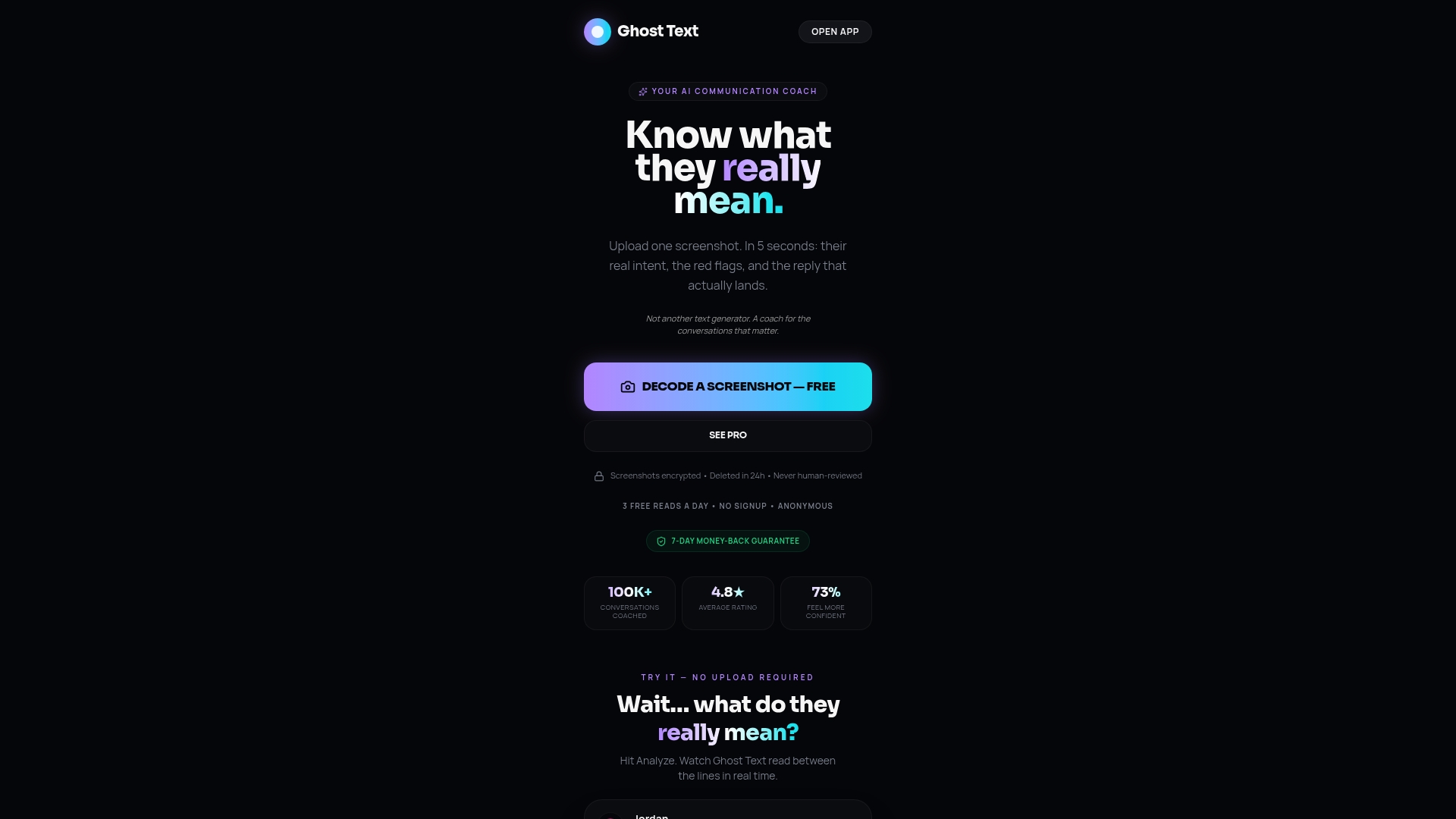
The free tier covers casual, everyday reads. Ghost Text Pro unlocks unlimited analyses, an interest meter for dating conversations, and sharper red-flag detection for patterns that build slowly across a thread, exactly the kind of context a single screenshot can't capture. Conversations you upload stay private and are never shared or sold. If a message has you rereading it for the fifth time, that's the signal to stop guessing. Try a free analysis on Ghost Text and see what your next reply should actually say.
Sources
- Mad or mad-mad: conveying subtle emotion with face emoji
- Six tips for reading emotions in text messages
- I get u. People correctly interpret the tone of text messages and emails