
The fastest way to save a flat "hey" text is to reply with a greeting plus one concrete thread, something specific enough to react to, like a question, a callback, or a quick detail from their profile. Mirroring "hey" back just creates two closed doors and no reason to keep talking. Everything below gives you exact wording to use depending on who sent it and what you want to happen next.
TL;DR:
- Respond with a greeting plus a specific handle, such as a question or detail from their profile, to keep the conversation moving.
- Use profile-based or playful replies that reference a photo or hobby to demonstrate genuine interest and prompt response.
- Match your reply to the sender’s investment level, responding proportionally to message length, timing, and relationship familiarity.
- Avoid echoing "hey," instead introduce a handle, and escalate to plans after two or three meaningful exchanges.
- Use AI tools like Ghost Text to analyze conversation tone and generate context-aware reply suggestions.
Table of Contents
- How to Respond to "Hey" Text: The Greeting + Handle Formula
- Quick Templates: Copy and Paste Replies by Style
- Which Response Type to Use When: A Quick Decision Guide
- Profile-Based Replies: Turning One Detail Into a Handle
- Playful, Flirty, and Confident Replies: Tone Rules That Keep It Safe
- When You Don't Want to Engage: Boundaries and Delay Tactics
- Common Mistakes That Kill Momentum (and Quick Fixes)
- How an AI Coach Like Ghost Text Helps You Pick the Right Reply
- How to Gauge the Sender's Intent Behind a "Hey" Text
- Cultural and Contextual Differences in Casual Greetings
- Strategies for Reviving a Stalled "Hey" Conversation
- Adapting Replies by Relationship Stage
- Why the Real Skill Is Reading Energy, Not Memorizing Lines
- Try Ghost Text for Reply Suggestions That Actually Fit the Conversation
- Sources
How to Respond to "Hey" Text: The Greeting + Handle Formula
The formula is simple: greeting, then a "handle," meaning one small, specific thing the other person can grab onto and respond to. That handle can be a question, a snapshot of your day, or a callback to something in their profile or previous chat. "Hey! Just got back from a run, how's your day going?" gives someone three things to respond to instead of zero.
This works because a bare "hey" is a closed loop. It doesn't ask anything, share anything, or point anywhere. When you reply with another "hey," you've just built a second closed loop on top of the first one, and conversations rarely survive two dead ends in a row, according to guides on how to respond to "hey" in text. The handle breaks that pattern by giving the other person an obvious, low-effort way to keep typing.
You don't need to overthink the handle. It can be as small as "hey, how's the week treating you?" The point isn't cleverness, it's momentum. A question mark does more work than a perfectly worded sentence.
Quick Templates: Copy and Paste Replies by Style
Pick the style that fits your mood, the platform, and how much you actually want this conversation to go somewhere. Here are ready-to-use options grouped by tone, each with a note on who it fits best.
- Profile-based one-liners (best for dating apps, new matches): "Hey! That hiking photo on your profile, where was that taken?" or "Hey, saw you're into [hobby], how long have you been doing that?" Swap in any detail from their bio or photos, even something small like a coffee mug in the background.
- Playful/witty one-liners (best for matches who seem relaxed or funny): "Hey yourself. Was that a proper greeting or are you just testing the waters?" or "Hey! Bold opener. I respect the confidence."
- Flirty/teasing replies (best once there's already some spark): "Hey. That's a lot of effort for one syllable, I'm impressed" or "Hey there. You've got about ten more words in you before I start judging your texting game." Keep these light and reversible, never anything that assumes physical intimacy before there's been a real conversation.
- Direct/confident replies (best when you want to skip small talk and move toward plans): "Hey! I'm around this weekend if you want to grab coffee" or "Hey, I don't love long text threads, want to just call or meet up?"
- Casual/open-question replies (best for low-stakes friends or slow-burn matches): "Hey! What's the best part of your week so far?" or "Hey, random question, what's your go-to comfort food?" A single relevant emoji or a well-placed GIF can soften a direct question without adding extra words.
Notice none of these repeat "hey" back as the whole message. Each one adds a handle. That's the entire trick.
Which Response Type to Use When: A Quick Decision Guide
Match your reply to how much the sender actually invested. A one-word "hey" at 2 a.m. from someone you matched with three days ago carries different weight than "hey :) hope your week's going well" from someone you've been chatting with daily.
Read investment through three signals: message length, timing, and relationship history. A longer message, a thoughtful send time, or an established rapport all suggest real interest and deserve a real answer. A lazy one-word "hey" with no follow-up, especially from a stranger, deserves a proportionally lazy reply, or none at all.
- Friend: match their casual tone, reference something recent between you.
- Dating app match: lean profile-based or playful, since profile-referencing replies signal you're a real person paying attention, not a mass-messaging bot.
- Stranger: stay neutral and low-commitment until you know more.
- Coworker: keep it professional but warm, one clear handle about work or plans.
- Ex: short, boundaried, or silent, depending on what you actually want.
If they send one word, send one sentence. If they send a paragraph, match the length but keep your reply focused on a single thread so the conversation doesn't sprawl before it's even started.*
Escalate to an actual plan once you've traded two or three real exchanges, not just greetings. If someone's already asking about your schedule, that's your cue to suggest a time instead of another round of chat.
Profile-Based Replies: Turning One Detail Into a Handle
Dating profiles are full of free material. Use it. The fill-in-the-blank version looks like: "Hey! [Specific detail from photo/bio], [question about it]?"
- "Hey! Is that your dog in the third photo? What's their name?"
- "Hey, saw you've traveled to [place], what was the best part of that trip?"
- "Hey! Your prompt about [topic] made me laugh, what's the story there?"
- "Hey, fellow [shared interest] fan, what got you into that?"
- "Hey! That book on your shelf in photo two, worth reading?"
Specificity does two things at once. It proves you actually read their profile instead of swiping and copy-pasting the same line to twenty people, and it gives the other person something concrete to answer instead of a generic "haha thanks."
Skip this approach when the profile is basically empty, just a name and one blurry photo with no bio. There's nothing to reference, and forcing it makes the reply feel strained. In that case, a playful hypothetical ("Hey, if you had to guess my job from this photo, what would you say?") or a confident direct ask works better than fishing for a detail that isn't there.
Playful, Flirty, and Confident Replies: Tone Rules That Keep It Safe
Flirting works best when it stays light enough to walk back without awkwardness. A few reliable moves:
- Playful tease: "Hey. Bold of you to lead with the classic."
- Light flirt: "Hey there, you've got my attention already."
- Confident ask: "Hey! I'm free Thursday if you want to actually meet instead of just texting."
Keep flirting reversible. No sexual escalation in the first few messages, and watch for reciprocal energy before you push further; if their replies stay short or flat, dial it back. A quick way to test tone before committing to a longer message is a one-line micro-check: "Hey, quick question, are you around this weekend? No worries if not." It signals interest without demanding a big response.
When You Don't Want to Engage: Boundaries and Delay Tactics
Not every "hey" earns a reply, and that's fine. A few honest scripts:
- Not now: "Hey, kind of swamped this week, I'll reach out when things calm down."
- Slow reply, on purpose: wait a few hours or a day before responding to low-effort messages; it's a natural way to signal reduced interest without confrontation.
- One-line shutdown: "Hey, appreciate it, but I don't think we're a match."
- Repeated low-effort messagers or exes: keep it short and final, "Hey, I'm good, but I don't think this is going anywhere."
Ignoring a message is itself a complete response in plenty of situations, especially with exes, unknown numbers, or someone who's sent nothing but "hey" three separate times without a follow-up, according to guidance on how to respond to "hey". Silence communicates disinterest just as clearly as words do, without the extra effort.
Common Mistakes That Kill Momentum (and Quick Fixes)
Three habits reliably stall a conversation before it starts:
- Echoing "hey" back. Fix: add a handle, any question or detail works.
- Leaning on sarcasm too early. Fix: save sharper humor for once you know their tone actually lands well.
- Oversharing in the first reply. Fix: keep the first message focused on one thread, not your whole week.
The one-line fix for almost every stalled chat is the same: greeting plus handle and matched energy, giving a clear path toward a plan once there's real back and forth.
How an AI Coach Like Ghost Text Helps You Pick the Right Reply
Reading tone from a screen is genuinely hard, especially with a vague opener like "hey." Ghost Text analyzes screenshots or pasted conversations to flag tone, intent, and possible red flags, then suggests replies matched to that context, helping you learn how to humanize AI text with instructions for more authentic replies. Two quick uses: sharpening a dating-app opener before you send it, or figuring out whether an ambiguous "hey" from an ex deserves a response at all.
How to Gauge the Sender's Intent Behind a "Hey" Text
The message itself carries clues once you know where to look. Timing matters: a "hey" sent at midnight reads differently than one sent at noon on a Tuesday. Frequency matters too. Someone who's texted "hey" three times over two weeks with no follow-up questions is probably not that invested, regardless of what they'd say if asked directly.
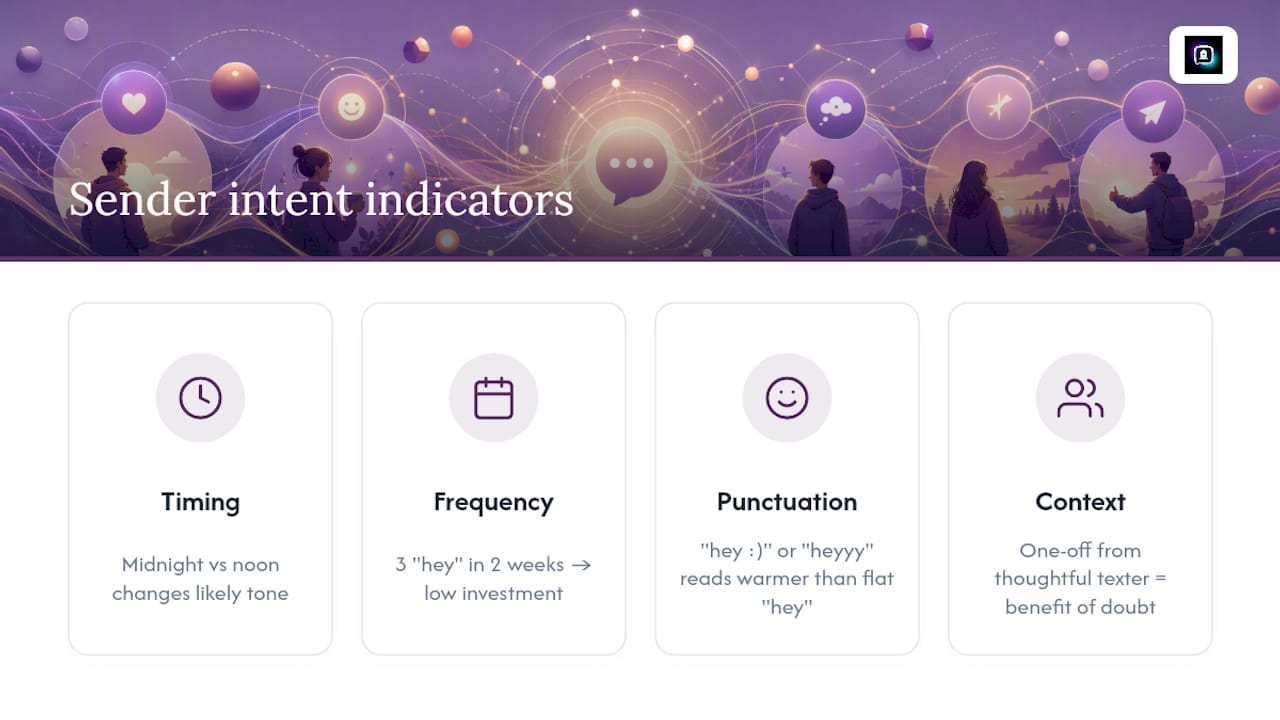
Punctuation and length offer more signal than people expect. "Hey :)" or "heyyy" often carries warmer intent than a flat "hey" with no punctuation at all. A "hey" that arrives right after you posted a new photo or story suggests it was prompted by something specific, which is itself a small handle you can use in your reply.
Context outside the message matters as much as the text itself. Has this person reached out first before, or do they only respond when you initiate? Do they double-text when you don't reply fast, or let it drop? Patterns over multiple exchanges tell you more than any single word choice. A one-off vague "hey" from someone who's otherwise been a thoughtful texter deserves the benefit of the doubt. The same message from someone who only ever sends one-word texts probably means exactly what it looks like: low effort, low investment.
Cultural and Contextual Differences in Casual Greetings
"Hey" doesn't mean the same thing in every context, and treating it as one universal signal is a mistake. In professional messaging, a coworker's "hey" is often just a placeholder before a work request, not an invitation for banter, so match that register with something equally brief and task-focused. In close friendships, "hey" might be shorthand for "I'm bored, entertain me," which opens the door for a much more casual, joke-heavy reply than you'd send a new match.
Generational and regional texting habits shift the read too. Some people use "hey" as their default opener for everything, from casual check-ins to serious conversations, while others reserve it specifically for low-stakes moments. On dating apps, cultural norms around directness vary: some daters expect a flirtier, faster-paced exchange, while others prefer several rounds of low-key small talk before anything playful. If you're unsure which camp someone falls into, a neutral, friendly handle, something like a simple question about their day, works across nearly every context without misreading the room.
Strategies for Reviving a Stalled "Hey" Conversation
A conversation that died after "hey, how's it going" isn't necessarily over. The easiest revival move is a fresh handle unrelated to the original dead end: reference something new, a show, an event, a random thought, rather than trying to resuscitate the exact thread that stalled.

Timing the revival matters. Reaching out a day or two later with something like "Hey, random thought, have you seen [show/event]?" reads as natural rather than desperate, especially compared to sending three follow-up messages within an hour of the original silence. If the stall happened because your first reply was too flat, don't just try again with more of the same energy, actually add color this time: a specific detail, a light joke, an actual question.
Sometimes the honest move is to name the stall directly: "Hey, feel like our conversation lost steam, what's something you're excited about lately?" This works particularly well with people you've already built some rapport with, since it treats the awkward pause as something worth acknowledging rather than pretending it didn't happen. If two or three genuine revival attempts get nothing back, that's usually your answer, and it's a good moment to let it go rather than keep pushing.
Adapting Replies by Relationship Stage
A new match and a close friend should never get the same "hey" reply, even if the words look similar on the surface. With a brand-new acquaintance or match, lean on profile-based handles and lighter, safer questions since you're still establishing whether there's mutual interest worth pursuing. Save the flirtier or more direct language for once you've traded a few real exchanges.
With an established friend, you can skip the introductory framing entirely. "Hey" from a close friend usually means "I have something to tell you" or "I'm bored," so a reply like "Hey! What's up?" or even just jumping straight into a specific question about their day fits better than anything formal. The handle still matters, but it can be much more casual, an inside joke, a shorthand reference, something that would confuse a stranger but lands instantly with someone who knows you.
Somewhere in between sits the acquaintance you've known a while but don't text often, a former coworker, a friend of a friend. Here, a slightly warmer version of the profile-based approach works: reference something you actually know about their life, a job change, a move, a shared event, rather than falling back on generic small talk.
Why the Real Skill Is Reading Energy, Not Memorizing Lines
Most advice about texting treats it like a script problem, find the perfect line, and the conversation takes care of itself. That's backwards. The actual skill is reading how much energy someone put into their message and deciding, on purpose, how much to give back. A "hey" is rarely just a word; it's a small test of whether you'll do the emotional labor of carrying the conversation or split it evenly.
One quiet truth: sending the exact right reply matters less than sending it with intention instead of reflex.
— DSean
Try Ghost Text for Reply Suggestions That Actually Fit the Conversation
Guessing at tone from a two-word text gets old fast, especially when the stakes feel higher than they should for something this small. Ghost Text reads the actual conversation, screenshots or pasted text, and flags tone, intent, and potential red flags before you commit to a reply, then suggests wording that matches the situation instead of a generic template.
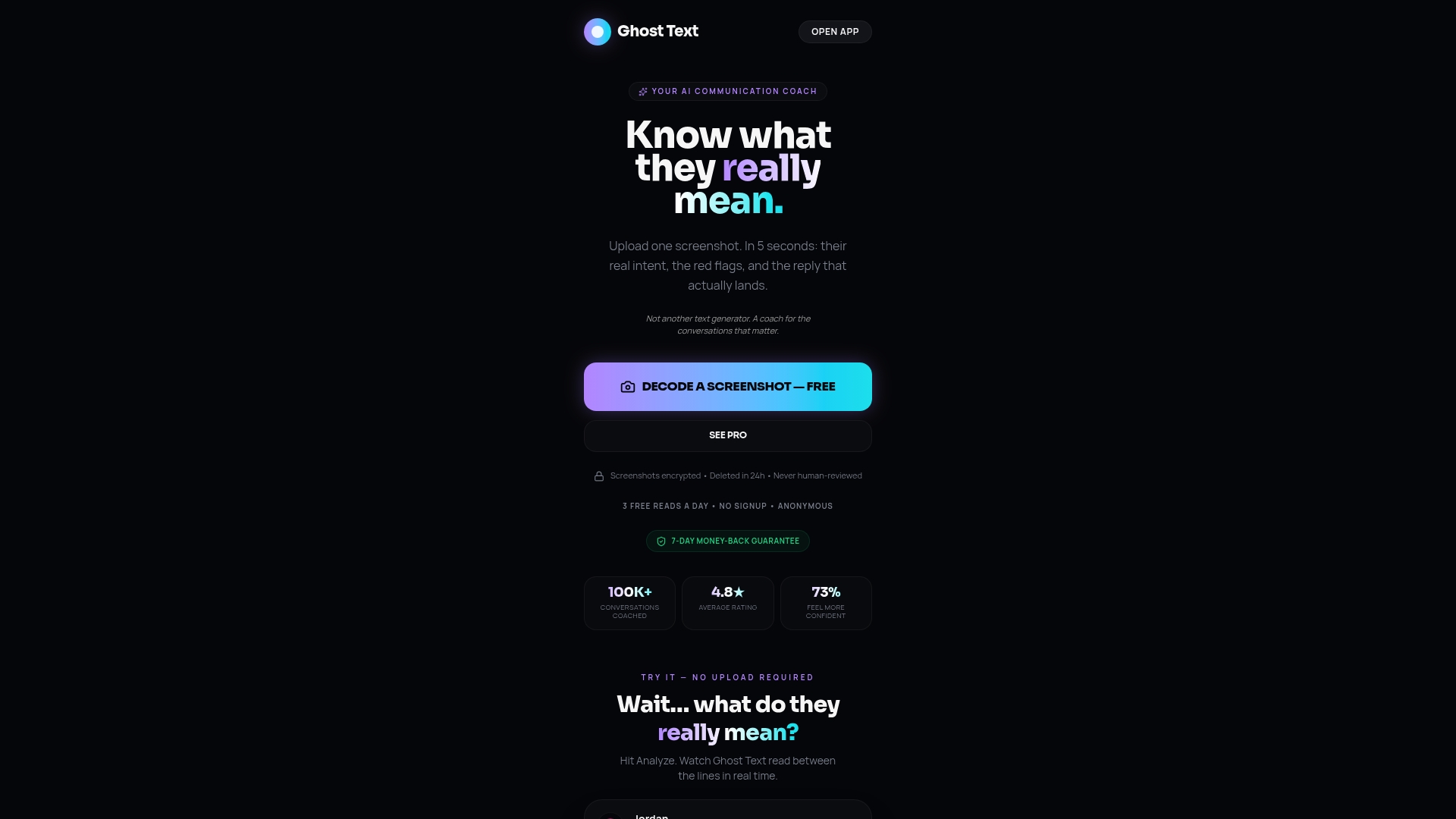
The free tier lets you check a few conversations without committing to anything, and Ghost Text Pro unlocks unlimited reads, sharper red-flag detection, and more tailored reply options for people who want ongoing help across dating, friendships, or work messages. If you're staring at a "hey" text right now trying to decide what it means, paste it in and see what comes back. Start free at Ghost Text.