
A passive aggressive text is a message that carries hostility, resentment, or blame through its structure, timing, or brevity instead of through actual words. The sender gets to deny they meant anything by it. That's the whole design.
If you just got one, don't reply yet. Take ten seconds to name what you're feeling and pick one goal for your response: repair the relationship, set a boundary, disengage, or ask to talk in person.
Watch for these quick tells:
- A period slapped on a short reply, like "Fine."
- One word and nothing else: "K."
- "I'm not mad" (sent unprompted)
- A reply that took much longer than usual
Pro Tip: Before you type anything, ask yourself what you actually want out of this exchange. A reply written to win feels completely different from one written to fix something.
Key Takeaways
Passive aggressive texts rely on structure, punctuation, timing, and brevity, to convey hostility while preserving the sender's deniability, and the best defense is naming your feeling and picking one clear reply goal before responding.
| Point | Details |
|---|---|
| Structure carries the hostility | Periods, single words, and delayed replies do the emotional work that explicit language would normally carry. |
| Lock in your feeling first | Name your reaction and choose one goal, repair, boundary, disengage, or talk, before typing anything. |
| Skip the "are you mad?" question | Observation statements about impact work better than confrontational questions that invite denial. |
| Patterns matter more than single texts | One short reply is often nothing; the same behavior repeated is a real signal worth addressing. |
| Use tools for an objective read | Ghost Text can analyze a screenshot and suggest replies matched to your goal when you're too close to the conversation to read it clearly. |
Table of Contents
- Examples of Passive Aggressive Texting and the Signals Behind Them
- Why Punctuation and Timing Read as Hostile
- How to Respond to Passive Aggressive Texts Without Escalating
- Common Passive Aggressive Phrases and What to Say Instead
- When to Ignore It and When to Set a Boundary
- How Ghost Text Helps You Decode Mixed Signals
- What Actually Matters When You're Decoding These Texts
- Sources
Examples of Passive Aggressive Texting and the Signals Behind Them
Some texts are hostile in plain sight. Passive aggressive ones hide it in the delivery. Here's what that looks like in practice.
- The one-word period bomb. "Fine." or "K." Nothing else. The period does the emotional work a full sentence would normally carry.
- The denial preload. "I'm not mad" sent before anyone accused them of being mad. It's a preemptive strike disguised as reassurance.
- The martyr offer. "No, it's fine, I'll just handle it myself." Sounds generous. Functions as a guilt trip.
- The praise-bury. "Wow, you actually remembered this time!" A compliment wrapped around a jab.
- The concern dagger. "Are you sure you want to wear that?" Framed as caring, aimed to undercut.
- The withdrawal signal. No text at all, after weeks of daily check-ins. Silence becomes the message.
Timing matters as much as wording. When a friend who usually responds quickly suddenly delays repeatedly and pairs this with clipped replies, it can usually be a signal. Structural analyses of passive-aggressive texting identify these exact patterns, weaponized agreement, martyr offers, praise-bury, concern daggers, as the most reliable markers, more reliable than any single word choice.
Here's a mock exchange showing the shift:
You: "Hey, running late, sorry!" Them: "K."
That single letter, no emoji, no "no worries," does more damage than a paragraph of complaints would.
Why Punctuation and Timing Read as Hostile
A period at the end of a two-word text isn't neutral. A 2015 Binghamton University study found that adding a period to a short reply like "Yup." made it read as less friendly and more negative than the identical word without one.
That finding matters because texting strips out everything that normally carries tone: facial expression, vocal pitch, pause length. Readers fill that gap with whatever structural clues are left, capitalization, punctuation, response time, and periods have become one of the strongest substitutes. NPR's reporting on texting and punctuation notes that younger adults in particular read a period as a marker of seriousness or finality, almost like a verbal full stop dropped mid-conversation.
This is exactly why passive-aggressive texts work so well as a tactic. The structure gives the sender total deniability.
That's the double bind. Call it out, and you look oversensitive for reacting to punctuation. Say nothing, and the hostility lands anyway. Confronting the sender directly ("are you mad?") almost always gets you denial or deflection, because you've just handed them the exact question they can dodge.

How to Respond to Passive Aggressive Texts Without Escalating
Start before you type a single word: name how the message made you feel, then choose one goal. Are you trying to repair things, draw a line, exit the conversation, or move it to a real conversation? Pick one. Trying to do all four in one text is how replies spiral.
A few tactics make this easier:
- Use observation statements, not accusations. "That reply felt dismissive" lands differently than "Why are you being so passive aggressive?" Practitioner guidance on responding to these texts recommends naming impact rather than demanding a confession, since forced-choice questions like "are you mad?" just give the sender an easy exit.
- Run the screenshot test. Before hitting send, ask if you'd be fine with this reply shown to someone else. If the answer is no, it's probably reactive.
- Match your script to your goal.
Here are four short scripts, pick the one that fits what you actually want:
- Validate and invite: "I noticed your reply felt short. Everything okay? Happy to talk if something's up."
- Set a boundary: "I'd rather we talk directly than through one-word texts. Can we hop on a call?"
- Brief disengage: "Got it, talk soon." (Send it, then step away from your phone.)
- Request real conversation: "This feels like something better discussed in person. Free tomorrow?"
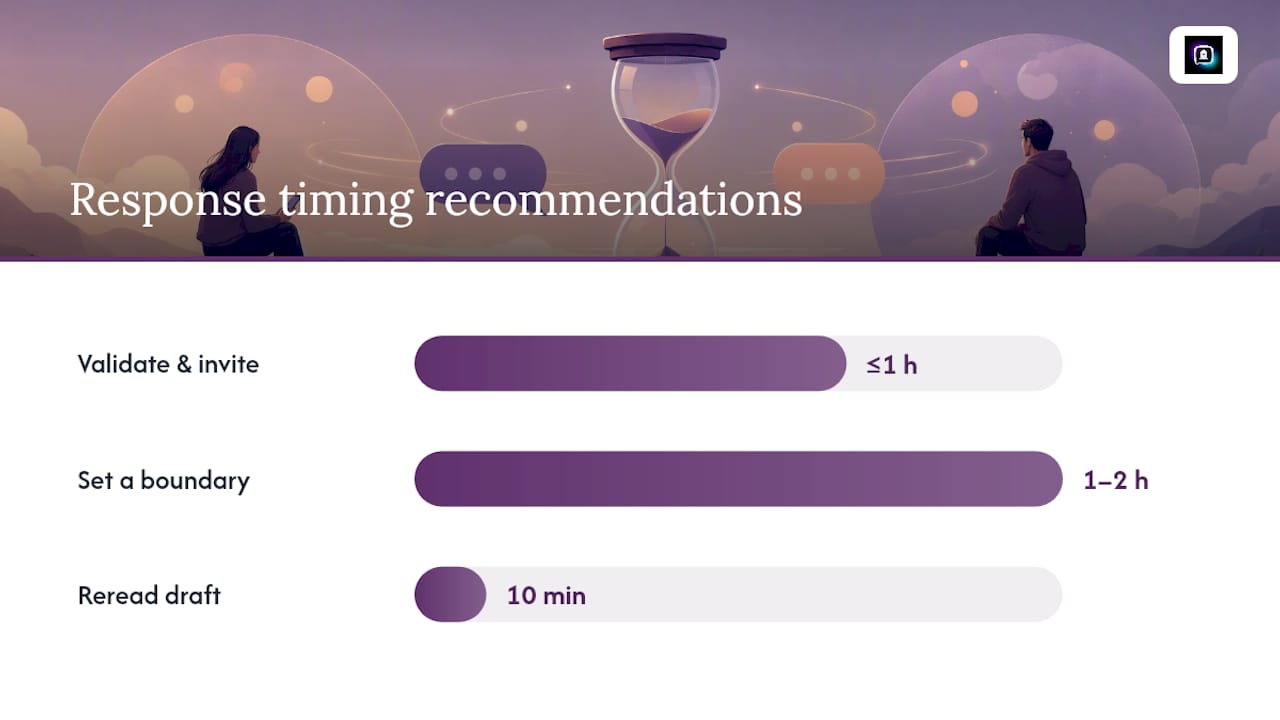
Send validate-and-invite scripts quickly, within the hour, while the moment is still fresh. Boundary scripts land better with a little distance, an hour or two of cooling off keeps them from sounding reactive. For a full walkthrough on wording de-escalating replies, see calm reply templates for difficult messages.
Pro Tip: Never send a boundary-setting text the same minute you read the message that triggered it. Draft it, close the app, and reread it after ten minutes. Half the sting usually disappears on the second read.
Common Passive Aggressive Phrases and What to Say Instead
Not every clipped text deserves the same response. Some call for humor, others need a firm line. The table below breaks down the most common phrases, what they typically signal, and a short reply that moves things forward instead of feeding the standoff.
| Phrase Received | What It Usually Signals | Suggested Reply |
|---|---|---|
| "Whatever." | Dismissal, shutting down the topic | "Seems like this bugged you more than 'whatever' suggests. Want to talk?" |
| "I'm not mad." | Denial of anger, preemptive defense | "Okay, just checking. I want us to actually be good." |
| "Fine." | Reluctant compliance masking resentment | "'Fine' sounds like it's not actually fine. What's going on?" |
| "Must be nice." | Envy or resentment disguised as observation | "Sounds like there's something behind that. What's up?" |
| "K." | Curt withdrawal, minimal engagement | "Feels like I caught you at a bad time, we can talk later." |
| "No worries!!" (after a real issue) | Overcorrected cheerfulness hiding annoyance | "I want to actually check, was that okay or not?" |
Dial up humor with people you trust and when the stakes are low, a late reply from a close friend, say. Save the firm boundary language for repeated patterns or anything involving a partner, family member, or coworker where the behavior affects your day-to-day. For more on decoding one-word replies specifically, what "K" really means in a text breaks down that particular pattern in more depth.
When to Ignore It and When to Set a Boundary
Not every clipped reply deserves a response. Some heuristics help you decide fast:
- Check if it's a pattern or a one-off. A single short reply during a busy week is probably nothing. The same behavior three times in a month is a pattern worth naming.
- Weigh the relationship's value. A distant acquaintance's snippy text usually isn't worth your energy. A partner's recurring silent treatment is.
- Consider safety and stability. If the behavior escalates into anything threatening or coercive, that's no longer a texting issue, move the conversation offline and involve someone you trust.
- Default to ignoring low-stakes, isolated incidents. Save direct confrontation for recurring harm that's actually damaging the relationship.
- Phrase the boundary without attacking character. "I need us to talk this through by phone instead of text" protects your position without accusing the other person of being manipulative.
Low-stakes and rare gets ignored. Recurring and damaging gets a boundary. Everything else is a judgment call based on how much the relationship matters to you.
How Ghost Text Helps You Decode Mixed Signals
Reading tone from a screen is genuinely hard, even when you know what to look for. Ghost Text analyzes the exact conversation you're stuck on, screenshots or pasted text, and flags tone, likely intent, and emotional signals so you're not guessing alone.
- Get an objective read on whether a message is actually hostile or just brief
- See reply variations matched to your goal (repair, boundary, disengage)
- Catch red flags in patterns you might not notice you're used to
For more scripts on cooling down a tense exchange, scripts that lower the temperature covers additional real-world phrasing.
What Actually Matters When You're Decoding These Texts
Most advice on this topic jumps straight to scripts, here's what to text back, without explaining why the message stung in the first place. That's backward. The Binghamton research on punctuation matters because it proves you're not imagining things: a period genuinely does change how a message reads. That's worth knowing before you write yourself off as "too sensitive."
Where conventional advice falls short is treating every clipped text as equally serious. It isn't. A one-off short reply during a hectic week means nothing. The same clip, delay, and one-word answer showing up for the third time this month is a pattern, and patterns are what deserve a boundary, not a single message taken out of context.
Prioritize this order: notice the pattern, name your own feeling, pick one goal, then write the reply. Skipping straight to a clever comeback is how texting fights spiral. Tools that give you an outside read, like Ghost Text, are useful precisely because they interrupt that reactive loop before you hit send.
— DSean
Sources
- Study: Punctuation in text messages helps replace cues found in face-to-face
- Are your texts passive-aggressive? The answer may lie in your punctuation (NPR)
- How to respond to a passive-aggressive text | DeftBrain