
If a texter you've never met in person quickly asks to move off the dating app, dodges every video call, or brings up money within the first few weeks, treat the conversation as high risk. Those three moves, alone or together, are the pattern behind most romance and relationship scams.
Scan for these first:
- Money requests — gift cards, wire transfers, or crypto, especially tied to a sudden "emergency."
- Push to private apps — a fast move to WhatsApp, Telegram, or Line, paired with refusal to video call.
- Overnight intensity — declarations of love within days, plus pressure or guilt when you ask questions.
If you spot any such warning signs, pause before replying, verify who you're talking to, and save your messages before they can be deleted.
Key Takeaways
Money requests, pressure to move off-platform, and refusal to video call together form the most reliable early signal of a romance or relationship scam.
| Point | Details |
|---|---|
| Money asks are the biggest tell | Gift cards, wire transfers, and crypto requests dominate reported cases because they can't be reversed. |
| Off-platform moves cut off safety nets | Pushing you to Telegram or WhatsApp early removes reporting tools and traceability. |
| Refused video calls equal failed verification | Repeated excuses to avoid a live, unedited call should be treated as a major warning sign. |
| Preserve evidence before you block | Export chats and screenshot timestamps first; screenshots alone can be disputed later. |
| Ghost Text adds a second read | Upload a suspicious thread to Ghost Text for tone and red-flag analysis alongside formal reporting steps. |
Table of Contents
- Scam Text Red Flags: A Checklist From Obvious to Subtle
- Why These Tactics Work: the Manipulation Arc
- What to Do Right Now: Verify, Preserve, Protect
- When to Get Help and How to Report It
- Sources
Scam Text Red Flags: A Checklist From Obvious to Subtle
Not every warning sign carries equal weight. Some flags mean stop immediately. Others just mean pay closer attention. Here's how to sort them.
High-confidence flags: stop and verify
1. Unsolicited or urgent money requests
Anyone asking for gift cards, wire transfers, or cryptocurrency, particularly framed as an emergency, a customs fee, or an "investment opportunity," is running the oldest play in the book. The FTC's guidance on romance scams confirms these payment methods dominate reported cases because they're nearly impossible to trace or reverse. Scammers pick them on purpose.

Check it: ask why a bank transfer or check won't work. A real partner, friend, or colleague can explain. A scammer will get evasive or angry.
2. Requests to move off-platform fast
You match on a dating app Monday, and by Wednesday they're pushing you to text or switch to Telegram. Homeland Security Investigations has flagged this as a deliberate tactic in digital romance scams, designed to strip away the platform's safety tools and reporting features before things get financial.
Check it: ask why the switch is urgent. "I don't check this app much" is common and often true. "This app isn't safe, let's talk somewhere private" from someone you just met is not.
3. Repeated excuses to avoid meeting or video calling
Working on an oil rig. Deployed overseas. Camera's broken, again. A Secret Service breakdown of romance scam tactics lists claims of living or traveling abroad as one of the most consistent excuses scammers use to avoid ever being seen live.
Check it: ask for a short, unedited video call with a specific, unpredictable request, like holding up three fingers or saying today's date out loud. A refusal or another excuse is functionally a failed identity check.
4. Sudden declarations of love or intense pressure
"I've never felt this way about anyone" after four days of texting isn't romantic, it's a script. Love-bombing compresses months of normal relationship pacing into a week, and it works because it feels flattering. Our breakdown of love bombing texts covers how to tell genuine enthusiasm from manufactured urgency.
Medium-confidence flags: pay closer attention
- Inconsistent personal details. Their job changes, their hometown shifts, or their age doesn't match their photos. One slip is human. Three is a pattern.
- Minimal or fake social presence. A profile with three photos, no tagged friends, and an account created last month.
- Generic or mismatched photos. Model-quality images that don't match casual selfies elsewhere, or a profile pic that shows up on a reverse-image search under a different name.
- Grammar that doesn't fit the claimed background. A supposed lifelong Texan writing with phrasing patterns common in scam scripts translated from another language.
Pro Tip: Drop a suspicious profile photo into a reverse-image search before you invest another conversation in it. It takes fifteen seconds and it's one of the few checks a scammer genuinely can't fake.
Why These Tactics Work: the Manipulation Arc
Romance scams follow a script, and it's the same reason it works on smart, skeptical people: it's built around trust, not gullibility. Research on online grooming and manipulation describes a consistent arc: attention, then intimacy, then isolation, then exploitation. Each stage sets up the next.
- Attention looks like genuine interest, mirrored hobbies, and constant availability.
- Intimacy arrives fast, pet names, future plans, "soulmate" language within days.
- Isolation shows up as requests to move to private messaging and to keep the relationship secret from friends or family.
- Exploitation is the ask, money, personal information, or explicit images used for leverage.
That third stage matters more than people realize. Research on grooming and manipulation dynamics notes that requests to delete messages or shift to private apps are common escalation signals precisely because they cut off outside visibility. Once a conversation moves off a dating platform, there's no algorithm flagging odd behavior and no easy way to report the account — learn more about how AI models detect risky conversations in our AI Behavioural Threat Detection Guide. The Secret Service's own guidance describes a recognizable script: fast personal mirroring, a push for secrecy, a move to private chat, then a manufactured emergency requiring money through channels that can't be refunded. Spot two adjacent steps in that sequence, and suspicion is warranted.
What to Do Right Now: Verify, Preserve, Protect
Once you've spotted a real red flag, what you do in the next hour matters more than what you do next week.
Don't:
- Send money, gift cards, or crypto, no matter how urgent the story sounds.
- Share verification codes, ID scans, or Social Security numbers.
- Comply with pressure or guilt tactics just to "prove" you trust them.
Verify: 4. Ask for a live, unedited video call with a specific, unpredictable action attached. 5. Reverse-image search their profile photos. 6. Look for a consistent footprint: tagged friends, older posts, a work history that checks out.
Preserve: 7. Screenshot everything, including timestamps, before you block or confront anyone. 8. Export the full chat log where the platform allows it. Screenshots can be edited; exported logs and message IDs are harder to dispute later, which matters if you ever need to file a report. 9. Save profile URLs and usernames before an account gets deleted.
If money already changed hands: 10. Contact your bank, card issuer, or payment app immediately and report it as fraud.
Pro Tip: Before you block someone you suspect is scamming you, take five minutes to screenshot the entire thread. Once they're gone, so is your evidence.
When to Get Help and How to Report It
Some situations call for more than caution, they call for reporting. If you've lost money, received threats, or are being blackmailed with private photos (sextortion), it's time to escalate beyond just blocking the account.
- Report on the platform using its built-in fraud or abuse tool first, since that flags the account for other users.
- File with ReportFraud.ftc.gov if money, personal data, or an investment scheme was involved.
- Contact local police if you're facing threats, extortion, or blackmail.
- Call your bank or payment provider the moment finances are affected, even a small amount.
- Talk to someone you trust. A friend or family member outside the situation often spots what you can't, and there's no shame in having been targeted. These scams are built by people who do this professionally.
A note on why this matters to us
Ghost Text exists because tone and intent are hard to read in the moment, especially when someone's working hard to manipulate how you feel. DSean and the Ghost Text team write ongoing guidance on exactly these patterns. If you're reading this because something feels off, that instinct is worth trusting. Getting scammed isn't a character flaw. Preserving evidence and getting help matters more than blame.
— DSean
Let Ghost Text Read the Tone You're Too Close to See
Ghost Text is built for exactly the moment you're in right now, staring at a message thread wondering if the affection is real or the excuses are scripted. Upload the conversation or a screenshot, and it flags tone shifts, urgency language, and the kind of escalation patterns covered above, then suggests replies that buy you time to verify without tipping off a manipulator.
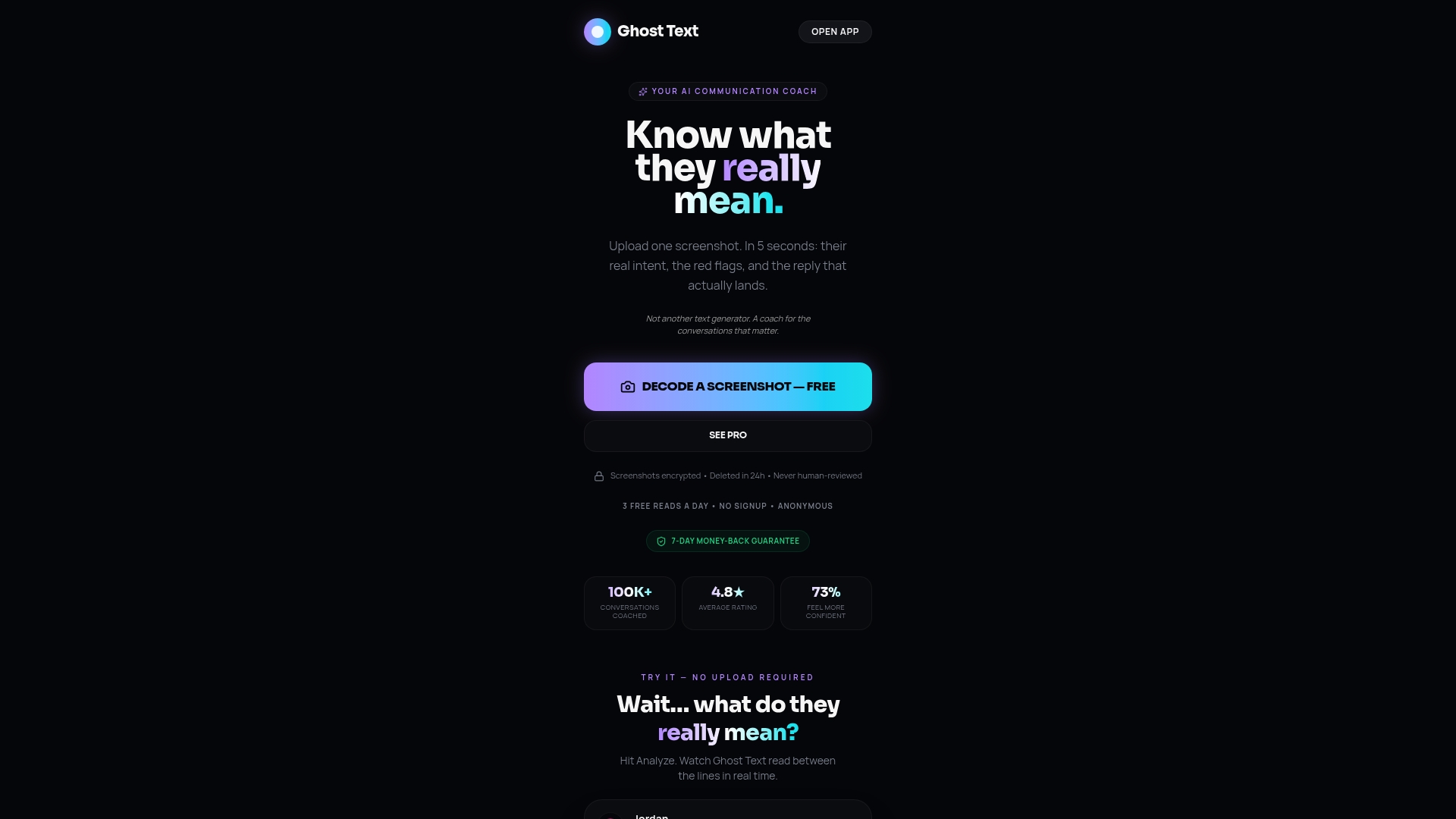
It won't file a police report or call your bank, and it's not a substitute for ReportFraud.ftc.gov when money's on the line. What it does is give you a second, unemotional read on a conversation before you respond. Start a free read of your current thread at Ghost Text and see what the tone actually says.
Sources
- Protect Yourself Against Romance Scams | Secret Service
- What to know about romance scams | FTC
- PMC article on online grooming and manipulation