
Text for anything quick, logistical, or worth keeping a record of. Call for anything urgent, emotionally loaded, or complicated enough that back-and-forth typing would waste time. That's the whole rule.
The exceptions matter, though. Late at night or early morning, text unless someone's hurt. If a person has a hearing issue or is driving, skip the call. And if you're not sure which category a conversation falls into, ask yourself one question: would this be easier to resolve in one voice exchange than in ten text bubbles?
Before you send anything, run this checklist:
- Does this need a written record (address, time, confirmation)? Text.
- Is there real emotion, tension, or nuance involved? Call.
- Is it urgent and the person might not check their phone for a while? Call.
Key Takeaways
Choosing between a text and a call comes down to three factors: how urgent the message is, how much emotion it carries, and whether you need a written record.
| Point | Details |
|---|---|
| Text for logistics | Use texting for scheduling, confirmations, and anything worth keeping in writing. |
| Call for emotional weight | Voice calls build more closeness than text, even though people expect calls to feel awkward. |
| Calls resolve conflict faster | Spoken disagreements produce fewer negative emotional expressions than the same disagreement in text. |
| Escalate after a few unclear replies | If a text thread hits five or six rounds without resolving, switch to a call. |
| Check tone before you decide | Tools like Ghost Text can flag ambiguous tone in a text thread so you're choosing a channel based on what a message actually says, not a guess. |
Table of Contents
- Text vs Call: Where Texting Wins
- Text vs Call: Where Calling Wins
- A 30-Second Framework for Choosing the Channel
- What the Research Actually Shows
- Etiquette and Timing Rules That Actually Work
- Why the Channel You Pick Changes the Relationship
- Try Ghost Text Before Your Next Hard Conversation
- Sources
Text vs Call: Where Texting Wins
Texting wins on convenience, and convenience isn't a small thing. A JMIR survey found most people read nearly every text they get and treat texting as the fastest way to reach them, often responding within minutes. That's the opposite of what most people assume about a "slower" channel.
Texting also gives you three practical advantages calling can't match:
- Asynchrony. The other person answers on their schedule, not yours, which lowers pressure on both sides.
- A paper trail. Addresses, times, prices, and confirmations live in the thread forever, so nobody has to remember them.
- Low emotional stakes. A quick "running 10 minutes late" doesn't require either person to perform enthusiasm or tone.
Think group logistics, appointment reminders, sending a link, or confirming you're outside. None of that needs a voice.
Pro Tip: If you find yourself typing three paragraphs to explain something simple, that's usually a sign the conversation wants a phone call instead.
Text vs Call: Where Calling Wins
Calling wins the moment nuance matters more than speed. A 2020 University of Texas study found that phone calls create noticeably stronger feelings of connection than text exchanges, even though the participants had predicted the opposite. People expect calls to feel awkward. They usually don't. Voice carries tone, pacing, and hesitation that text simply can't encode, and that missing context is exactly where misread texts turn into arguments.
Calls also settle things faster. A conversation that would take twenty text messages to untangle often takes ninety seconds out loud.
- Comforting someone who's upset
- Negotiating a price, deadline, or schedule change
- Resolving a disagreement before it escalates
- Delivering news that needs a human reaction attached to it
Research on 699 recorded conversations found spoken disagreements produced more receptive language and fewer negative emotional expressions than the same disagreements carried out in writing, according to a Greater Good analysis. Texting a conflict doesn't just delay resolution. It tends to make the exchange sharper.
A 30-Second Framework for Choosing the Channel
You don't need a flowchart taped to your wall. Three questions cover almost every situation.
- How fast does this need to land? If it can wait an hour, text. If it can't wait ten minutes, call.
- How much emotion is riding on this? Low stakes, text. High stakes, call.
- Will you need proof of what was said? If yes, text, or follow up a call with a summary text.
From there, two default workflows handle most of daily life:
- Text first, then call if: the thread hits five or six replies without resolving, someone seems confused, or the tone starts feeling off.
- Call immediately when: safety is involved, the topic is sensitive, or you're delivering news that shouldn't arrive as a wall of text.
Asking for a call doesn't have to feel heavy. "Got a sec to hop on a call?" works better than silently dialing someone who's mid-meeting. If timing's the issue, offer a window: "Free to talk around 6?" respects their schedule instead of demanding it.
The escalation rule of thumb: if you've reread a text twice trying to guess someone's tone, that's your cue to call. Guessing is where misunderstandings live, and it's exactly the gap a tone-reading tool exists to close when a call isn't possible right away.

What the Research Actually Shows
The evidence here isn't ambiguous, but it does have limits worth knowing before you treat it as gospel.
- People read texts fast and expect fast replies, per JMIR's 2024 survey findings on responsiveness.
- Hearing a voice increases closeness more than text does, and it does so without making the interaction feel more awkward, based on the UT Austin study.
- In disagreements specifically, spoken exchanges produced fewer negative emotional expressions than written ones.
Participants consistently predicted calls would feel more awkward than texts. The calls didn't. They just felt closer.
The caveat: these studies measure general trends across broad samples, not your specific relationship or your specific coworker. Context still counts. Someone who hates talking on the phone won't suddenly love it because a study says voice builds connection. Read the room, then apply the rule.
Etiquette and Timing Rules That Actually Work
Good channel choice still needs decent delivery. A few working scripts:
- Asking to call: "Mind if I call in a few minutes? Want to talk this through properly."
- Sensitive topics: "This deserves more than a text. Can we talk tonight?"
- Closing gracefully: After a call, send a one-line text recap so nothing gets lost or misremembered.
- Urgent notifications: Call first. Text only as backup if they don't pick up.
Avoid double-texting out of impatience. Give it a couple of hours before following up, unless it's genuinely time-sensitive. Voice notes split the difference nicely: they carry tone without demanding someone stop what they're doing to answer live, which makes them a solid option when a full call feels like overkill but plain text feels too flat.
Pro Tip: If you're not sure how a message will land before you send it, that uncertainty itself is a signal. Reread it as if a stranger sent it to you.
Why the Channel You Pick Changes the Relationship
Most people treat "text or call" as a logistics question. It's really a relationship question wearing a logistics costume. The channel you choose signals how much weight you're putting on the conversation, and the other person reads that signal whether you intend it or not.
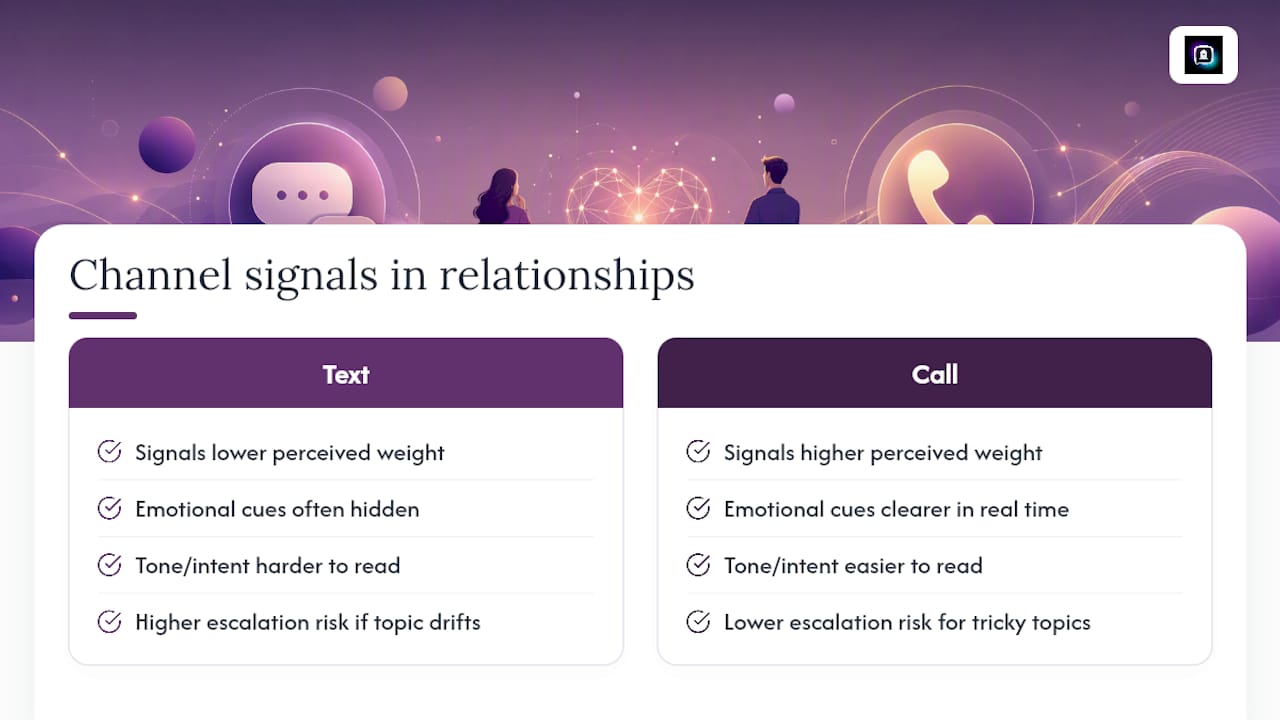
Ghost Text was built around that gap. It reads tone, intent, and emotional signals in a conversation you paste in or screenshot, then flags when a reply sounds colder or warier than you meant, or when a topic has drifted somewhere a text thread genuinely can't handle anymore. Run your next tricky exchange through the framework above, then check it against what the tone actually looks like on the page.
Try Ghost Text Before Your Next Hard Conversation
Ghost Text won't tell you whether to text or call. It tells you what the message you're staring at actually means, so the decision you make next is an informed one instead of a guess. Paste in a conversation or upload a screenshot, and it flags tone, intent, and red flags in seconds, along with a suggested reply if you want one.
The free tier lets you test this on a real conversation right now, no explanation needed. If you're weighing whether that ambiguous text warrants a call, run it through Ghost Text first and see what the tone analysis turns up. It won't make the call for you. It just makes sure you're not reading the room wrong before you decide.
Sources
- JMIR (2024) — survey on text reading and responsiveness
- UT Austin news — phone calls create stronger bonds (2020)
- Greater Good — talking vs texting for disagreements (2020)