
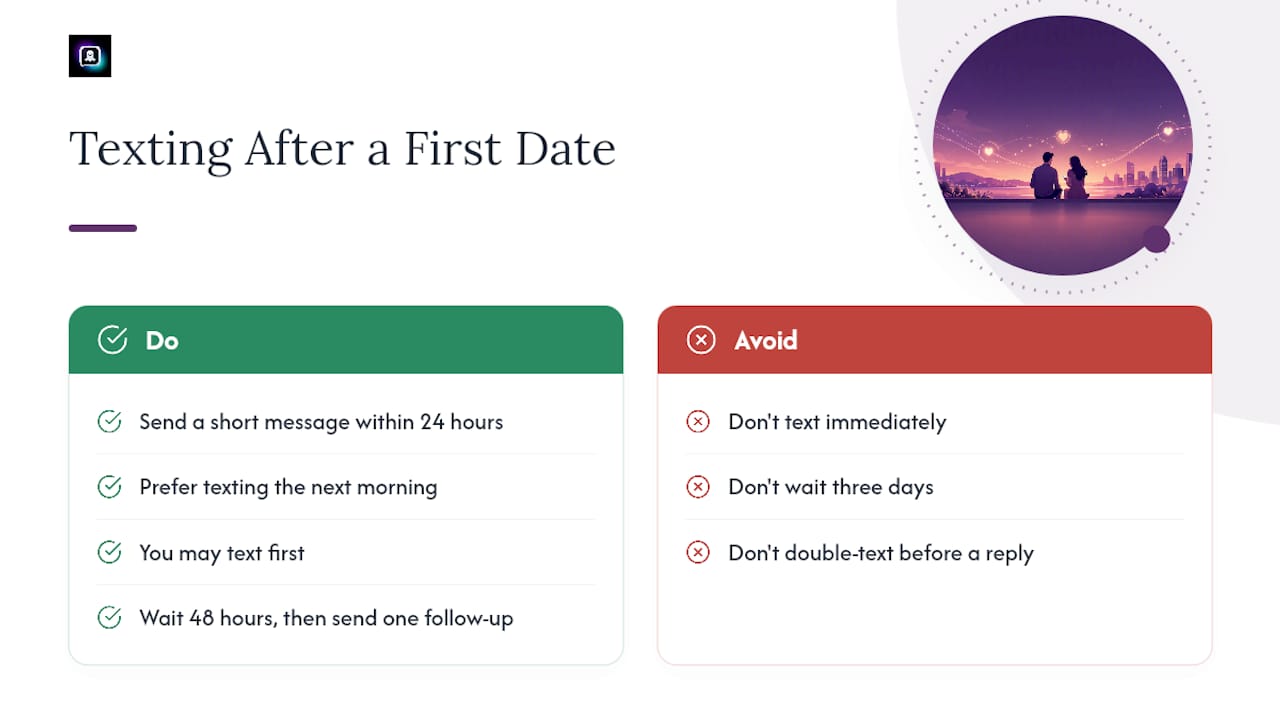
If you liked them, send a short, specific text within 24 hours, ideally the next morning. That single window beats both the instant post-date text and the old "wait three days" advice, based on how people actually respond to timing.
Three moves matter right now: mention one real detail from the date, keep it under two sentences, and send it before noon the day after. A solid template: "Had a great time last night. That story about your dog eating your passport is still making me laugh." Nothing fancy required.
Skip texting if:
- You're still out with them or in the cab home
- You've had a few drinks and can't proofread a sentence
- You've already sent two texts with no reply
Key Takeaways
A well-timed, specific text sent within 24 hours of a first date, ideally the next morning, produces better outcomes than texting immediately or waiting several days.
| Point | Details |
|---|---|
| Time it right | Send your follow-up text the next morning rather than immediately or after a multi-day wait. |
| Be specific, not generic | Reference an actual moment from the date instead of a vague compliment. |
| Match their energy | Mirror their texting tone and pace rather than escalating enthusiasm or going silent. |
| Read replies, don't chase them | A single delayed or short reply is a signal; multiple follow-ups rarely change the outcome. |
| Use a tool when a reply confuses you | Ghosttextai analyzes tone and intent in a text thread and suggests edit-ready replies for post-date conversations. |
Table of Contents
- Why a Follow-Up Text After a First Date Matters
- When Is the Best Time to Text After a Date?
- What Should You Do and Avoid Texting After a Date?
- What to Text After a First Date: Examples for Every Vibe
- How to Read Their Reply (and What to Do Next)
- What to Do If They Don't Reply at All
- How to Spot Red Flags in Early Texting
- Let Ghosttextai Help You Decode the Reply You Just Got
- Frequently Asked Questions
- Sources
Why a Follow-Up Text After a First Date Matters
A follow-up text isn't a formality. It closes the loop on a date that otherwise just ends in silence, and it removes the guesswork both people are doing about whether the other person had a good time.
Therapists point to a simple reason this works: people read texting after a first date as a direct signal of interest, and mentioning something specific from the date makes that signal land as genuine rather than scripted. Skip it, and even a great date can fade into ambiguity by the next afternoon.
That's the core advice from relationship writers covering post date etiquette, and it cuts against a lot of outdated dating "strategy." A text doesn't need to be clever. It needs to:
- Confirm you had a good time
- Reference something specific, not generic
- Leave room for them to respond without pressure
When Is the Best Time to Text After a Date?
Timing is where most people overthink things, and the research actually gives a clear answer. Studies on post-date communication found an inverted pattern: texting immediately after the date produced the lowest interest ratings, next-morning texts produced the highest, and waiting two or more days dragged interest back down. SimplyPsychology's coverage of this research is blunt about it: the three-day rule is not just outdated, it can actively work against you.
Here's how the three main timing options play out:
- Immediately after the date. Signals enthusiasm, but can read as anxious or overeager, especially if sent within minutes of saying goodbye.
- The next morning. The sweet spot. Enough space to seem calm, soon enough to seem interested.
- Two or more days later. Reads as disinterest even when that's not the intent, and it lets momentum die.
A few exceptions are worth knowing:
- Long-distance travel home or a very late night ending? A next-afternoon text is fine.
- Something felt off or unsafe during the date? Skip the text and trust that instinct instead.
- One study found women were more sensitive to timing than men, so if you're unsure, erring toward next-morning is the safer default either way.
What Should You Do and Avoid Texting After a Date?
Getting the timing right doesn't matter much if the message itself falls flat. A few rules separate texts that get a warm reply from texts that get left on read.
Do this:
- Reference something specific: a joke, a place, a detail they mentioned about their life
- Match their energy. If they're playful over text, be playful back. If they're more reserved, don't overdo the enthusiasm
- Keep it short. One or two sentences says more confidence than a paragraph
- Offer a next step only if you actually want one, don't suggest plans out of politeness
Skip this:
- Double-texting before they've replied to the first message
- Turning the text into an interview about their job, family, or past relationships
- Sending anything after a few drinks that you haven't reread sober
- Waiting exactly three days because some article told you to
Pro Tip: Swap generic compliments for a callback. "You're funny" gets ignored. "Still thinking about the terrible pun you made about the wine list" gets a reply, because it proves you were actually listening.
Watch how they text back, too. Short, delayed, one-word replies after an otherwise good date can be a mismatch signal worth noting rather than a fluke.
What to Text After a First Date: Examples for Every Vibe
The best post-date text depends on tone, not a script. Here's a set organized by vibe so you can pick one and swap in your own details.
Casual and appreciative (works for almost any first date):
- "Had a really good time last night. Let's do it again sometime."
- "That was fun. Glad we finally met up after all that texting."
Flirty (best when there was clear chemistry in person):
- "Can't stop thinking about that laugh of yours. When are we doing this again?"
- "You're even better in person than your profile pictures. High bar, well cleared."
Funny and playful (great after a date with a lot of joking around):
- "Official verdict: 9/10 date. Docking a point for beating me at trivia."
- "I'm still recovering from that terrible joke about tacos. 10/10 delivery though."
Asking for a second date directly (best once you know you want to see them again):
- "I'd love to see you again. Are you free Thursday?"
- Relationship experts suggest naming an actual day and activity rather than a vague "we should hang out," since a concrete plan gets a faster yes.
Polite decline (when it was fine, but there's no spark):
- "I really enjoyed getting to know you. You seem like a great person, but I don't think I felt the romantic connection I'm looking for."
For dating app matches, lean casual and specific since you're often still low on trust. For a blind date set up by friends, a warmer tone works because there's already social vouching in place. For an in-person meetup like a mutual event, referencing how you met adds a nice personal touch.
How to Read Their Reply (and What to Do Next)
Their reply tells you almost everything you need to know. A fast, warm response with a question back means genuine interest, so it's fine to suggest a second date within that same conversation or the next day. A short but friendly reply without follow-up questions is mixed. Wait a beat and let them lead the next move. A one-word reply hours later usually signals low interest, so don't chase it with a longer message trying to fix it.
Once someone shows clear interest, propose a second date within that conversation rather than a “sometime” follow-up.
- Strong reply: "I'd love that, Thursday works great" → confirm time and place immediately.
- Mixed reply: short but polite → ask one open question and see if energy picks up.
- Minimal reply: one word, no question → give it space, don't escalate effort.
What to Do If They Don't Reply at All
No reply is frustrating, but it's information, not a verdict on you as a person.
- Wait at least 48 hours before considering any follow-up.
- If you do send one, keep it light and low pressure: "Hey, no worries if you're busy, just wanted to see how you're doing."
- Send that follow-up once. Not twice, not three times with increasingly casual rephrasing.
- If there's still nothing after that, treat it as your answer and move on without a debrief or extra explanation.
Repeated follow-ups rarely change the outcome and usually just cost you dignity you'll want back later.
How to Spot Red Flags in Early Texting
Tone tells you a lot before words do. Enthusiastic, consistent texting usually means genuine interest. Evasive answers to direct questions, or a pattern that swings between intense and cold, usually means something else is going on.
Watch for these patterns specifically:
- Hot and cold behavior, intense one day, silent the next
- Pressure to meet again immediately or share personal details fast
- Disrespectful jokes or comments dressed up as playful teasing
- Attempts to isolate you from friends or rush physical intimacy early
Pro Tip: One inconsistent text isn't a pattern. Three in a row usually is. Give mild oddities a little grace, but don't explain away a repeated pattern just because the person is otherwise charming.
For mild concerns, a direct question ("Hey, that comment felt off, what did you mean?") usually clears things up. For serious red flags like pressure or disrespect, the right move is to stop responding and not look for a diplomatic exit.
A Quick Note From the Author
I've watched too many good first dates get sabotaged by overthinking the follow-up text instead of just sending something honest. The research backs that up, timing helps, but authenticity is what actually gets a reply. Full author credentials and background are available on our About page. This guide reflects Ghosttextai's mission: helping people read what a message actually means instead of guessing.
Let Ghosttextai Help You Decode the Reply You Just Got
Knowing what to send is one problem. Figuring out what their reply actually means is a different one, and it's the part most people get stuck on. Ghosttextai reads the tone, hesitation, or interest buried in a text thread and tells you plainly what's going on, instead of leaving you to reread the same three words for twenty minutes.
For post-date texts specifically, that means uploading the exchange and getting a quick read on whether their reply signals real interest, polite distance, or something worth watching for. It also drafts edit-ready reply options in whatever tone fits, casual, flirty, or direct, so you're not starting from a blank text box after a good date. If you've got a confusing reply sitting in your inbox right now, try Ghosttextai and see what it actually means before you respond.
Frequently Asked Questions
Should I text after a first date? Yes, if you're interested. A short, specific message within 24 hours signals genuine interest without seeming overeager.
How long should I wait to text after a date? Aim for the next morning. It outperforms both texting immediately and waiting the old "three days."
Who should text first after a date? Either person can. There's no etiquette rule requiring one gender to initiate, and waiting on the other person often just delays a text you both want to send.
What if they don't text back? Wait 48 hours, send one low-pressure follow-up if you want, and treat continued silence as your answer rather than something to fix.
Is double-texting after a date a bad idea? Generally, yes. Sending a second message before they've replied to the first tends to read as pressure rather than interest.
Sources
- How long should you wait to text after a date? (Psychology Today)
- Texting the next morning maximizes romantic interest after a first date (SimplyPsychology)
- What to text after the first date (Verywell Mind)
- Texts to send after a great first date (Cosmopolitan)
- What to text after a first date (PureWow)