
A late-night "u up?" text is almost always a low-effort availability check with a hookup in mind. According to WikiHow's dating communication guide, these messages land most often between 10 p.m. and 2 a.m., and the stripped-down spelling is part of the signal: the sender wants to know if you're awake and open, without putting in much effort. Your three immediate options are simple: ignore it, send a firm redirect to a daytime plan, or reply playfully if a casual encounter is what you want too.
Key Takeaways
A late-night "u up?" text is almost always a low-effort hookup probe, but context clues — time stamp, sender history, and follow-up content — determine the real intent.
| Point | Details |
|---|---|
| Dominant meaning | Sent between 10 p.m. and 2 a.m., "u up?" most often signals a casual hookup or availability check. |
| Key context clues | Time stamp, sender history, follow-up content, and relationship stage together reveal intent more reliably than the text alone. |
| Top response moves | Ignore, redirect to a daytime plan, or clarify intent — your reply should match what you actually want. |
| Safety note | Meet in public, share your location, and block without explanation if someone becomes pressuring or threatening. |
| Ghosttextai | Paste the conversation into Ghosttextai for instant tone analysis, red flag detection, and tailored reply suggestions. |
Table of Contents
- What does "u up?" usually mean when someone texts it late at night?
- When "u up?" might mean something else entirely
- Context clues that change how you should read the message
- How to reply to "u up?" — scripts for every goal
- Red flags and safety steps to know before you respond
- How to set boundaries around late-night texts
- How Ghosttextai can help you decode ambiguous messages
- The part most guides skip
- Ghosttextai makes ambiguous texts easier to read
- Sources
What does "u up?" usually mean when someone texts it late at night?
The short answer: it's a booty call, worded to minimize rejection risk. Dating coaches describe it as a low-effort test of availability — the sender gets a yes-or-no answer without committing to anything. The Free Dictionary's idiom entries define "u up?" as slang for asking whether someone is awake, with the late-night hookup connotation listed as the dominant use.
The most common motivations behind the message:
- Casual hookup or booty call. The sender wants company, sex, or both, and the late hour signals they're not planning a date.
- Boredom or loneliness. Scrolling at midnight and reaching out to whoever might be awake — you may be one of several people they texted.
- Testing your availability. They want to know if you're interested without asking directly, keeping their own exposure low.
- Keeping a connection warm. Occasional late-night pings can be a way to stay on someone's radar without committing to anything real.
The time stamp alone carries a lot of weight. A message sent at 11:45 p.m. after a day of silence reads very differently from the same words sent at 7 p.m. during an ongoing conversation. Frequency matters too: a one-off message might be a fluke, but repeated late-night texts with nothing in between are a pattern worth reading carefully.
When "u up?" might mean something else entirely
Not every late-night text is a hookup probe. Elite Daily's interviews with senders make clear that intent varies: a close friend might send the exact same three characters because they're in crisis, locked out, or just scared and need to talk. A family member in a different time zone might not realize it's midnight where you are.
Signals that point toward an innocent meaning:
- An immediate follow-up message explaining why they're reaching out ("hey, are you up? I need a ride, my car broke down")
- The sender is a close friend, sibling, or family member with no romantic history
- A time-zone gap that makes the hour reasonable on their end
- The message arrives during a stretch of regular, non-romantic contact
The clearest indicator of non-sexual intent is that follow-up context. When someone texts "u up?" for a real reason, they almost never leave it hanging. The absence of any follow-up is usually the strongest signal that the sender is waiting to see how you respond before revealing what they want.
If you're genuinely unsure, one short clarifying question handles it cleanly: "Everything okay?" or "What's up?" Neither escalates the situation nor assumes the worst.
Context clues that change how you should read the message
Before you reply, run through these signals quickly:
- Sender history. Have they texted late at night before? Is this a pattern or a first?
- Recent contact. Did you talk earlier today, or has it been days of silence?
- Time stamp. Anything after 10 p.m. with no prior conversation that day leans heavily toward the hookup interpretation.
- Punctuation and emoji. A bare "u up" with no punctuation reads differently from "u up? 😊" or "u up?? need to talk."
- Relationship stage. Someone you've been on two dates with is a different read than a longtime friend.
- Follow-up content. Did they send anything after? A location pin with no context is a red flag. An explanation is a green one.
A simple decision frame: if there's been no contact all day, the message arrives after 10 p.m., and there's no follow-up context, the probability of a hookup intent is high. If the sender is a close contact, the message comes with an explanation, or the hour is reasonable given their time zone, give them the benefit of the doubt and ask.
Mixed signals happen. Someone you've been casually dating might send "u up?" at 11 p.m. after a normal day of texting. In that case, messaging frequency and sender history together give you more information than the time stamp alone. Weigh the full picture, not just one cue.

Pro Tip: If the message feels ambiguous, don't overthink a single text. Reply to the pattern, not the moment. One late-night "u up?" might be nothing. Three in a row with no daytime contact tells you exactly what you need to know.
How to reply to "u up?" — scripts for every goal
Your reply should match what you actually want, not what you think you're supposed to say. Here are grouped scripts with brief notes on when each fits:
| Goal | Tone | Example reply | Likely outcome |
|---|---|---|---|
| Decline cleanly | Neutral, firm | "Heading to sleep, talk tomorrow." | Closes the door without drama |
| Redirect to a real date | Warm, forward | "Not really a late-night person — want to grab coffee this week?" | Tests whether they want more than a hookup |
| Clarify intent | Curious, open | "Everything okay? What's going on?" | Gets context without assuming |
| Flirt / consent | Playful, direct | "Depends — what did you have in mind?" | Opens the door on your terms |
| Safety check before meeting | Practical | "Sure, but let's meet somewhere public first." | Sets a boundary before agreeing |
A few usage notes worth keeping in mind. The redirect reply is one of the most useful tools here: it shifts the dynamic from low-effort late-night contact to something that requires actual planning. If they follow through and suggest a real time and place, that's a good sign. If they go quiet or push back, that tells you something too.
The clarifying reply works best when the sender is someone you care about and you genuinely don't know if something is wrong. It's not a great fit for someone you barely know, where the hookup read is almost certainly correct.
Pro Tip: Suggesting a phone call instead of texting back and forth is one of the fastest ways to gauge seriousness. Someone who wants a real connection will usually say yes. Someone who only wanted a low-effort hookup often won't.
For more ready-to-use templates, AI dating reply generators can help you find the right tone when you're not sure how to phrase something.
Red flags and safety steps to know before you respond
Some "u up?" patterns cross from low-effort into manipulative. Watch for these:
- Repeated late-night texts after you've already said no or ignored the message
- Pressure to meet immediately, with no flexibility on location or timing
- Location-only invites with no public meeting option offered
- Inconsistent stories about where they are or what they want
- Guilt-tripping or escalating language when you don't respond
These patterns are worth taking seriously. Dark psychology in texting often shows up in exactly this kind of low-effort, high-pressure late-night contact.
If you do decide to meet someone in person after a late-night text exchange, a short safety checklist:
- Meet in a public place first, not a private residence
- Share your location with a trusted friend before you go
- Let someone know where you're going and when you expect to be back
- Trust your instincts if something feels off when you arrive
If someone becomes threatening or harassing after you decline, block them without explanation. You don't owe a response to pressure, and you don't owe an explanation for protecting yourself.
How to set boundaries around late-night texts
Responding once to a "u up?" text sets a precedent. If you don't want late-night contact, the clearest move is to say so directly, once, and then hold the line.
A sample boundary message you can send the next morning:
"Hey, I'm not really available for late-night texts. If you want to hang out, let's plan something during the day."
Short, specific, and not an apology. You're not explaining yourself or bargaining for attention. You're stating a preference.
A few dos and don'ts for texting etiquette in these situations:
Do: Respond at a time that works for you, not immediately. Match your behavior to your words — if you say you're not available late, don't reply at 1 a.m. the next week.
Don't: Over-explain your boundaries or apologize for having them. A long explanation invites negotiation. One clear sentence does not.
Consistency is what makes a boundary real. If you redirect someone to daytime contact and then respond to their next late-night text anyway, the message you send is that the boundary is optional. That's not a criticism — it's just how the dynamic works.
How Ghosttextai can help you decode ambiguous messages
When a message like "u up?" lands and you genuinely can't read the intent, an AI conversation coach can do the analysis for you. Ghosttextai lets you paste a conversation or upload a screenshot and get back a breakdown of tone, likely intent, emotional signals, and suggested replies with adjustable tone.

For a "u up?" text specifically, that means: is this sender's history consistent with hookup-seeking behavior? Does the punctuation and timing suggest urgency or casualness? What reply fits your goal, and what tone should it carry?
Ghosttextai also flags red flags in conversation patterns, which is useful when you're too close to a situation to see the pattern clearly. The AI communication coaching capabilities go beyond single-message reads — they account for the full conversation history you provide.
Pro Tip: When uploading screenshots for analysis, remove or blur any identifying details you don't need to share — full names, phone numbers, profile photos. The AI needs the text and context, not the personal identifiers.
The part most guides skip
There's a tendency to treat "u up?" as either obviously bad or obviously fine, and the reality is messier than either read. A single late-night text from someone you've been talking to all week is not the same as the same text from someone who's been silent for a month. Context is the whole game.
What I'd push back on is the idea that you need to decode every message perfectly before you respond. You don't. The scripts above are tools, not rules. Use the one that matches what you actually want, and let the other person's response tell you what you need to know. A redirect to a daytime plan is one of the most informative replies you can send — it costs you nothing and reveals everything about what the other person is actually after.
Ghosttextai makes ambiguous texts easier to read
Reading tone and intent in a three-word late-night text is genuinely hard, and getting it wrong can cost you time, energy, or worse. Ghosttextai gives you a fast, private way to paste in a conversation and get back a clear read on what's likely happening, what the red flags are, and what to say next.
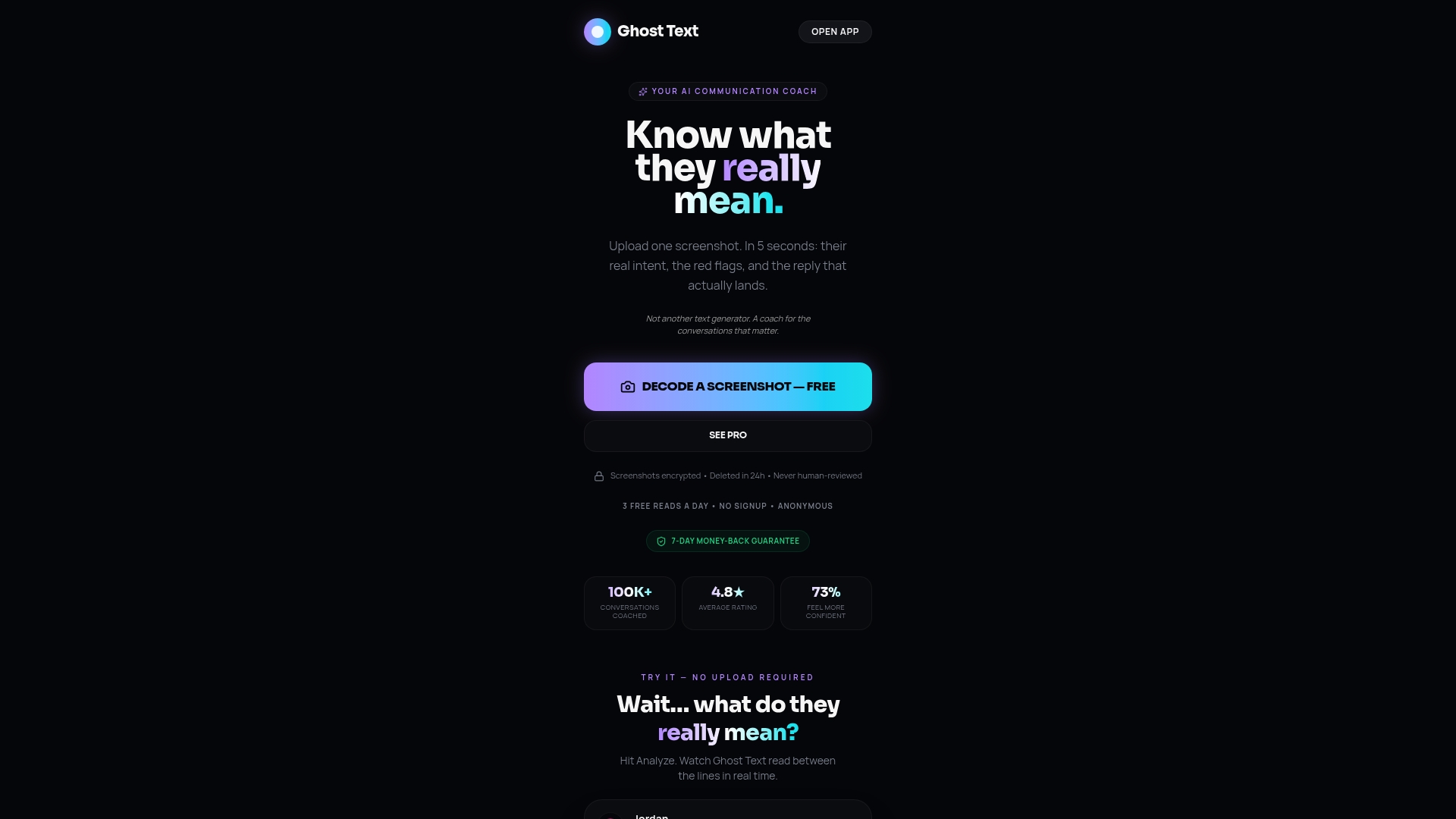
The freemium version lets you analyze a few conversations at no cost. Ghost Text Pro unlocks unlimited reads, advanced red flag detection, an interest meter, and reply generation with tone control — so you can match your response to your actual goal, not just your gut reaction in the moment. Whether you're navigating a "u up?" text or something far more complicated, Ghost Text gives you the clarity to reply with confidence.
Sources
- You Up? Text Meaning & How to Respond
- What Does "You Up?" Mean? Guys Reveal What It Means To Them
- U up? - Idioms by The Free Dictionary