
If texting activates your anxious attachment, pause before you reply. Either wait until you're calm or send one short message that names one feeling and asks one answerable question. That single move interrupts the spiral. The scripts and deeper techniques below build on it.
TL;DR:
- Most anxious texting patterns, such as double or triple texting and seeking validation, reinforce the brain's threat detection and prolong insecurity.
- Immediate in-the-moment strategies like delaying replies and reframing thoughts help break the cycle of hyperactivation triggered by ambiguous signals.
- Building attachment security through therapy, consistent relationships, and self-compassion reduces the baseline anxiety fueling reactive texting habits over time.
- Slow, predictable partner responses and preemptive reassurance can weaken anxious patterns, while inconsistent or dismissive replies intensify the cycle.
- Using tools like AI communication coaches to draft calm, focused messages can assist in practicing healthy responses during moments of distress.
Table of Contents
- Why Texting Triggers Anxious Attachment So Fast
- Common Anxious Texting Patterns You Can Spot and Measure
- Practical In-the-Moment Strategies Before You Tap Send
- What to Say: Scripts That Actually Get a Reply
- How to Raise the Pattern With a Partner in One Conversation
- How Anxious Attachment Develops and Shapes Texting Habits
- The Real Impact on Your Relationships
- Romantic Partners vs. Friends: The Response Isn't the Same
- Long-Term Work: Building Attachment Security, Not Just Coping Skills
- Your Partner's Response Can Calm the Cycle or Feed It
- Why Most Advice on This Topic Misses the Point
- Practice the Skills With an AI Communication Coach
- Sources
Why Texting Triggers Anxious Attachment So Fast
Texting strips away almost every signal your nervous system uses to feel safe. No tone of voice, no facial expression, no timing context. Just a blank screen and a guess. For someone with anxious attachment, that gap between "message sent" and "message answered" is not neutral. It's a threat window.
The mechanism is called ambiguity intolerance. When a reply is delayed, your brain doesn't file it as "busy" or "driving" or "in a meeting." It files it as evidence of rejection, and it starts generating stories to match. Read receipts and typing indicators make this worse, not better. Seeing "read 4:12 PM" with no reply for twenty minutes gives your mind a precise timestamp to obsess over.
This is attachment hyperactivation: the vigilance, the phone checking, the mental replay of what you sent. Research on attachment under stress shows this response is designed to pull a partner closer, but it rarely regulates itself without outside reassurance. And that reassurance tends to fade fast. One kind reply calms things for an hour, maybe a day, then the vigilance resets. A SAGE Journals study of college daters found anxious attachment didn't actually predict how often people texted. It predicted something subtler: a heavier use of future-focused language, like asking where things are headed or when you'll see each other next. The anxiety shows up in what you write, not just how often you write it.
Common Anxious Texting Patterns You Can Spot and Measure
Anxious texting has a recognizable shape once you know what to look for. These aren't personality flaws. They're hyperactivation showing up in your thumbs.
- Double or triple texting: sending a follow-up before the first message gets a response, often within minutes.
- Initiative asymmetry: you start most conversations, and tracking who texts first over a week reveals a lopsided pattern.
- Instant replies paired with a widening gap: you respond in under a minute; their replies stretch to hours, and the contrast itself becomes a trigger.
- Validation-seeking phrasing: "Are we okay?" or "Did I do something wrong?" appearing more than once in a single exchange.
- Future-focused language: asking about weekend plans, next dates, or "what this means" earlier than the relationship's pace supports.
To the other person, this often reads as pressure, even when your intent is connection. That mismatch is what feeds the loop. You want closeness, they feel crowded, they pull back slightly, and your alarm bells get louder.
Practical In-the-Moment Strategies Before You Tap Send
Most of the damage happens in the sixty seconds after you notice the anxiety, not in the hours of waiting. That's the window worth training.
Start with three immediate moves. Put your phone somewhere you have to stand up to reach. Set a specific next-check time, like 6:30 PM, instead of checking every four minutes. Write down your prediction of the worst-case outcome before you look at your phone again, then compare it to what actually happens later. That comparison alone teaches your brain that the catastrophe rarely lands.
From there, borrow two structured techniques:
- CBT thought labeling: name the automatic thought ("They're losing interest") as a thought, not a fact, then generate one alternative explanation that fits the same evidence just as well.
- Gradual delay practice: extend your reply-checking interval slightly each day, the same way exposure therapy builds tolerance for any avoided discomfort.
- ACT urge-surfing: notice the urge to check or send a follow-up, name it ("This is the urge talking"), and let it crest and pass without acting on it for five minutes.
- Self-compassion reframing: replace "I'm being needy" with "This reaction makes sense given how my nervous system learned to read distance." Self-compassion practices measurably reduce the intensity of rejection-related rumination.
If you've already sent a wave of messages, send exactly one calm repair text and stop. Repeated apologies or explanations after the fact tend to escalate the situation rather than close it, since each new message reopens the conversation the other person was trying to let settle.
Pro Tip: Keep a running note titled "Predicted vs. Actual." Every time you brace for the worst after a slow reply, log what you feared and what really happened. After two weeks, the pattern usually does more to calm you than any single reassuring text ever could.
What to Say: Scripts That Actually Get a Reply
The most reliable message format pairs one feeling with one answerable request. It gives the other person something concrete to respond to, instead of an open-ended emotional prompt they don't know how to handle.
- Dating: "I felt a little unsure after our last exchange. Can you let me know if you're still up for Thursday?"
- Friendship: "I've missed talking. Any chance you're free for a call this week?"
- Family: "I got worried when I didn't hear back. Can you send a quick text when you land?"
For repair after a double or triple text, keep it to one line: "Sorry for the extra texts, I got anxious. No need to respond to all of them." That's it. No follow-up justification.
Text works for logistics and check-ins. It stops working once you notice you're trying to resolve tone, hurt feelings, or "what this means" over several back-and-forth messages. That's the cue to say, "Can we talk on the phone about this instead?" Voice and video carry the tone signals text can't, and switching formats often ends a spiral that more texting would only extend.
How to Raise the Pattern With a Partner in One Conversation
You don't need a dramatic sit-down. You need one clear conversation, ideally in person or on a call, not over text.
- Open without blame: "I've noticed I get anxious when replies take a while. It's about my patterns, not something you're doing wrong."
- Ask for one concrete thing: "Could we agree that texts marked 'urgent' get a same-day reply, and everything else can wait?"
- Set a shared next-check expectation, like a rough window for replying during work hours versus evenings.
- If a wave happens anyway, agree on a repair signal, something as simple as "resetting" typed once, meaning both of you drop it and move on.
- If your partner tends to avoid hard conversations, propose a short time limit up front, five or ten minutes, so the ask feels contained rather than open-ended.
How Anxious Attachment Develops and Shapes Texting Habits
Anxious attachment typically forms early, often from caregiving that was loving but inconsistent, warm one day and distracted or unavailable the next. A child in that environment learns that closeness can't be counted on unless it's actively monitored and protected. That lesson doesn't disappear in adulthood. It just changes format, from checking a parent's mood to checking a read receipt.
The specific vulnerability anxious attachment creates is a heightened sensitivity to ambiguous social signals. Clinical research on rejection sensitivity shows that people high in this trait interpret neutral or unclear cues, like a slow reply, as far more threatening than people with secure attachment do. Texting is almost engineered to expose this vulnerability, since it's built entirely out of ambiguous signals: delays, short replies, punctuation, or its absence.
This is also why anxious texting habits feel so involuntary. You're not choosing to spiral over a lowercase "k." Your attachment system is running a threat-detection routine it learned decades before smartphones existed, applied to a medium that generates far more ambiguity per hour than face-to-face contact ever did. Understanding that origin matters, because it reframes the goal. You're not trying to stop caring about replies. You're retraining a detection system that's currently calibrated for a different, less safe environment.
The Real Impact on Your Relationships
Texting anxiety doesn't stay contained to your phone. It reshapes how present you are in the relationship itself. Time spent rehearsing what a message meant, drafting and redrafting a reply, or waiting for a notification is time pulled directly from whatever you're actually doing, which slowly teaches your nervous system that the relationship lives mostly in the phone rather than in shared time together.
There's also a trust cost that compounds quietly. Every unanswered prediction of disaster that turns out wrong should build confidence that your fears often overshoot reality. But hyperactivation resists that lesson. Instead of updating toward "this usually turns out fine," anxious attachment tends to file each calm resolution as a lucky exception rather than the norm, keeping the alarm system just as sensitive for next time.
Partners on the receiving end notice the volume and tone shift over months. Frequent reassurance requests, even gentle ones, can start to feel like a quiet obligation rather than a genuine exchange. That's rarely because the anxious partner is doing anything unreasonable. It's because unaddressed texting anxiety tends to generalize, spreading from "are we okay" moments into everyday logistics, until nearly every exchange carries a faint undertone of checking. The relationship dynamic that results isn't dramatic. It's just quietly exhausting for both people, which is exactly why naming the pattern early, rather than after resentment builds, changes the trajectory.
Romantic Partners vs. Friends: The Response Isn't the Same
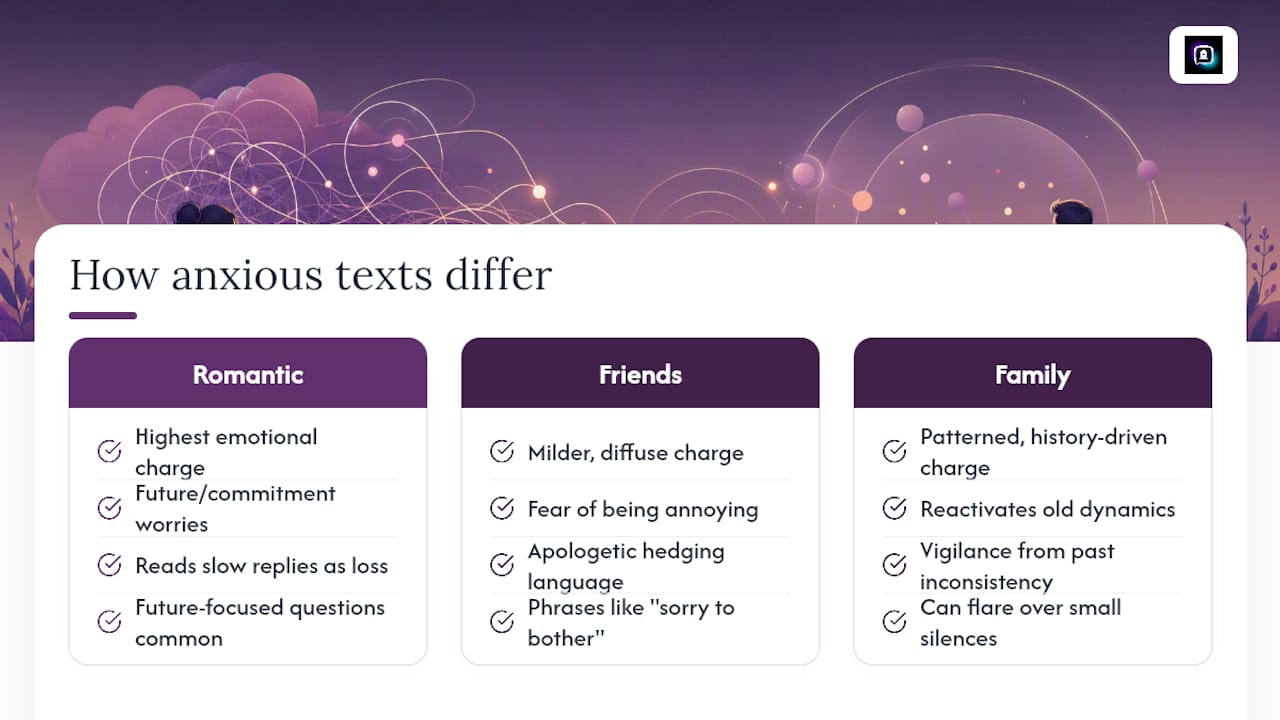
Anxious attachment shows up differently depending on who's on the other end of the thread, and the differences are worth knowing so you don't treat every relationship with the same intensity.
Romantic texting carries the highest charge, largely because it's loaded with stakes about commitment and exclusivity that friendship rarely carries. This is exactly where the future-focused language documented in the SAGE Journals research tends to concentrate: questions about where things are going, whether feelings are mutual, what a delayed reply "means" for the relationship's future. A slow reply from a romantic interest gets interpreted through a lens of potential loss in a way a slow reply from a college friend usually doesn't.
Friendships tend to trigger a milder, more diffuse version. The fear is less "they're losing interest in me specifically" and more "I'm being annoying" or "I'm too much." Friend-based anxious texting often produces apologetic hedging, phrases like "sorry to bother you" or "no worries if not," layered onto otherwise simple requests.
Family texting adds its own twist, since it usually carries decades of established relational patterns. If a parent or sibling was historically inconsistent in responding to emotional needs, adult texting with them can reactivate that exact same vigilance, even over something as mundane as a group chat going quiet.
Knowing which category a relationship falls into helps you calibrate your response. The one-feeling, one-request script works everywhere, but how much weight you assign to a slow reply should shift depending on whether you're texting a partner, a friend, or a parent.
Long-Term Work: Building Attachment Security, Not Just Coping Skills
In-the-moment scripts manage flare-ups. They don't change the underlying wiring that produces the flare-ups in the first place. That takes longer, steadier work aimed at attachment security itself.
Three approaches have real support behind them. First, therapy focused on attachment patterns, particularly approaches that help you notice hyperactivation as it starts rather than after it's taken over, gives you a earlier intervention point each time. Second, deliberately building or strengthening a few securely attached relationships, whether romantic or platonic, gives your nervous system firsthand evidence that consistency is possible, which is a different kind of proof than any single reassuring text can offer. Third, ongoing self-compassion practice, shown to reduce the intensity of rejection-related rumination, slowly lowers the baseline anxiety that texting exploits in the first place.
None of this moves fast. Attachment patterns that took years to form don't reorganize in a few weeks of trying harder. But the "Predicted vs. Actual" tracking mentioned earlier compounds over months into something closer to real evidence, a written record showing your catastrophic predictions rarely matched what happened. That record becomes one of the more persuasive tools you have, precisely because it's your own data, not a reassurance from someone else that fades by next week.
Your Partner's Response Can Calm the Cycle or Feed It
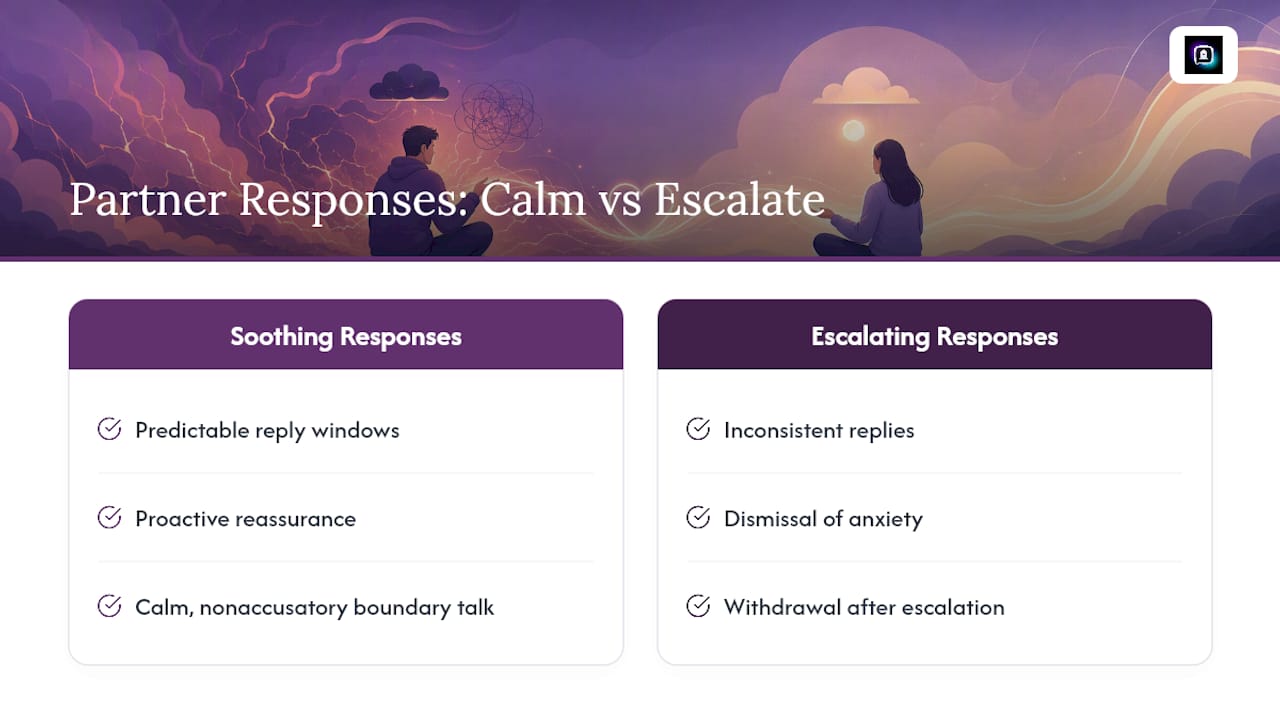
Partner behavior isn't the root cause of anxious attachment, but it's a powerful lever that speeds up either healing or escalation.
Certain partner responses tend to soothe hyperactivation over time. Predictable reply windows, even slow ones, calm the system more than fast but erratic replies do, because consistency, not speed, is what an anxious nervous system is actually scanning for. Direct reassurance offered before it's requested, rather than only after visible distress, teaches your attachment system that safety doesn't require vigilance to produce. And a partner willing to have the one boundary-setting conversation outlined earlier, without treating it as an accusation, shortens the loop dramatically.
On the other side, certain responses reliably make things worse. Inconsistent replying, fast and warm one day, slow and flat the next, mirrors exactly the unpredictable caregiving that often produces anxious attachment in the first place, so it activates the deepest version of the fear. Dismissing the anxiety outright ("you're overreacting") removes the option of repair and teaches the anxious partner to hide the pattern instead of managing it. And matching escalation with withdrawal, going quiet in response to a wave of texts, confirms the exact fear driving the wave to begin with.
None of this makes a partner responsible for someone else's attachment style. But Gottman's research on repair attempts is clear that a single genuine, well-timed repair from either side does more to de-escalate conflict than any amount of repeated over-explaining. Partners who understand what secure attachment actually looks like in practice, rather than assuming it means never having reactions, tend to become the steady presence that helps anxious hyperactivation fade rather than intensify.
Why Most Advice on This Topic Misses the Point
Most articles on anxious texting tell you to "just relax" or "trust the process," which is roughly as useful as telling someone with a fear of heights to enjoy the view. The anxiety isn't a mindset problem you talk yourself out of. It's a trained response that needs a trained counter-response, one specific script, one paused moment, one tracked prediction at a time.
The piece people underestimate most is how much the content of anxious texting matters more than the volume. Fixating on "am I texting too much" misses that a single future-focused, validation-hungry message can do more relational damage than five neutral ones. Watch what you're actually asking for, not just how often you're asking.
An AI communication coach like Ghost Text fits naturally into this kind of practice work, offering a pause point where you can check a draft's tone before sending and get a calmer reply option when your own read on a message is running hot. It's a tool for rehearsing the skills above, not a substitute for therapy or the deeper attachment work that changes the pattern long term.
— DSean
Practice the Skills With an AI Communication Coach
Reading scripts is one thing. Testing them in real time, on a message that's actually making your stomach drop, is another. Ghost Text gives you that second step: paste in a screenshot or a conversation, and it reads the tone, flags what's ambiguous versus what's actually concerning, and drafts a calmer reply option you can send instead of the one written in a panic.
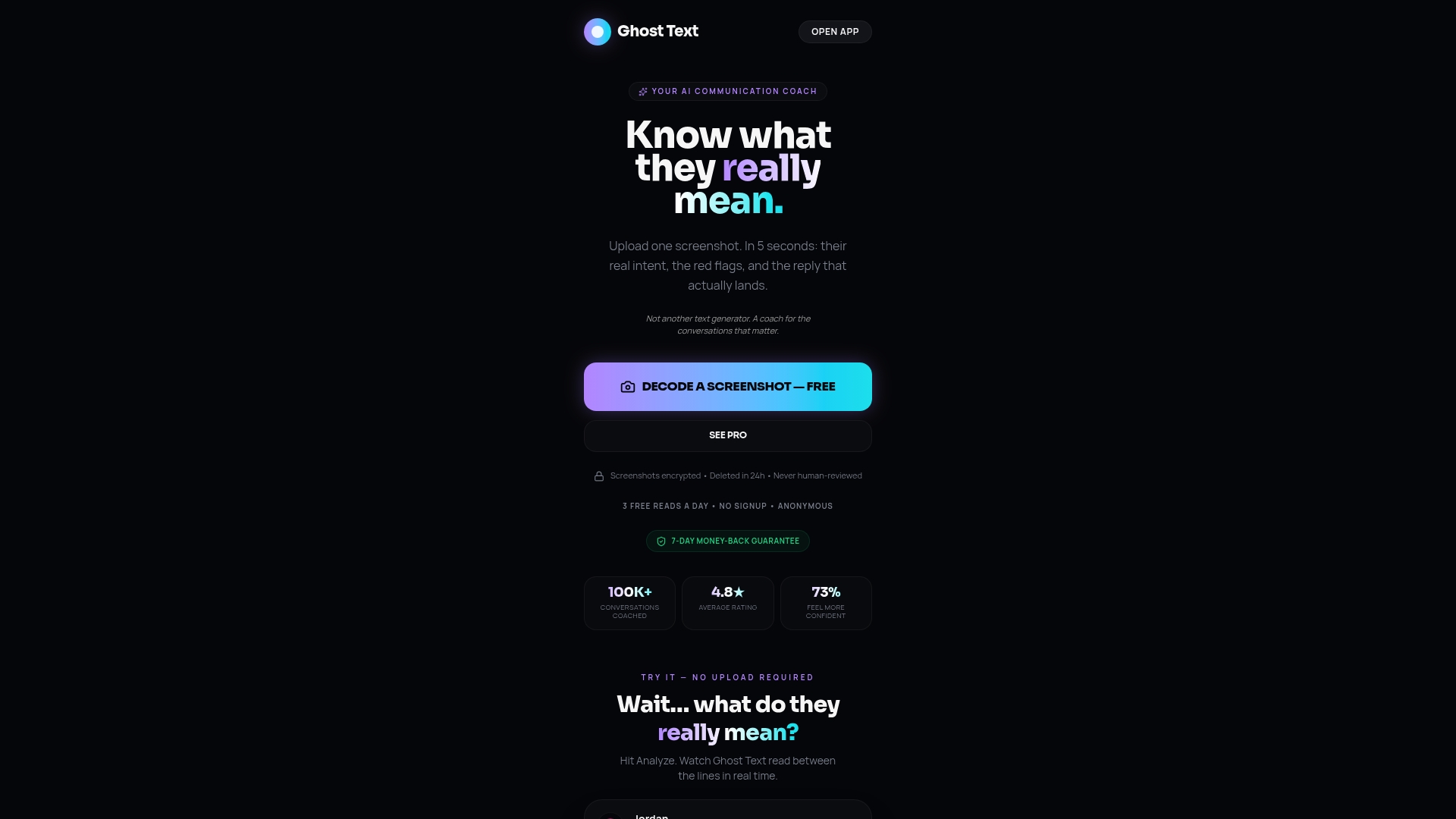
It's built for exactly the moment this article covers, the sixty seconds between "I want to reply right now" and "I should probably wait." If you're staring at a slow reply and drafting your fourth version of a follow-up text, paste the conversation into Ghost Text and see what a one-feeling, one-request version looks like before you send anything. Try Ghost Text on your next hard-to-read text and see whether the drafted reply matches what you'd actually want to say once the panic settles.
Sources
- SAGE Journals — study on attachment and texting language
- Psychology Today — why you can't stop thinking about that text