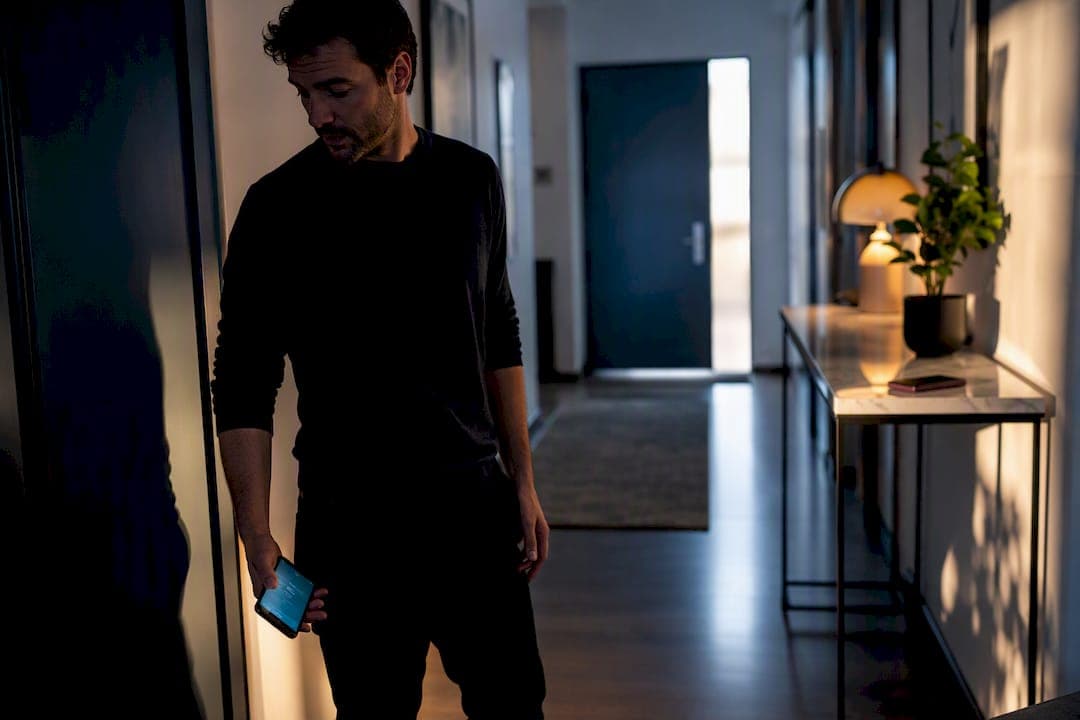
A reply is late when it arrives after the response window a specific context calls for, not after some fixed clock. There's no universal threshold for lateness; five minutes can be late during an emergency text chain, and three days can be perfectly normal for a casual group thread. The rule of thumb: match your read of "late" to the urgency and relationship, not to a stopwatch.
TL;DR:
- Most delayed responses are caused by logistical issues or simple forgetfulness rather than active avoidance or disinterest.
- Reply expectations vary widely based on context, with minutes for emergencies, hours for messaging apps, and days for casual or low-stakes messages.
- Repeated slow replies and missed commitments reveal more about reliability or relationship imbalance than isolated delays.
- Read receipts and notifications can mislead interpretations, as they do not accurately indicate intent or engagement behind a delay.
- Prioritize the tone and content of the reply over the delay time, as a warm and engaged message is more meaningful than a quick, flat response.
Table of Contents
- Late Reply Meaning by Context: Timeframes That Actually Apply
- Why People Actually Reply Late (It's Rarely What You Think)
- Is a Late Reply a Red Flag? A Quick Framework
- How to Reply After Waiting Too Long
- When an Apology for a Late Reply Is Actually Necessary
- How AI Coaching Reads the Situation for You
- The Psychological Weight of Waiting for a Reply
- Cultural Differences in What Counts as "Late"
- How Read Receipts and Notifications Warp Reply Timing
- The Take: Stop Treating Every Delay Like Evidence
- Sources
Late Reply Meaning by Context: Timeframes That Actually Apply
The definition of a late answer bends around the channel you're using and who's on the other end. A recruiter who takes four days to respond to your email hasn't necessarily gone cold. A partner who takes four days to answer "you up?" probably has.
Etiquette norms cluster into rough bands depending on the medium and the stakes involved, and those bands hold up reasonably well across contexts:
- Urgent or safety-related messages: minutes. If someone says "call me now, it's an emergency," an hour of silence reads as alarming regardless of relationship.
- Active messaging app conversations: a few hours. If you're mid-conversation on iMessage or WhatsApp and the other person goes quiet for six hours, that's a delayed response worth noting.
- Workplace email: same business day, sometimes next morning for less time-sensitive requests. This is the norm baked into most corporate cultures, not a formal rule.
- Low-stakes social texts: a few days is fine. Nobody owes an instant answer to "hey, how was the trip?"
- Dating app messages: highly variable, but replies stretching past 48 to 72 hours during an otherwise active match often signal waning interest, not just a busy week.
The mistake people make is applying workplace-email patience to a dating conversation, or applying urgent-text anxiety to a casual group chat. Context sets the clock. Nothing else does.
Why People Actually Reply Late (It's Rarely What You Think)
Most delayed messages have a boring explanation. The mind jumps to rejection or anger; the reality is usually logistics.
Common innocent causes:
- The message got buried under twenty others, or a notification simply didn't fire.
- The person is in a different time zone and saw it at 3 a.m. their time.
- They read it, meant to answer, and genuinely forgot. This happens more with text than any other medium because there's no visual reminder like an unread badge always guarantees.
- The question required actual thought (a decision, a complicated answer, an emotional topic) and they wanted to sit with it before typing.
Then there are the less innocent reasons: avoidance, low interest, or a deliberate choice to let you wait. Psychology research on delayed responses notes that a gap between a stimulus and a reaction can reflect active cognitive processing rather than neglect. Someone who delays because they're planning what to say is doing something fundamentally different from someone who delays because they don't care.
Pro Tip: Before assuming the worst, check whether the delay matches a pattern. A single slow reply after a heavy question is normal. A pattern of slow replies to easy questions is the signal worth paying attention to.
Is a Late Reply a Red Flag? A Quick Framework
Isolated lateness rarely means anything. Repeated lateness combined with other behavior tells you almost everything.
- Look for patterns, not incidents. One slow reply during a busy week is noise. Three slow replies in a row, especially after you've asked something direct, is a pattern.
- Check content quality against delay length. A three-day gap followed by a warm, detailed message reads very differently than a three-day gap followed by "lol yeah sorry, busy." The second suggests the delay wasn't really about time.
- Watch for missed commitments stacked on top of the delay. Someone who says they'll call and doesn't, then apologizes days later with no explanation, is showing you something about reliability, not just about their schedule.
- Notice reciprocity over time. If you're consistently the one initiating and consistently the one waiting, the late replies are a symptom of an imbalance, not the actual problem.
- Weigh context that lowers alarm. A demanding job, a family emergency, travel, or a documented pattern of being generally slow to text (some people just are) all reduce how much weight a single delay should carry.
Stonewalling after a fight, repeated no-shows paired with silence, or going quiet specifically after you raise something important are the combinations that deserve real scrutiny. Everything else is probably just life.
How to Reply After Waiting Too Long
The reply itself matters more than the delay that preceded it. A short, warm response erases most of the damage a slow one might have caused.
Skip the apology when the stakes are low. If a friend asks how your weekend was and you answer two days later, "ha sorry, been slammed. It was great, went hiking" does the job. Reserve the actual apology for delays that caused real inconvenience: missed deadlines, unanswered logistics questions, or a friend who was clearly waiting on you for something specific.
Templates that work across contexts:
- Friend, casual: "Sorry for the radio silence, life got hectic. What's new with you?"
- Dating, early stage: "Been a rough week, didn't mean to leave you hanging. Still want to grab that coffee?"
- Manager or colleague: "Apologies for the delay on this. Here's the update, and I can jump on a call tomorrow if that's faster."
- Client: "Sorry for the slow turnaround. I've attached the file and I'm available this week to talk through next steps."
When a missed commitment is involved, the repair formula is ownership plus remedy plus timeline: acknowledge the miss, provide whatever you were supposed to deliver, and give a concrete next step. Writing guidance from Grammarly's advice on delayed replies backs this up directly, recommending a brief owned reason followed by forward motion rather than an extended apology. That advice holds up particularly well for professional networking follow-ups, where a fast, action-oriented reply after a gap often matters more than the apology wrapped around it. For more reply patterns across tone and relationship type, see how to reply to a message with confidence.
When an Apology for a Late Reply Is Actually Necessary
Not every delay needs an "I'm sorry." Apologize when the gap caused real inconvenience, made someone wait on a decision, or could reasonably read as neglect. Skip it for a same-day reply to a non-urgent text; that's not lateness, that's just texting.
The formula that works in almost every register is short: ownership, a brief reason if it's relevant, and a forward action. "Sorry for the delay, work's been chaotic, here's what you need" covers casual and professional situations alike.
- Business tone: "Apologies for the delayed response. I wanted to give this proper attention before replying."
- Casual tone: "Ugh sorry, totally lost track of my messages this week."
- Skip entirely: same-day replies, non-urgent group chats, situations where the other person also replies slowly as a norm.
Writing guidance on this specifically warns against ritual over-apologizing for low-stakes messages, since it can read as performative rather than sincere, and recommends moving straight to the next action when the stakes don't call for a formal apology at all.
How AI Coaching Reads the Situation for You
Interpreting a late reply gets harder when the message itself is ambiguous, short, or mixed with other signals like tone shifts or sudden formality. That's the gap Ghosttextai is built to close. Ghost Text analyzes a screenshot or pasted conversation and flags tone, intent, and potential red flags rather than leaving you to guess whether "sorry, been busy" is genuine or a soft exit.
Where this adds real value:
- Mixed signals, where the words say one thing and the timing says another.
- High-stakes conversations (job offers, relationship check-ins) where misreading a delay is costly.
- Situations where you've reread the same text six times and still can't tell if it's warm or dismissive.
Ghost Text also generates tailored reply suggestions matched to tone and relationship, though the smartest move is treating those drafts as a starting point and adjusting the wording to sound like you, not like a template. For dating specifically, pairing that analysis with AI-assisted reply drafting helps close the gap between "I don't know what to say" and sending something that actually lands.
The Psychological Weight of Waiting for a Reply
Waiting on a reply activates something closer to anticipation stress than patience. The sender starts rereading their own message, wondering if it came across wrong, checking whether it was even delivered. That loop gets worse the more the relationship matters, which is why a late reply from a new date feels disproportionately heavier than the same delay from a long-time friend.
On the receiving end, the person who took a while to respond often has no idea any of this happened. They were busy, or tired, or needed to think, and the silence that felt loaded to the sender felt like nothing to them. That mismatch, one side spiraling and the other side oblivious, is where most unnecessary conflict over reply timing actually comes from.
There's also a quieter effect worth naming: chronic late replies from one side of a relationship can train the other person to expect less, lower their investment, and stop reaching out first. That's not usually a dramatic red flag moment. It's a slow erosion that happens one unanswered text at a time, which makes it easy to miss until the relationship has already gone flat.
None of this means every slow reply deserves analysis. It means the anxiety around waiting is real and worth naming, even when the explanation turns out to be nothing more than a phone left on silent.
Cultural Differences in What Counts as "Late"
Reply-time expectations aren't universal, and treating them as if they were is a common source of unnecessary friction. In some professional cultures, an unanswered email after 24 hours is a mild breach of etiquette. In others, especially where hierarchy and formality shape communication more heavily, a multi-day gap before a considered response is standard practice and even expected for anything beyond a trivial request.
Texting norms shift the same way across social circles, generations, and countries. Some groups treat instant replies as baseline politeness; others treat rapid-fire texting as slightly intrusive and view a thoughtful delay as a sign of respect rather than disinterest. Forum discussions on reply etiquette consistently note that what reads as rude in one circle reads as completely normal in another, and that calibrating your expectations to the actual norms of the person you're talking to beats applying a fixed personal standard to everyone.
This matters most in cross-cultural friendships, international dating, and remote work with global teams. A colleague in a different country replying "late" by your personal clock may simply be operating on a completely different, equally valid norm. Before reading a delay as a signal about the relationship, it's worth asking whether it's actually a signal about culture instead.
How Read Receipts and Notifications Warp Reply Timing
Technology didn't invent the anxiety around late replies, but it sharpened it considerably. Read receipts turn a simple delay into visible evidence: you can now see that someone opened your message and still didn't answer, which feels like a much sharper signal than silence alone ever did. That visibility is often misleading. Opening a message and being interrupted a second later looks identical, from the receipt, to opening it and deliberately ignoring it.
Notification behavior adds another layer of noise. Muted chats, batched notifications, and "Do Not Disturb" settings mean a message can sit unseen for hours through no fault of the recipient, while the sender assumes it was seen and set aside. Group chats compound this further, since a reply "to the group" can feel like it satisfies the conversation even when a specific message to you personally goes unanswered.
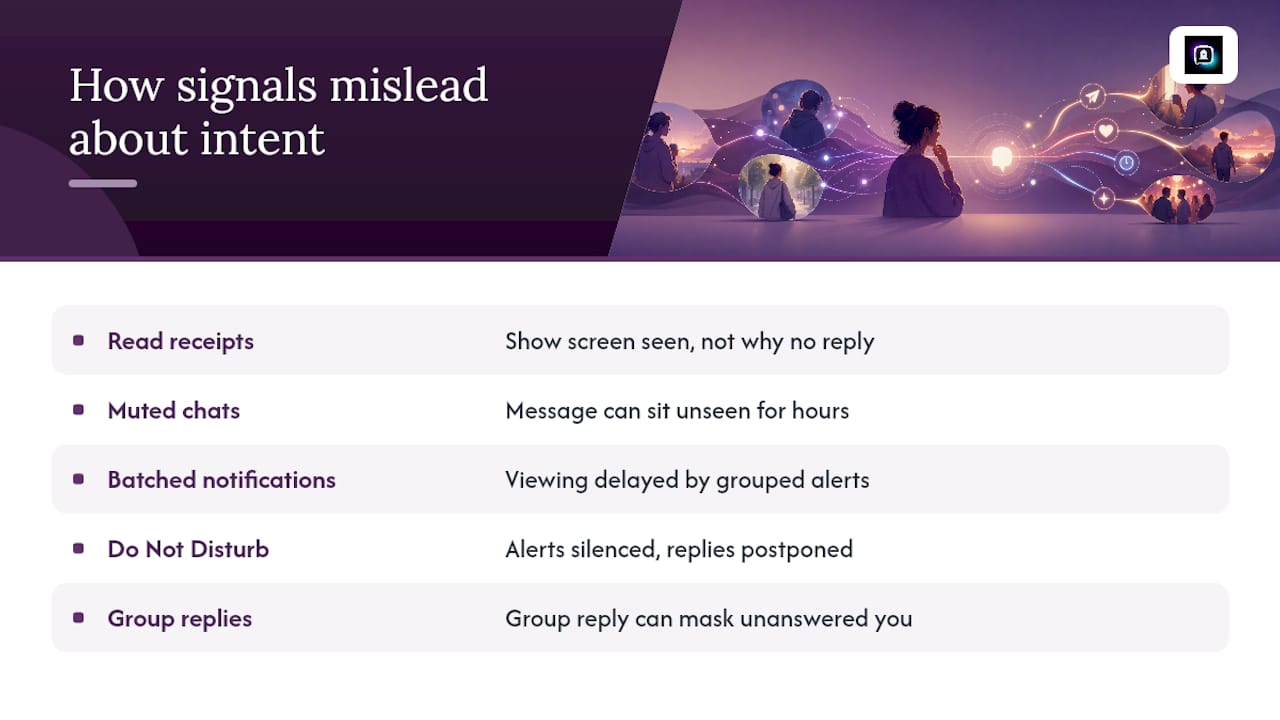
If read receipts are shaping how you interpret a delay, it helps to understand what that little "read" label actually does and doesn't tell you about intent, since it's a much weaker signal than most people assume. For a closer look at that specific piece of the puzzle, see what read receipts really say about intent. The short version: a read receipt tells you a screen was looked at. It doesn't tell you why the reply didn't follow.
The Take: Stop Treating Every Delay Like Evidence
The biggest mistake in how people read late replies is treating an isolated delay as proof of something, when it's almost always more information about someone's week than about their feelings toward you. The conventional advice, apologize more, respond faster, read into every gap, gets the emphasis backward. What actually predicts relationship health isn't reply speed. It's whether the content stays warm and whether commitments still get honored once someone does respond.
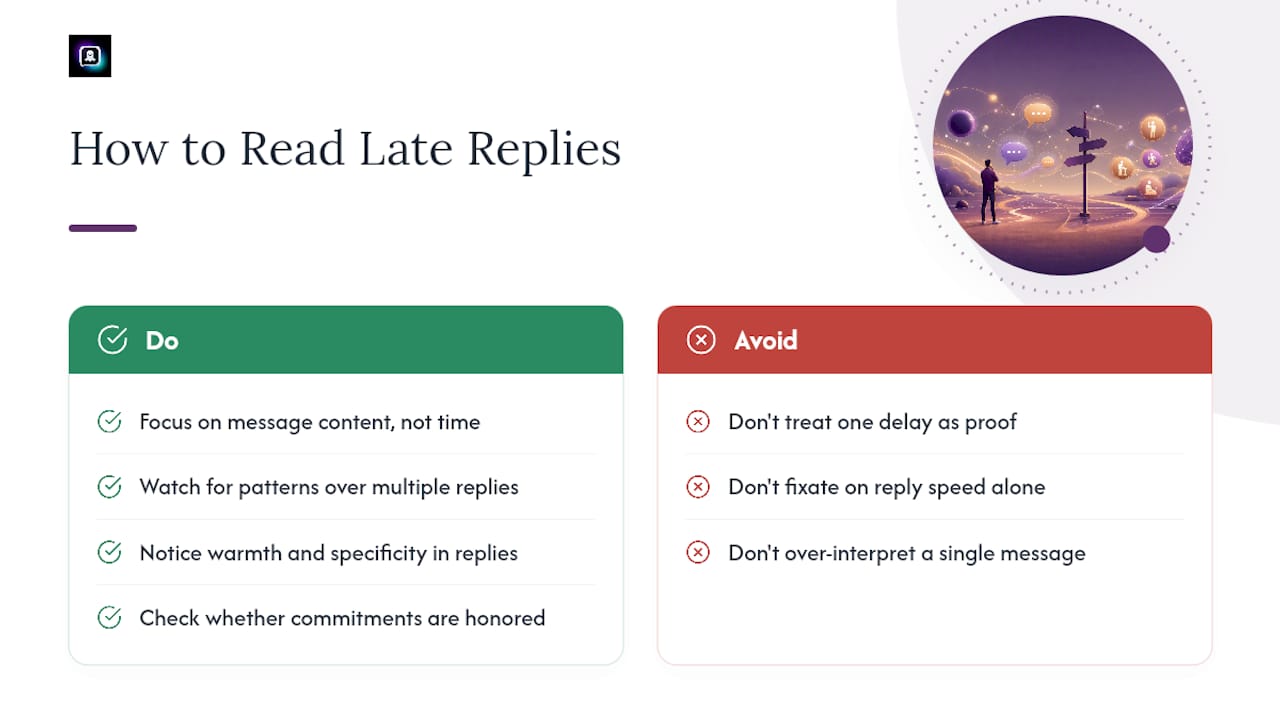
Where most people should redirect their attention is pattern over incident. A single slow reply tells you almost nothing. Three slow replies paired with shorter messages, fewer questions back, and missed follow-through tells you a lot. That distinction gets lost constantly because a single unanswered text is emotionally loud and a three-week pattern is easy to rationalize away one excuse at a time.
If there's one practical shift worth making, it's this: read the message, not the clock. A late reply that arrives warm, specific, and engaged has told you more than a fast reply that arrives flat.
— DSean
Ghosttextai reads exactly that pattern for you when the signals feel too mixed to trust your own read. Upload the conversation, and Ghost Text will flag the tone shifts, the reciprocity gaps, and the actual intent behind a delay, then hand you a reply that fits the situation instead of one written from anxiety. Try Ghost Text the next time a late reply has you rereading the same three words for the tenth time.
Sources
- Collins Dictionary — late
- Sorry for the Late Reply: How to Apologize for a Delayed Response — Grammarly
- APA Dictionary — delayed response