
In texting, "lol" stands for "laughing out loud," but it usually signals mild amusement, a social buffer, or simple acknowledgment rather than literal laughter. The gap between the acronym's literal meaning and how people actually use "lol in texting" today trips up more conversations than you'd think.
Three things "lol" typically does in a message:
- Softens a blunt statement so it doesn't land too hard
- Acknowledges something without adding new content
- Signals amusement, sometimes genuine, sometimes sarcastic
One-word "lol" replies deserve extra scrutiny. Dictionary usage notes point out that a standalone "lol" can double as a dry, low-effort response rather than a sign someone actually laughed, and capitalization ("LOL" versus "lol") often hints at how much energy the sender meant to convey.
Key Takeaways
"Lol" functions primarily as a social softener and acknowledgment tool in modern texting, not a literal report of laughter.
| Point | Details |
|---|---|
| Definition has shifted | "Lol" began as literal laughter in the mid-1980s but now mostly softens, acknowledges, or signals irony. |
| Capitalization signals intensity | "LOL" reads louder than "lol," and repeated letters (LOLOL) are performative exaggeration. |
| Watch for dry replies | A standalone "lol" with no elaboration, especially after a delay, often signals low engagement. |
| Context beats content | Sender relationship and response timing usually matter more than the word "lol" itself. |
| Match the setting | Skip "lol" in professional or sensitive messages; it fits best in casual, low-stakes exchanges. |
Table of Contents
- The Origin of "Lol" and How Its Meaning Shifted
- How People Actually Use "Lol" in a Text Today
- Lmao, Rofl, and Other Louder Versions of "Lol"
- When "Lol" Is a Dry Reply (and What to Do About It)
- Better Options Than "Lol" When You Want to Be Clear
- When to Use "Lol" and When to Leave It Out
- How Ghost Text Reads "Lol" in Context
- Why the Real Skill Isn't Defining "Lol," It's Reading It
- Frequently Asked Questions
- Sources
The Origin of "Lol" and How Its Meaning Shifted
"Lol" didn't start as a texting habit. It shows up in electronic messages as early as 1985, with usage solidifying by 1990 in the Oxford English Dictionary's records, and it was already a fixture of Usenet and early chat culture before texting existed. Both the Oxford English Dictionary and Cambridge Dictionary have formal entries for it, and Dictionary even tracks verb forms like "LOLed" and "LOLing," which tells you how deep it burrowed into everyday English.
What changed is the weight behind the word. Corpus research cited in linguistic summaries of "lol" found it was the single most frequent initialism in early instant-messaging samples, a dominance that pushed it toward something linguists call semantic bleaching:
- The literal claim ("I am laughing out loud") faded.
- The social function (buffering, rapport, filler) took over
- Frequency of use accelerated the fade, not slowed it
By the time texting exploded, "lol" had already become punctuation more than confession.
How People Actually Use "Lol" in a Text Today
Modern "lol" does a handful of specific jobs, and most of them have nothing to do with actual laughing.
- Softening. "Can't make it tonight lol" reads gentler than the same sentence without it. The word takes the edge off bad news or an awkward ask.
- Acknowledgment. When someone texts "running 10 min late," a reply of "lol okay" just confirms you saw it. No amusement required.
- Irony or sarcasm. "Sure, I'll get right on that lol" flips the sentence's meaning, turning a flat statement into a jab.
- Genuine amusement. Sometimes it's exactly what it says: something was funny.
Context does most of the interpretive work. In dating conversations, "lol" often smooths over vulnerability, like softening a compliment or an admission. Between old friends, it's frequently just rhythm, filler between real content. In family group chats, it defuses tension. In casual workplace chat, it signals you're being friendly, not curt.
Pro Tip: Before reacting to a text with "lol" in it, reread the sentence without the word. If the meaning barely changes, it was probably a softener, not a laugh.
Lmao, Rofl, and Other Louder Versions of "Lol"
When "lol" feels too muted, people reach for stronger variants:
- LMAO ("laughing my ass off") signals a bigger reaction than "lol," used for genuinely funny content
- ROFL ("rolling on the floor laughing") goes even further, often used half-jokingly given how rarely anyone is actually on the floor
- Lulz or lolz lean more into internet-culture irony than sincere amusement
Grammarly's guide to "lol" notes that capitalization changes perceived intensity: "LOL" in all caps reads louder and more emphatic than a lowercase "lol," which often reads almost whispered by comparison. Stack the letters (LOLOL, LOLLLL) and you've left literal laughter behind entirely. That's performance, a way of signaling "this was extremely funny" through sheer typographical exaggeration, not a report of how many times someone laughed.
When "Lol" Is a Dry Reply (and What to Do About It)
A one-word "lol" sitting alone in a text thread is one of the most misread signals in texting. A few tells help you separate genuine amusement from a brush-off:
- Timing. A reply that took hours for something time-sensitive reads differently than an instant one.
- Elaboration. "Lol" with zero follow-up, especially after you asked a real question, often means low engagement.
- Tone mismatch. If you sent something emotionally loaded and got back just "lol," that's a mismatch worth noticing.
Once you've spotted a dry "lol," you have three real options: let it go if the stakes are low, ask a direct clarifying question, or mirror their brevity and see what happens next. Our guide on decoding one-word texts like "k" covers the same pattern in more detail. If the conversation matters and texting keeps producing dry replies, a phone call usually resolves in five minutes what ten more texts won't.
Pro Tip: Try "haha real talk though..." to test whether the other person actually wants to engage or is just being polite.
Better Options Than "Lol" When You Want to Be Clear
"Lol" is efficient, but efficiency isn't always what a conversation needs.
- Use LMAO or ROFL when something is genuinely funny and you want that to land.
- Use "haha" or "ha" for a lighter, warmer tone without the acronym's flatness.
- Use an emoji (😂, 🙂) when you want a visual cue instead of text shorthand.
- Skip "lol" entirely and just say what you mean when clarity matters more than casualness.
Three quick templates:
- To defuse tension: "Haha fair point, I hear you" instead of a bare "lol"
- To confirm without sounding dismissive: "Got it, thanks for the heads up"
- To show real amusement: "Lmao that's actually hilarious"
Our reply templates for difficult messages go deeper on scripting these moments.
When to Use "Lol" and When to Leave It Out
A few rules keep you from misjudging the room.
- Avoid "lol" in professional or formal messages. It reads as unserious even when you don't mean it that way, and it can undercut a message you need taken seriously.
- Use it sparingly in sensitive conversations. Apologies, conflict, or bad news rarely benefit from a softener that can look like you're not taking things seriously.
- In casual dating or friend contexts, "lol" works well as a tension reducer, especially when you're testing the waters on something a little vulnerable.
For a broader rundown, our texting etiquette guide covers tone rules beyond just "lol." When in doubt, picture reading the message out loud to the person's face. If "lol" would feel out of place there, it probably belongs out of the text too.
How Ghost Text Reads "Lol" in Context
Ghost Text's AI weighs the same micro-signals a sharp human reader would: capitalization, message length, punctuation, adjacent emoji, and how long someone took to reply. Those cues shift the odds that a "lol" means genuine laughter versus polite distance.
Picture a message that reads: "yeah I guess we could reschedule lol." Sent an hour after your last text, with no emoji and a lowercase "lol," the AI flags it as likely reluctant agreement dressed up as casual, not real enthusiasm. A suggested reply might be: "No worries if the timing's bad, want to just pick a day that actually works?"
- Capitalization and repetition shift perceived intensity, a pattern dictionary guides on "lol" confirm
- Relational history and response timing usually matter more than the word itself
- Screenshots analyzed through Ghost Text surface tone and intent readings in seconds, drawing on the same signals outlined above
Why the Real Skill Isn't Defining "Lol," It's Reading It
Most advice on "lol" stops at the dictionary definition and calls it done. That's the weak point in almost every guide on this topic: knowing that "lol" can mean four different things is useless if you can't tell which one you're looking at in an actual message. The dictionaries get you the vocabulary. They don't get you the read.
What the evidence actually supports is that context variables, timing, capitalization, relationship history, do more interpretive work than the word itself. A "lol" from your sister after bad news means something entirely different from a "lol" from someone you've been texting for three days straight. Treating every "lol" the same way, as either always sincere or always dismissive, is the most common misread I see people make.
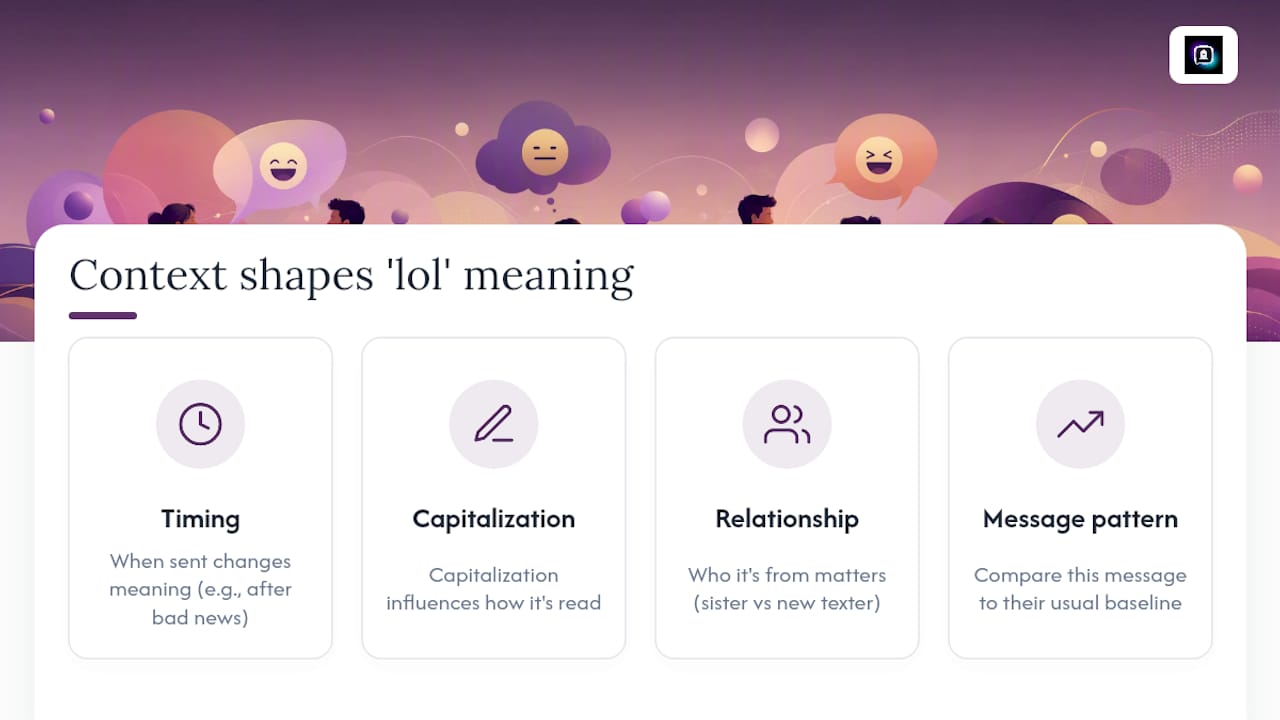
Prioritize the pattern, not the word. Look at how someone typically texts you, then measure this message against that baseline. That single habit will tell you more than any glossary ever could.
Frequently Asked Questions
What does "lol" mean in a text? "Lol" stands for "laughing out loud," but in most texts it signals mild amusement, acknowledgment, or a softer tone rather than actual laughter.
Is "lol" passive aggressive? It can be. When paired with a sarcastic or curt statement, "lol" often signals irritation dressed as humor rather than genuine amusement.
What's the difference between "lol" and "haha"? "Haha" tends to feel warmer and more personal, while "lol" reads flatter and more automatic, often functioning as filler rather than a reaction.
Why does someone reply with just "lol"? A standalone "lol" frequently signals low engagement or a lack of anything more to say, especially if it follows a longer delay or a substantive message.
Should I use "lol" in professional messages? Generally no. It reads as too casual for formal contexts and can undercut a message you want taken seriously.
Sources
- Oxford English Dictionary (entry: LOL)
- Grammarly — What Does Lol Mean?
- Cambridge Dictionary — LOL
- Dictionary