The upside-down smiley (🙃) is a flexible tone marker that signals sarcasm, irony, playful silliness, or frustrated resignation — depending entirely on context. Emojipedia, Dictionary, and Unicode (codepoint U+1F643) all define it similarly: a single emoji that can mean several things at once.
The three senses you'll encounter most often:
- Sarcasm or irony: The smile is flipped, and so is the literal meaning of whatever text it follows.
- Playful silliness: A lighthearted, goofy signal that the sender is joking around.
- Bemused resignation: "I'm smiling, but I'm not okay" — frustration worn lightly.
Key Takeaways
The upside-down smiley (🙃) is a tone marker, not a fixed meaning — context, pairing, and relationship history determine whether it reads as sarcastic, playful, or passive-aggressive.
| Point | Details |
|---|---|
| Core meanings | 🙃 signals sarcasm, irony, playful silliness, or frustrated resignation depending on context. |
| Context is everything | Surrounding emoji, punctuation, and recent chat tone determine the actual reading. |
| Cultural caution | In some Vietnamese contexts, the emoji reads as sarcastic or impolite rather than playful. |
| Unicode origin | Added in Unicode 8.0 (2015) at codepoint U+1F643; vendor designs vary and affect tone perception. |
| Ghosttextai | Paste any ambiguous conversation into Ghosttextai for a confidence-rated tone read and suggested reply. |
Table of Contents
- What does the upside down smiley mean in everyday use?
- Short examples that show how to read 🙃 in context
- Is 🙃 flirty, sarcastic, or rude? How to tell the difference
- When to use 🙃 and when to leave it out
- Where did 🙃 come from? Unicode origin and platform differences
- Cultural and regional interpretation risks
- A quick checklist for reading an ambiguous 🙃 message
- How Ghosttextai helps you read ambiguous emoji like 🙃
- The part most people skip
- Ghosttextai reads the tone so you don't have to guess
- Sources
What does the upside down smiley mean in everyday use?
The emoji covers a wider range than most people expect. Here's how each core sense actually plays out in real conversations.
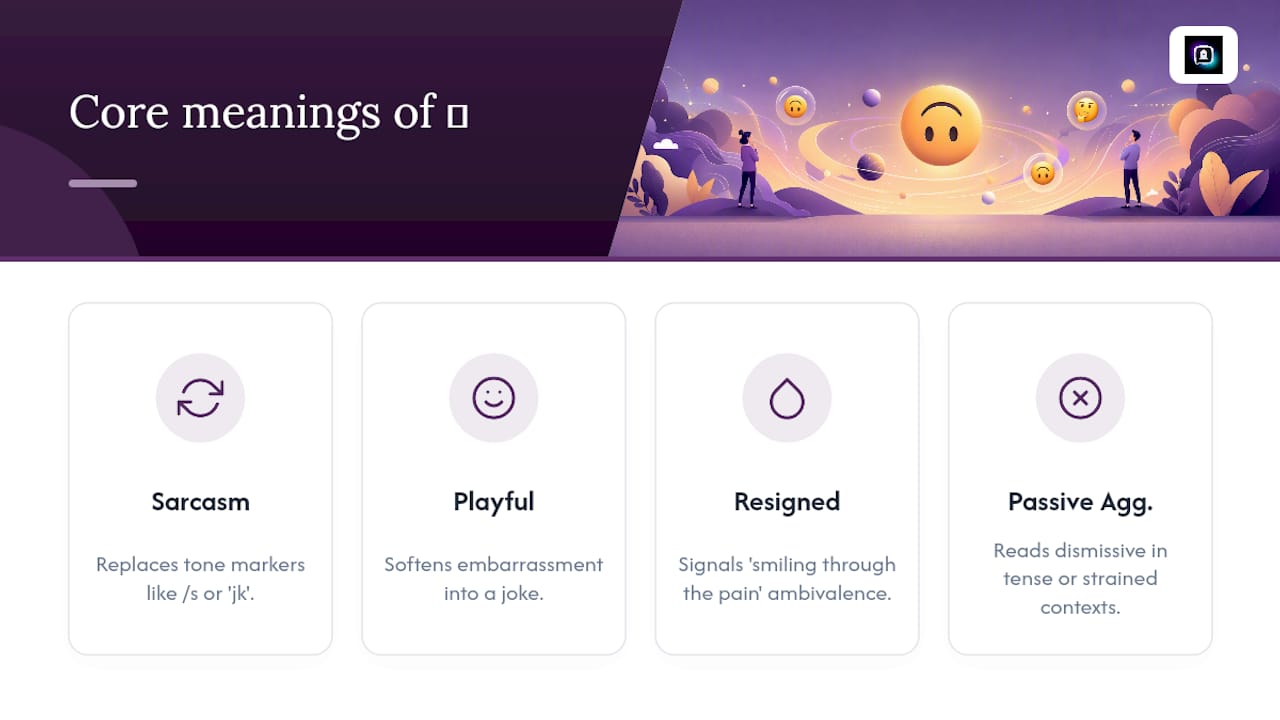
Sarcasm and irony are the most common uses. The flipped smile visually mirrors a flipped meaning, so "Oh sure, that went great 🙃" reads as the opposite of what it literally says. Dictionary.com notes that 🙃 often replaces explicit tone markers like /s or "jk," which is why it lands so naturally at the end of a dry comment.
Playful silliness is the friendlier cousin. When someone sends "I just tripped in front of my entire office 🙃," the emoji softens the embarrassment into a joke. It signals: don't take this too seriously.
Frustrated resignation is subtler. Emojiologist Jane Solomon describes the upside-down face as inherently ambivalent — "at once mad and glad" — which is exactly what makes it so useful for the "smiling through the pain" moment. Think of it as the emoji equivalent of a tight-lipped grin.
Passive aggression is the fourth reading, and the trickiest. When the surrounding text is tense or the relationship is strained, 🙃 can read as dismissive rather than playful. Personality and prior conversation history do most of the interpretive work here.
Short examples that show how to read 🙃 in context
Concrete snippets make the range clearer than any definition:
- "Totally fine with working the holiday weekend 🙃" — Sarcasm. The emoji flags that "totally fine" means the opposite.
- "I just sent that to my boss instead of my friend 🙃" — Embarrassed resignation; Android Authority calls this the "wrong-recipient" use, a social lubricant for awkward moments.
- "You're literally the worst 🙃😂" — Playful teasing. The laughing emoji alongside it confirms the joke.
- "Sure, I'll just do everything myself 🙃" — Passive aggression. No other emoji to soften it.
- "Missing you 🙃" — Flirty and a little vulnerable; the flipped smile adds a self-deprecating edge that reads as charming rather than sad.
- "FINE. 🙃" — All-caps plus the emoji signals barely contained frustration, not acceptance.
Punctuation and capitalization shift the reading significantly. A period after 🙃 tends to feel colder than no punctuation at all. Pairing it with 😂 or ❤️ pulls it toward warmth; pairing it with silence or a blunt statement pulls it toward passive aggression.
Is 🙃 flirty, sarcastic, or rude? How to tell the difference
All three are possible, and the emoji itself doesn't decide. The surrounding text does.
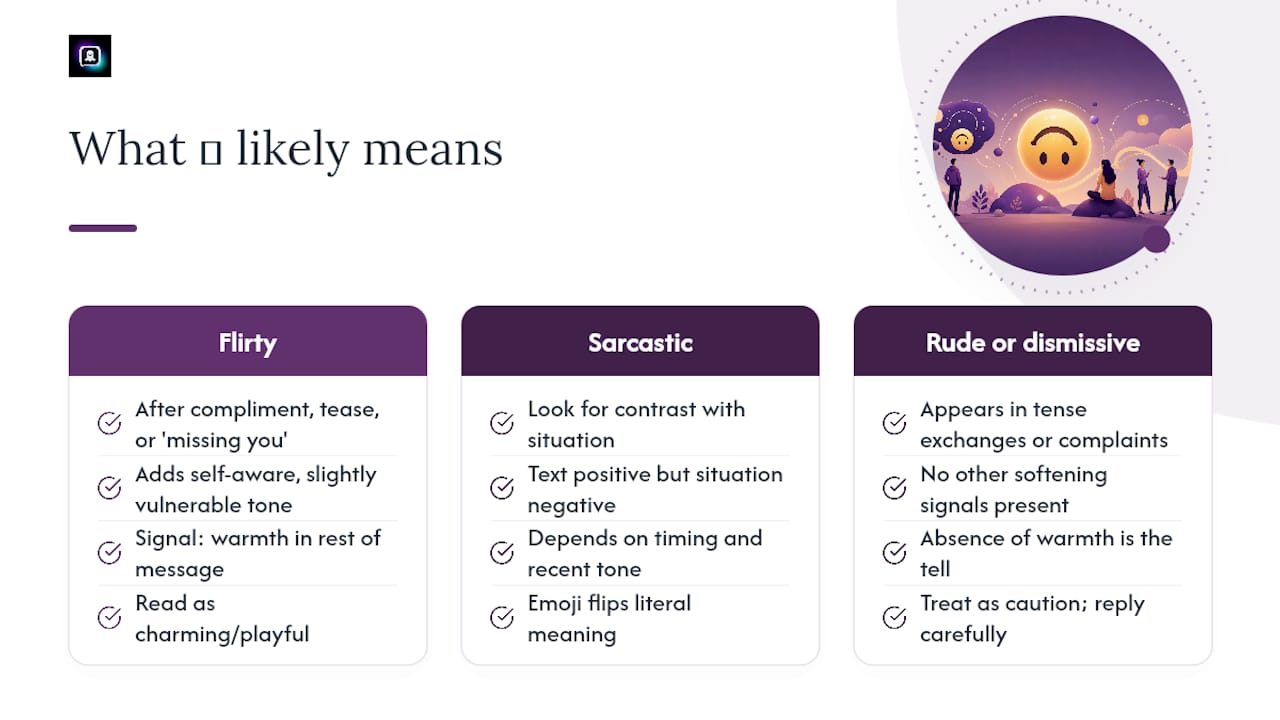
Flirty: When someone uses 🙃 after a compliment, a teasing comment, or a "missing you" message, it adds a self-aware, slightly vulnerable quality that reads as charming. The key signal is warmth in the rest of the message.
Sarcastic: Look for contrast. If the text says something positive but the situation is clearly negative, the emoji is flipping the meaning. Android Authority points out that interpretation depends heavily on context — timing, the conversation's recent tone, and what the sender just experienced all matter.
Rude or dismissive: When 🙃 appears in a tense exchange, after a complaint, or with no other softening signals, it can read as flippant. The absence of warmth is the tell.
Pro Tip: When a message feels ambiguous, scroll up. If the last few exchanges were warm and jokey, 🙃 is almost certainly playful. If the conversation has been tense or one-sided, treat it as a caution signal and reply carefully.
When to use 🙃 and when to leave it out
Use it when:
- You want to soften a complaint without dropping it entirely.
- You're making a self-deprecating joke and want to signal you're in on it.
- The conversation is already light and you're adding a playful layer.
Avoid it when:
- The message involves a serious commitment, conflict, or apology — 🙃 can signal emotional distance you don't intend.
- You're texting a professional contact for the first time. Texting etiquette in professional contexts calls for clarity over cleverness.
- The topic is sensitive enough that any ambiguity could damage trust.
A single ambiguous emoji in a high-stakes message can do real damage. Android Authority flags this directly: in professional or high-stakes communication, 🙃 risks reading as dismissive or flippant, and a clarifying question is often the safer move.
Where did 🙃 come from? Unicode origin and platform differences
The upside-down face was added in Unicode 8.0 in June 2015, encoded at codepoint U+1F643 in the Emoticons block. It is essentially a mirrored version of the Slightly Smiling Face (🙂), and vendor designs vary — Apple, Google, and Samsung each render it slightly differently, which can affect how warm or unsettling it looks to the recipient.
| Property | Detail |
|---|---|
| Codepoint | U+1F643 |
| Unicode version | 8.0 |
| Release year | 2015 |
| Design basis | Flipped Slightly Smiling Face (🙂) |
Cultural and regional interpretation risks
Emoji meanings don't travel cleanly across cultures. Wiktionary's entry for 🙃 documents that the emoji is perceived as sarcastic or outright impolite in some Vietnamese contexts, where a flipped smile carries a different social weight than it does in American or Western European messaging norms.
More broadly, cultures with stricter politeness norms around disagreement or complaint may read the "smiling through frustration" use as passive-aggressive rather than self-deprecating. When messaging someone from a different cultural background, explicit language is safer than relying on an emoji to carry the tone.
A quick checklist for reading an ambiguous 🙃 message
Run through these before you reply:
- Who sent it? A close friend's 🙃 reads differently than a coworker's.
- What did the message just before say? The emoji responds to something — find what.
- Are there other emoji or punctuation? 😂 beside it = joke. Period after it = colder.
- What's the recent chat tone? Warm and playful, or tense and one-sided?
- How often does this person use it? Frequent use usually means it's a casual habit, not a loaded signal.
Pro Tip: When you genuinely can't tell, ask. "Was that sarcastic or are you actually okay?" takes five seconds and prevents a misread that could last days. You can also use an AI tone detector to get a second read before you respond.
How Ghosttextai helps you read ambiguous emoji like 🙃
Ghosttextai is built for exactly this problem. Paste a conversation or upload a screenshot and you get:
- Instant tone analysis: Confidence-rated reading of whether a message is sarcastic, sincere, frustrated, or flirty.
- Intent and emotional signals: Flags when an emoji like 🙃 is paired with content that suggests distance or passive aggression.
- Red-flag detection: Identifies patterns across a conversation, not just a single message.
- Suggested replies: Contextually tailored response options with tone and style you can adjust.
A message like "Sure, I'll handle it 🙃" might read as fine on the surface, but tools like Iteration can compare AI approaches to conversational feedback and help flag ambiguous tone. Ghosttextai catches the contrast between the agreeable text and the flipped emoji and flags it as likely frustrated resignation, then offers reply options that acknowledge the sender's tone rather than ignoring it.
The part most people skip
Most emoji guides treat 🙃 as a sarcasm emoji and stop there. That's the least interesting thing about it. What makes it genuinely useful is the ambivalence Jane Solomon identified — the ability to hold two feelings at once. It lets people complain without escalating, flirt without committing, and joke without fully owning the joke. That's not a bug. It's the whole point.
The risk is that the same ambivalence that makes it socially useful makes it genuinely hard to read. Context isn't a tiebreaker here; it's the only input that matters. Read the conversation, not just the emoji.
Ghosttextai reads the tone so you don't have to guess
Ambiguous messages cost you more than a moment of confusion. They cost you the right response.
Ghosttextai analyzes the full conversation, not just the emoji, so you know whether that 🙃 is playful, frustrated, or a quiet red flag. Paste the message, get a confidence-rated tone read, and choose from suggested replies matched to the actual intent. No more second-guessing a single flipped smile.
Read what your messages really mean with Ghosttextai — free to start, no guesswork required.
Sources
- Upside-Down Face emoji
- Dictionary
- Unicodeplus: U+1F643 UPSIDE-DOWN FACE
- Emojiology: What Does The Upside-Down Face Emoji Mean?