
Managers may text employees only for short, time-sensitive, operational reasons, and only after getting consent to use that channel. Keep the message factual, brief, sent during business hours, and free of anything confidential or disciplinary. When a text starts feeling complicated or emotionally loaded, that's the signal to pick up the phone or write an email instead.
TL;DR:
- Texting should only be used for urgent, operational updates with explicit employee consent obtained during onboarding and documented properly.
- Messages must be concise, professional, sent during business hours, and avoid sharing sensitive or disciplinary information to mitigate legal and compliance risks.
- Managers should limit after-hours texts to genuine emergencies and avoid expecting immediate replies outside scheduled work hours to prevent resentment and wage-hour issues.
- Group texts and including employees in threads should be strictly limited to essential recipients, avoiding personal or performance information to protect privacy.
- Always check tone, clarity, and sensitivity before sending, and prefer calling or emailing for nuanced, high-stakes, or emotionally charged messages.
Table of Contents
- When Is Manager Texting Etiquette Appropriate?
- Manager Texting Rules: Concise Do's and Don'ts
- When Should Managers Send Texts, and How Fast Should Employees Reply?
- Sensitive Information, Legal, and Compliance Considerations
- Group Texts, CCs, and Who Belongs in the Thread
- Practical Message Templates and Scripts for Managers
- Building a Simple Team Texting Policy
- Checking Tone Before You Hit Send
- Handling Misunderstandings and Misread Texts
- Texting vs. Email vs. Calling: Choosing the Right Channel
- Privacy When Texting Employees Outside Work Hours
- A Manager's Quick Checklist to Follow Every Time
- Checking Your Message Tone Before It Becomes a Problem
- Sources
When Is Manager Texting Etiquette Appropriate?
Texting works best when speed matters more than nuance. It is not suitable when a message requires context, documentation, or a paper trail with signatures. The boundary between these situations is where most managers get into trouble.
**Good reasons to text an employee: **
- A shift changed and someone needs to know in the next 20 minutes, not the next email check.
- A safety alert requires immediate acknowledgment (weather closure, equipment failure, building evacuation).
- You need a quick yes/no confirmation ("Can you cover the 2pm shift?").
- You're relaying a short logistical update that doesn't require a signature or record trail.
Situations where texting creates risk instead of solving a problem:
- Disciplinary conversations. A write-up, a performance warning, or a termination notice belongs in a documented meeting, not a text thread.
- Anything touching protected health information or personally identifiable information. Standard SMS isn't encrypted the way HR systems are, and a breach here becomes a compliance problem fast.
- Policy changes that require an employee's signature or acknowledgment. If HR needs proof someone read and understood something, a text doesn't create that proof.
The fix for most of this starts at onboarding, not in the moment you need to send a message. Ask new hires directly: "Is it okay if I text you for shift changes or urgent updates?" Document that yes. It sounds like overkill until the first time an employee claims they never agreed to receive work texts on their personal number, which is exactly the kind of dispute the FCC's TCPA rules are built to prevent. Consent isn't a formality. It's the thing that turns a helpful text into a defensible one.
Setting expectations matters as much as getting permission. Inform employees upfront about the types of texts they may receive, how frequently, and what response time (if any) is expected. This helps prevent confusion later.
Manager Texting Rules: Concise Do's and Don'ts
Here's the part you can screenshot and keep on your phone. These rules aren't theoretical. They're the difference between a text that solves a problem and one that creates a new one.
Do this every time:
- Ask permission before you ever text someone about work, and get a clear yes on record.
- Identify yourself in the first message if the employee doesn't have your number saved ("Hi, it's Dana from scheduling").
- Stick to one idea per text. Two topics in one message means one of them gets missed.
- State the action you need and the deadline, if there is one. "Can you confirm by 3pm?" beats "let me know."
- Send during business hours unless it's a genuine emergency.
- Keep the tone plain and professional, even when the news is good.
- Sign off with your name on the first message of any new thread, especially with newer employees.
Never do this:
- Never send disciplinary content, performance reviews, or termination details over standard text.
- Never transmit medical information, Social Security numbers, or anything that qualifies as PII or PHI over SMS.
- Never lean on slang, emojis, or all caps for anything official. A thumbs-up emoji reads differently depending on the platform and device it's viewed on, and that ambiguity is the last thing you want in a work message.
- Never demand an immediate reply outside working hours unless it's a true emergency. If it's not urgent enough to justify a midnight phone call, it's not urgent enough for a midnight text either.
- Never assume silence means agreement. No response to a text is not consent, confirmation, or acknowledgment of anything.
Best-practice guides on business texting consistently point to the same core habit: keep messages concise, one idea at a time, and clearly identified. That's not a stylistic preference. It's what keeps a text legible when someone reads it back weeks later without the context you had in your head when you sent it.
Pro Tip: Before you hit send, read the message once as if you were the employee receiving it with zero context. If it could be misread as a threat, a demand, or a decision that needs a paper trail, don't send it as a text.
A simple pre-send checklist saves you from most of the mistakes above:
- Did I get consent to text this person for this kind of message?
- Is this one idea, stated plainly, with a clear action or deadline?
- Am I sending this during reasonable hours?
- Does this message contain anything confidential, disciplinary, or medical? If yes, stop and use another channel.
- Have I identified myself if this is a new or infrequent contact?
Run through those five questions and you'll catch nearly every problem before it becomes one.
When Should Managers Send Texts, and How Fast Should Employees Reply?
Texting outside a reasonable window is one of the fastest ways to create resentment, and in some cases, legal exposure. Business-texting guidance commonly points to an 8 AM to 9 PM local-time window as the outer boundary for non-emergency messages, but a tighter window tied to actual working hours is safer for most teams.
- Send routine or informational texts only during scheduled work hours.
- Reserve after-hours texts for genuine emergencies: safety issues, urgent schedule gaps, or something that can't wait until the next shift.
- For urgent operational texts (a shift covering, a safety issue), a reasonable reply window is under an hour.
- For informational texts (a schedule reminder, a heads-up), there's no expectation of an immediate reply at all.
The reply-window question gets more complicated with non-exempt, hourly employees. If someone is expected to read and respond to a work text outside their scheduled shift, that time can count as compensable work under wage-hour rules, which means unplanned texting can quietly generate overtime exposure most managers never see coming. The safer approach is to limit non-urgent texts to scheduled hours and document any exceptions when they occur.
Double-texting deserves its own mention. If someone hasn't responded within a reasonable window, one polite follow-up is fine. Two or three follow-ups in a row reads as pressure, not urgency, and it's usually a sign you've picked the wrong channel. If a text has gone unanswered and the matter is genuinely time-sensitive, escalate to a call. Calls carry urgency in a way text can't fake, and they resolve ambiguity that a string of unanswered texts only compounds.
Sensitive Information, Legal, and Compliance Considerations
Every work text a manager sends is a potential company record. That's not a scare tactic. It's how the law actually treats these messages.
Federal recordkeeping standards treat business-related communications, even on personal devices, as records that may need to be preserved, and the Federal Records Act makes that preservation obligation explicit once litigation or an investigation is on the table. If a dispute ever escalates, texts get pulled into discovery the same way emails do, except they tend to be more casual, more emotionally loaded, and easier to misread months later without context.
Informal communications, including texts, can be used as evidence in workplace investigations. A manager's off-the-cuff message can carry the same weight as a formal memo once it becomes part of a record.
That's the practical reality behind the EEOC's guidance on retaliation and adverse action: informal channels don't get an informality discount when they end up in front of an investigator. A sarcastic text sent in frustration reads very differently in a deposition than it did in the moment.
Two compliance frameworks matter most here. The TCPA requires clear consent for many business text messages and obligates employers to honor opt-out requests through any reasonable method the employee uses, not just a formal unsubscribe process. The FLSA creates wage-hour exposure when non-exempt employees are expected to respond to texts outside their paid hours, since that response time can count as compensable work.
Practical safeguards that actually reduce risk:
- Use an approved company platform for anything beyond casual scheduling texts, not personal numbers, when the organization has one available.
- Never put PHI, PII, or disciplinary content into standard SMS.
- Keep a retention practice: know how long texts are kept and how they'd be retrieved if legal counsel ever asked.
HR-focused guidance is blunt about this: texting without a written policy and an approved platform is one of the more common ways employers accumulate wage-hour and documentation exposure they never intended to create.
Group Texts, CCs, and Who Belongs in the Thread
Group texts multiply every risk that exists in a one-to-one message. Before adding someone to a thread, ask whether they actually need real-time visibility into this specific message, not just whether it's convenient to include everyone at once.
- Include only the people who need to act on the message right now. A shift-coverage request goes to the two or three people who could actually cover it, not the whole department.
- Use an approved broadcast tool for wider announcements (a building closure, a policy reminder) rather than a sprawling group thread where replies get tangled.
- Never mention one employee's schedule, performance, or personal situation in a thread that includes other employees. That's a privacy problem waiting to surface.
Compare the phrasing difference: a one-to-one message might read, "Hey Sam, can you cover Jordan's shift tomorrow? Jordan called in sick." A group version of that same need should never name Jordan's reason for calling out. It becomes: "Need coverage for tomorrow's 9am shift, reply if you're available." Same operational goal, no personal information shared with people who don't need it.
Practical Message Templates and Scripts for Managers
Copy these, adjust the specifics, and you'll cover most of the situations that actually come up.
- Shift change: "Hi [Name], it's [Manager]. Your Thursday shift moved from 2pm to 4pm. Reply to confirm you got this."
- Confirm receipt: "Quick check: did you see the email about the new intake form? Just need a thumbs-up that it landed."
- Safety alert: "Building closed today due to [reason]. Do not come in. Full update coming by email within the hour."
- Follow-up after a meeting: "Thanks for the conversation earlier. I'll send the full notes by email so we both have a record."
For exempt staff, a slightly more casual tone is fine since after-hours contact carries less wage-hour risk. For non-exempt employees, keep texts strictly within scheduled hours and lean more formal, since that message could later be reviewed as a timekeeping question. Include your name on the first text of any new thread, and if a message references a policy or a document, link to it rather than trying to explain it inside the text itself.
Building a Simple Team Texting Policy
A written policy doesn't need to be long to work. It needs to cover six things clearly enough that a manager can follow it without calling HR first.
- Scope: who can text whom, and for what categories of message.
- Opt-in consent: collected at onboarding, documented, and revisited if someone changes their number.
- Communication windows: the specific hours texting is acceptable, with a defined emergency exception.
- Allowed content: operational and scheduling only, never disciplinary or medical.
- Retention: how long messages are kept and how they'd be retrieved if needed.
- Opt-out handling: a clear process for honoring a STOP request or any other reasonable revocation, in line with TCPA opt-out obligations.
Workplace texting policy guides consistently pair that opt-in consent with a designated platform and an export or retention capability, since that combination is what actually holds up if HR needs to review a message trail later. Train managers on the policy once at rollout, then again any time it changes. A policy nobody's read isn't a policy. It's a document.
Pro Tip: Keep the policy to one page. A texting policy that takes ten minutes to read is a policy managers will actually follow.
Checking Tone Before You Hit Send
A short self-audit catches most texting mistakes before they leave your phone. First, ask what the message is actually doing: is it directive (an instruction) or informational (an update)? That framing changes how it should read. Second, scan for ambiguity or emotional charge. A phrase like "we need to talk" reads as a threat to most people, even when you meant nothing by it. Third, redact anything sensitive and add your name if the recipient might not immediately know who's texting.
A quick example: "Why didn't you finish this?" reads as an accusation. "Did you run into an issue with this task? Let's talk when you have a minute" gets the same information without putting someone on the defensive. Running your own messages through a tone check for miscommunication before sending is a habit worth building, especially for managers texting people they don't know well yet.
Handling Misunderstandings and Misread Texts
Text strips out tone, facial expression, and pacing, which means the same words can land as neutral to you and hostile to someone else. When an employee reacts to a text differently than you intended, don't try to fix it with another text. Call, or ask to talk in person, and open with something direct: "I think that came across wrong. Here's what I meant."
Resist the urge to over-explain in writing after a misunderstanding surfaces. A long text trying to clarify an earlier short one usually makes things worse, because now there are two messages to misread instead of one. If the confusion involves anything with performance or disciplinary implications, move that clarification to a documented conversation rather than trying to patch it over text. And if you notice a pattern where your texts are regularly misread, the problem usually isn't the employee's reading comprehension. It's the message design: too terse, too ambiguous, or missing context the recipient needed. A calm-reply approach works in both directions here, whether you're the one who caused the confusion or the one trying to de-escalate it.
Texting vs. Email vs. Calling: Choosing the Right Channel
Texting is fast and low-friction, which is exactly why it's wrong for anything that needs nuance, documentation, or emotional context. Email creates a timestamped, searchable record and gives both sides time to think before responding, which makes it the better choice for anything involving policy, performance, or multi-step instructions. A phone call carries tone and urgency that text simply can't replicate, and it resolves ambiguity in real time instead of over several back-and-forth messages.
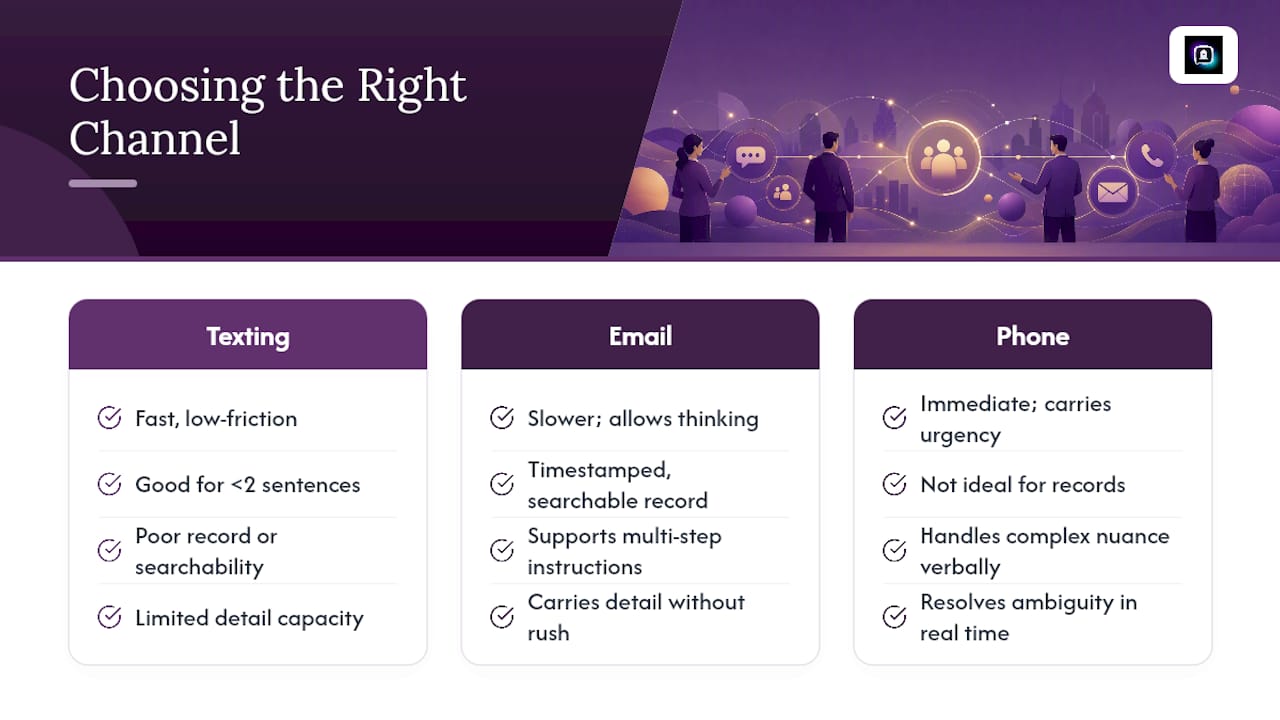
A rough rule: if the message is under two sentences and time-sensitive, text it. If it needs a record or more than a couple of details, email it. If it's emotionally loaded, ambiguous, or high-stakes, call. Choosing the right channel for the message instead of defaulting to whichever one is fastest is the single biggest thing separating managers who use texting well from those who create problems with it.
Privacy When Texting Employees Outside Work Hours
Texting an employee's personal phone after hours is different from emailing a work account, because it reaches a device tied to someone's personal life, not just their job. Employees notice, and unspoken resentment builds fast when work intrudes on personal time without a clear reason.
Limit after-hours texts strictly to genuine emergencies, and say so explicitly when you send one: "Sorry to text after hours, this is time-sensitive." That one line signals respect for the boundary you're crossing and reduces the sting of the intrusion. Avoid checking whether someone read a non-urgent text sent outside their shift, and never penalize slow replies to after-hours messages that weren't marked as emergencies. If your team regularly needs after-hours contact for a legitimate operational reason, that's a signal to formalize an on-call process rather than relying on ad hoc texts to whoever happens to be reachable.
A Manager's Quick Checklist to Follow Every Time
Before any text goes out, run this in your head: did I get consent, is this one idea, is it business hours, have I stripped out anything sensitive, and does the recipient know who's texting them? That five-second check catches almost every mistake this article covers.
The real tension in manager texting isn't speed versus politeness. It's speed versus the record you're creating without meaning to. A text feels casual in the moment and reads as evidence months later. Slow down just enough to notice the difference.
— DSean
Checking Your Message Tone Before It Becomes a Problem
There are other ways to catch a badly worded text: read it out loud, ask a colleague to glance at it, or wait five minutes before sending anything written in frustration. Some tools offer a second read on messages before they go out. By uploading a screenshot or pasting the text, these tools can flag tone, ambiguity, and emotional risk that might not be obvious, and offer rewritten versions if the original reads harsher or more ambiguous than intended.
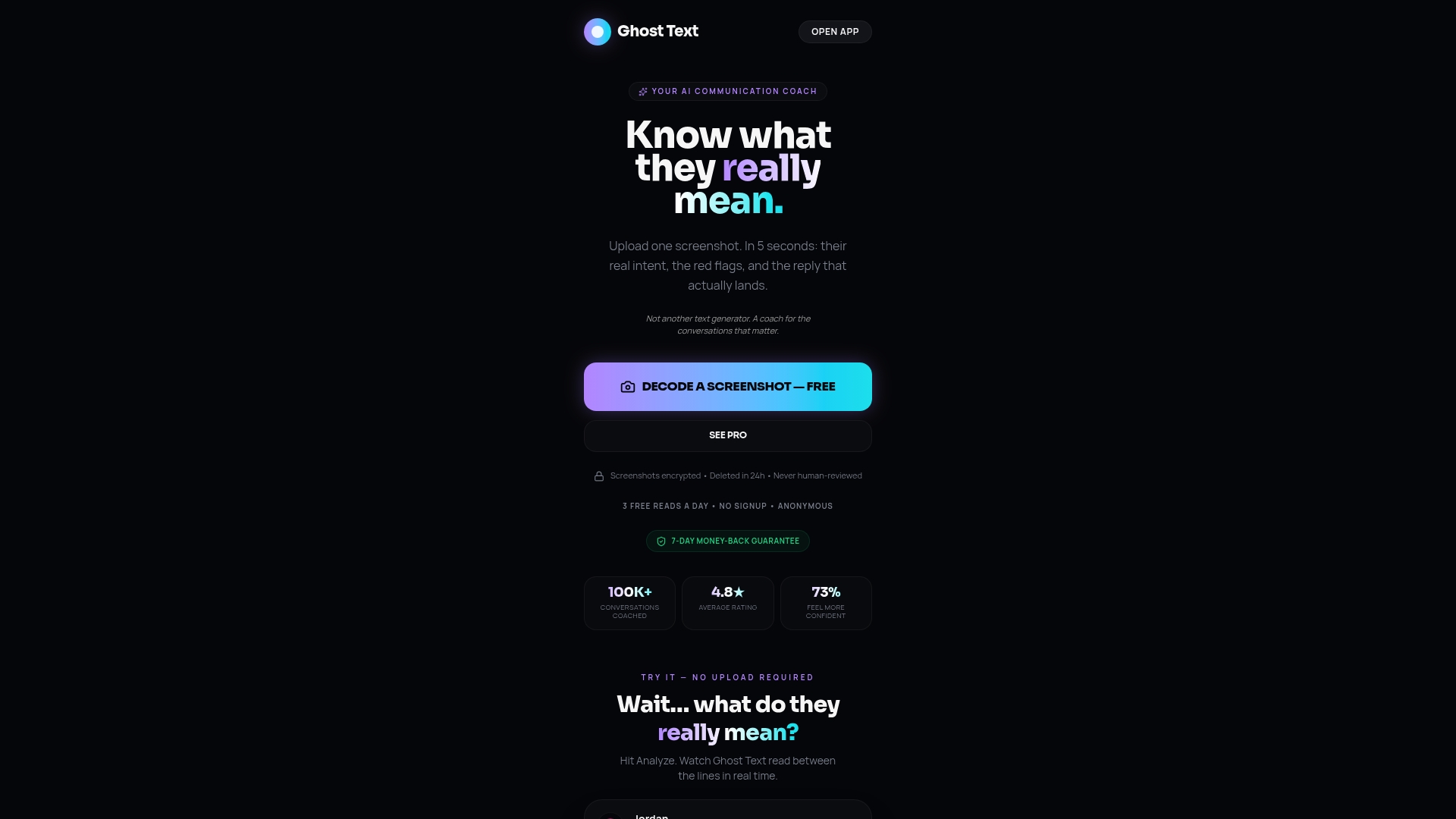
That kind of check matters most in the exact situations this article flagged as risky: a message about a missed deadline, a follow-up after tension in a meeting, anything where wording could be read two different ways. Instead of guessing whether your phrasing will land the way you mean it, run it through Ghost Text before you hit send.
Sources
- FCC — TCPA rules (PDF)
- Payentry — Texting with employees: proceed with caution in workplace communications
- OfficeVibeHub — Guide to using text messages to communicate with employees
- HubSpot — Business texting etiquette and best practices