
Both "k" and "ok" mean yes, agreed, understood. The difference is tone, not meaning: "ok" reads as a normal, neutral confirmation, while a lone "k" frequently comes across as cold, clipped, or annoyed, especially outside close, established relationships. Before you assume the worst, check the sender's usual texting style and the mood of the conversation leading up to it.
TL;DR:
- A single "k" is often perceived as cold or dismissive outside close relationships, especially when it appears after a long period of warm exchanges.
- The impact of "k" varies greatly depending on sender history and timing, with abrupt or isolated "k"s more likely to signal disengagement or annoyance.
- Adding punctuation like exclamation points or words such as "thanks" can clarify tone, preventing misinterpretation of short responses.
- Formal contexts or older users tend to prefer full "ok" or "okay" with proper punctuation, while younger groups view minimalism as casual and friendly.
- Context-aware tools like Ghost Text can help interpret ambiguous texts and suggest appropriate, tone-matched responses to avoid misunderstandings.
Table of Contents
- OK vs K Meaning: A Quick Comparison
- Why Relationship History Changes How 'K' Lands
- How to Reply Without Starting a Misunderstanding
- How Punctuation Changes the Temperature of 'OK'
- What Linguists and Ghost Text Both Say About Short Replies
- When to Let It Go and When to Ask
- Let Ghost Text Read the Tone So You Don't Have to Guess
- Sources
OK vs K Meaning: A Quick Comparison
Texting shorthand collapses full words into single letters, but each form carries its own social weight. "OK" and "okay" have been interchangeable for over a century, according to YourDictionary, functioning as a neutral, all-purpose acknowledgment in speech and writing alike. "K" is a newer, texting-specific shorthand, born in early online chat rooms and gaming communities where speed of reply mattered more than warmth, according to Know Your Meme.
Here's how the four common forms typically land:
- Ok — Neutral, standard confirmation. Reads fine in almost any context, from a coworker's request to a friend's plan change.
- Okay — Slightly warmer than "ok" simply because it takes more effort to type; often used in more personal or emotional exchanges.
- Kk — Casual and friendly. The doubled letter signals playfulness rather than dismissal, and it's common in fast-paced group chats and gaming voice channels.
- K — Often the coldest of the four. Without punctuation or context, it can read as annoyed, bored, or done with the conversation.
Younger texters and gamers tend to use "k" and "kk" more casually and without any negative charge, since speed is the norm in those spaces. Outside that context, a bare "k" is more likely to be read as a red flag than a neutral nod.
Why Relationship History Changes How 'K' Lands
The same three-letter word can mean two completely different things depending on who sent it. A "k" from your best friend of ten years, sent mid-joke in a group chat, reads as a shrug. That same "k" from someone you started dating three weeks ago, sent after you asked a direct question, reads as a shutdown.
Think of it as an emotional baseline: how a person normally texts you sets the standard you measure every new message against. If your partner always writes in full sentences with emojis and suddenly replies "k," that's a real shift worth noticing. If they've always been a one-word texter, it's just Tuesday.
Timing matters just as much as history. A "k" sent instantly after a casual update feels different from a "k" that arrives twenty minutes after you shared something vulnerable. The delay plus the brevity often reads as disengagement, even if the sender meant nothing by it.
The data backs up the gut reaction. Coverage of research on text message reception found that single-letter replies like "k" consistently score among the most negatively perceived responses in studies, frequently getting flagged as cold or dismissive regardless of the sender's actual intent. That gap between intent and perception is exactly where most texting misunderstandings live.
How to Reply Without Starting a Misunderstanding
Before you fire back a reply, run through a quick three-step check:
- Assess the baseline. Does this person always text short, or has something changed?
- Pick your warmth level. Match or slightly exceed their usual tone, don't undercut it.
- Reply accordingly. If you're unsure, err toward a warmer, clearer response rather than mirroring a cold one.
A few scripts for common situations:
- To a friend who went quiet: "Hey, all good? Didn't mean to overload you with texts lol"
- To a date who replied 'k' after you suggested plans: "No worries if tonight's bad, want me to check another day?"
- To a coworker's terse 'k' on a work thread: "Got it, thanks! Let me know if anything changes on your end."
Each script does the same job: it lowers the stakes and gives the other person an easy way to clarify without feeling accused of anything.
Pro Tip: If you're the one sending "k," add one extra word. "K, thanks" or "K sounds good" takes two seconds and removes almost all ambiguity about your tone.
How Punctuation Changes the Temperature of 'OK'
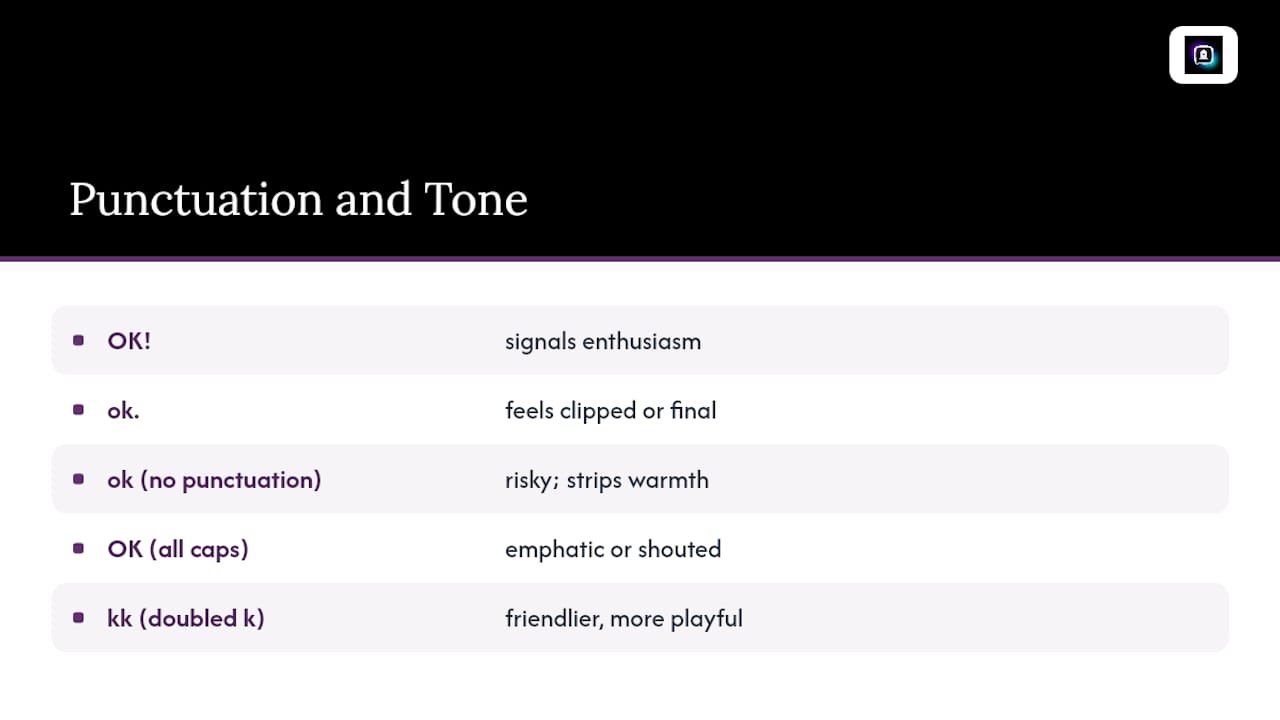
A single exclamation point does more work than most people realize. Adding an exclamation mark after "OK" can signal enthusiasm, while a period can make "ok" feel more clipped or final, almost like a door closing. Lifehacker's guidance on texting specifically flags punctuation-free short replies as risky, since they strip out any signal of warmth the recipient might otherwise pick up on.
Capitalization plays a role too. "OK" in all caps can read as emphatic or even shouted, depending on context, while lowercase "ok" feels casual and low-key. "Kk," with its doubled letter, tends to be read as friendlier and more playful than a single "k" according to slang trackers like StreetSlang, likely because doubling a letter mimics the rhythm of a laugh or a quick, upbeat response.
Older texters and more formal contexts (work emails, texts to parents) lean toward full punctuation and capitalization. Younger texters and close friend groups drop both, and it rarely reads as coldness there because the baseline already accounts for it.
What Linguists and Ghost Text Both Say About Short Replies
Linguist Gretchen McCulloch has written extensively about how texting developed its own grammar of warmth, where extra characters and punctuation function as substitutes for the facial expressions and tone of voice we lose in text. Dropping those extra characters, intentionally or not, strips out the signal that usually tells a reader "I'm not upset."
Digital communication compensates for the absence of face-to-face cues by leaning on small textual details, punctuation, capitalization, letter repetition, that carry real emotional weight even though they look trivial on the page.
That framing, discussed in coverage from the University of Colorado's AS Magazine, explains why a missing punctuation mark can feel like a missing smile.
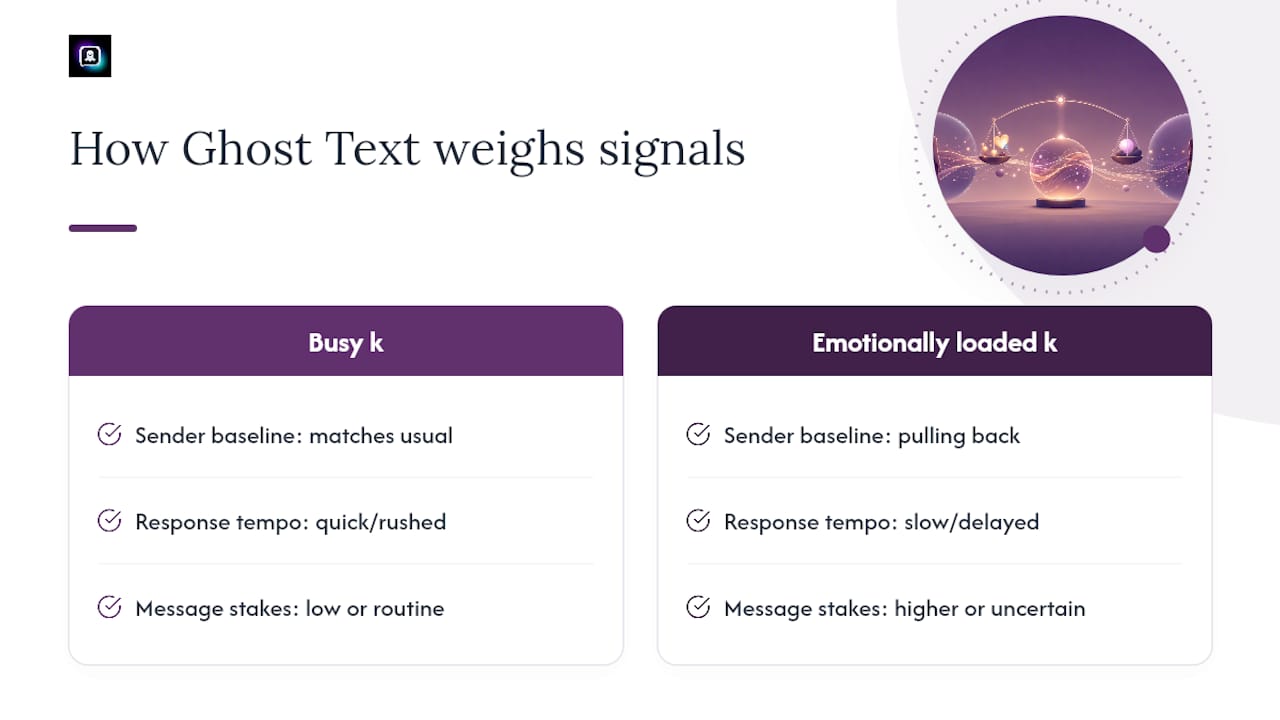
Ghost Text approaches this problem the same way, by weighing multiple signals instead of judging a single word in isolation. The tool looks at sender baseline, response tempo, and message stakes together to distinguish a "busy k" (someone genuinely rushing) from an "emotionally loaded k" (someone pulling back). No single text ever gives you a fully confident answer on its own. Context and pattern always matter more than any one word.
When to Let It Go and When to Ask
Here's the short version: if the relationship is solid and the tempo feels normal, let the "k" pass. If it's a new relationship, a tense moment, or a pattern shift, ask.
Two lines that work almost anywhere: "Hey, everything ok?" or "Did that come across wrong, or am I overthinking it?" Both invite clarity without accusation. For deeper patterns in short replies, Ghost Text's breakdown on texting shorthand digs further into specific scenarios.
— DSean
Let Ghost Text Read the Tone So You Don't Have to Guess
Ghost Text gives you a faster, more reliable read on ambiguous texts than staring at a screen wondering what someone meant. Instead of re-reading the same "k" for the tenth time, upload the screenshot and get an instant breakdown of tone, intent, and any red flags worth noticing.
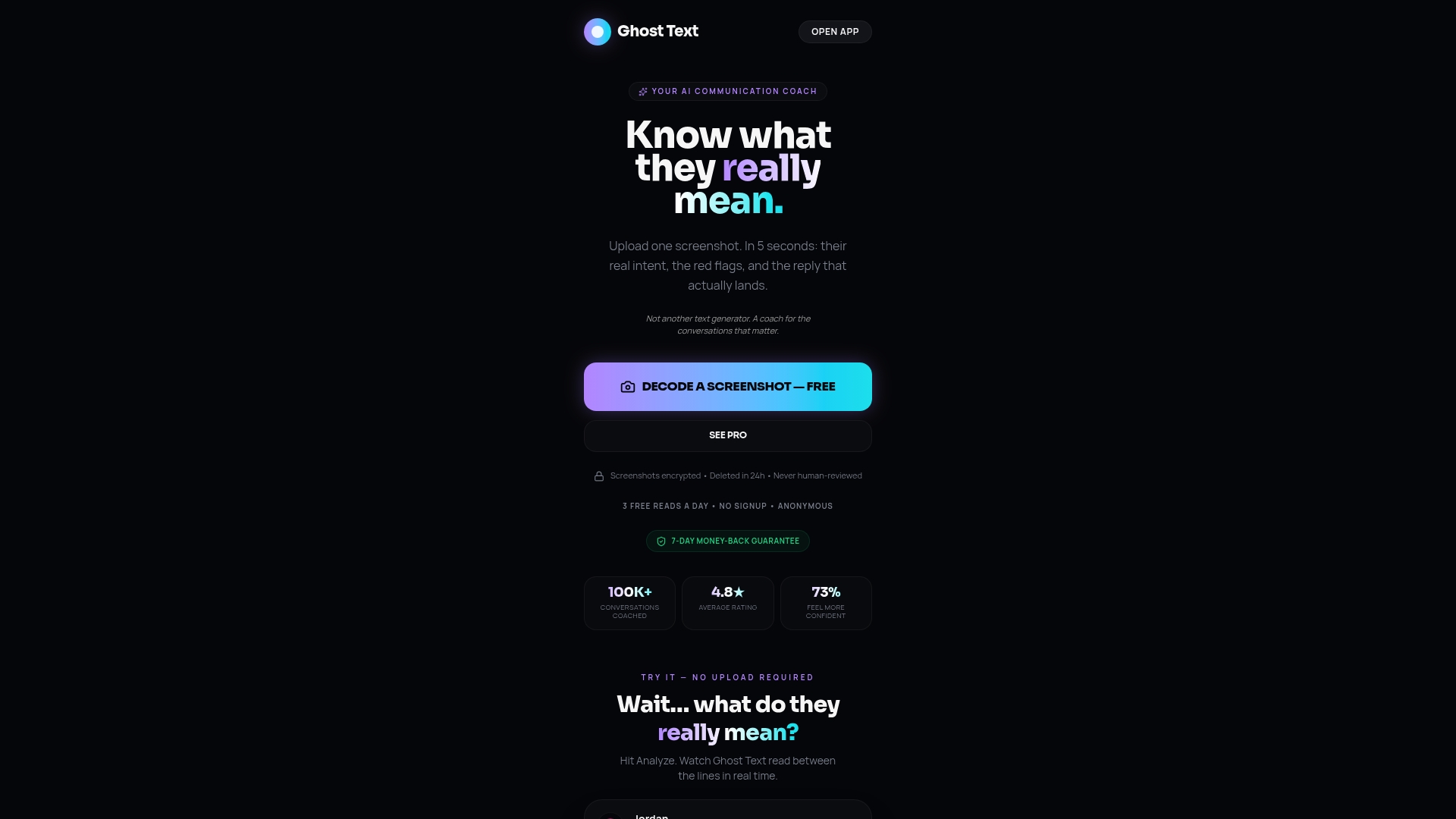
The tool flags whether a short reply fits the sender's normal pattern or signals a real shift, then suggests reply options calibrated to the warmth level you want to hit. That's especially useful in dating conversations, where a misread "k" can spiral into hours of overthinking over nothing, or over something real you'd rather catch early. For more on setting a warmer default in your own texting habits, Ghost Text's guide to texting etiquette is a solid next stop, and pairing tone awareness with phrasing habits from Bab Love Growth's guide to humanizing text rounds out the picture.
Ghost Text's free tier lets you test a few reads before deciding if the deeper analysis in Ghost Text Pro, including unlimited reads and advanced red-flag detection, is worth it. Start by uploading your first conversation and see what it actually says.
Sources
- Why 'k' is the most hated text message, according to science - Fast Company
- Don't text 'OK' | Lifehacker
- Your texts: using or nixing the period conveys your mood - AS Magazine (University of Colorado)
- OK vs okay: which is correct? | YourDictionary