
One-word replies are inherently ambiguous, and the meaning almost always comes from context, not the word itself. A "k" from someone who just left the house tells you nothing about interest; a "k" replacing a real answer to an emotional question tells you plenty. Your default move: if the exchange actually matters, ask one clarifying question. If it doesn't, mirror the brevity and move on with your day.
TL;DR:
- Most one-word responses are driven by external factors such as multitasking, personality, or technical issues, and often have nothing to do with disinterest.
- Context, including the type of question, relationship stage, pattern of responses, and tone cues, is essential for accurate interpretation of brief replies.
- When replying, clarify your intentions by choosing open-ended questions, simple confirmations, or gentle check-ins based on your goals and the situation.
- Repeated short replies over weeks, refusal to commit, or contradicting signals indicate a pattern of disengagement or avoidance worth reconsidering.
- Professional short responses like "Noted" typically signal efficiency rather than emotional cues, while overly emotional or contradicting signals suggest genuine disengagement.
Table of Contents
- Why People Send One-Word Texts
- Reading One-Word Text Responses In Context
- How To Respond To One Word Texts
- Red Flags In Short Replies (What Not To Do)
- When To Let A One-Word Reply Go
- What Etiquette Experts And Research Say About Short Replies
- Why I Think Most People Overreact To Short Texts
- Try Ghost Text When You Want A Second Opinion On A Text
- Sources
Why People Send One-Word Texts
Most one-word replies have nothing to do with you. They come from logistics, personality, or the sheer mechanics of typing on a phone while doing five other things.
Someone driving, walking into a meeting, or juggling a toddler doesn't have the bandwidth for a paragraph. A "sure" or "yep" is often just a placeholder that means "confirmed, talk later." Other people are naturally terse texters across the board, with every friend and partner getting the same clipped style. That's a communication habit, not a signal aimed at you.
Then there's the less comfortable category: avoidance. Short replies sometimes mean the person doesn't want to engage, whether because the topic feels heavy, they're annoyed, or interest has cooled. Mood plays a role too. Someone stressed, exhausted, or irritated after a bad day will text shorter than usual, and that has more to do with their afternoon than with you.
A few common drivers:
- Logistics or confirmation ("k" to a plan, "yep" to a time)
- Personal texting style (naturally brief with everyone)
- Avoidance or discomfort with the topic or the relationship
- Emotional state like fatigue, stress, or irritation
- Technical friction like voice-to-text errors or a cracked keyboard
Notice how three of those five have nothing to do with disinterest. That's the pattern people miss when they spiral over a text.
Reading One-Word Text Responses In Context
The word "fine" means something completely different depending on what came before it, so context does most of the interpretive work. A useful way to sort through it:
- Check the question type. Closed questions ("Are we still on for 7?") naturally invite one-word answers like "yep" or "confirmed." Those are neutral by design. Open or emotional questions ("How are you feeling about everything?") that get a one-word reply carry more weight, because the brevity itself is the information.
- Weigh the relationship stage. A long-term partner's "k" during a hectic workday reads differently than the same word from someone you matched with three days ago who's been fading fast.
- Look for a pattern, not a single text. One short reply is noise. Five short replies in a row, especially after you've asked something direct, is a signal worth taking seriously.
- Read the punctuation and tone cues. "Ok." with a period lands colder than "Ok!" or "okk" with a lowercase run. Capitalization, emoji, and even response speed all shift the temperature of a one-word text.
- Factor in the platform and recent behavior. Someone who just spent twenty minutes voice-texting you yesterday isn't suddenly cold because today's reply is short. Compare against their baseline, not against your worst-case story.
Etiquette guidance on this is consistent: the same short reply can be perfectly acceptable or genuinely dismissive depending entirely on who sent it and why. A single-letter "k" tends to read colder than "ok" or "kk," which matters when you're trying to gauge whether someone's actually annoyed or just typing fast.
How To Respond To One Word Texts
Before you type anything, decide what you actually want out of the exchange: re-engage the conversation, clarify what's going on, match their energy, or quietly step back. That one decision determines which reply actually works, and skipping it is why so many follow-up texts backfire.
If you want to re-engage, open-ended prompts do more work than any clever line. Try:
- "Random, but what's the best thing that happened to you today?"
- "Ok, but tell me more, how did that actually go?"
- "Sounds like a lot. What happened?"
- "K, but I need details later."
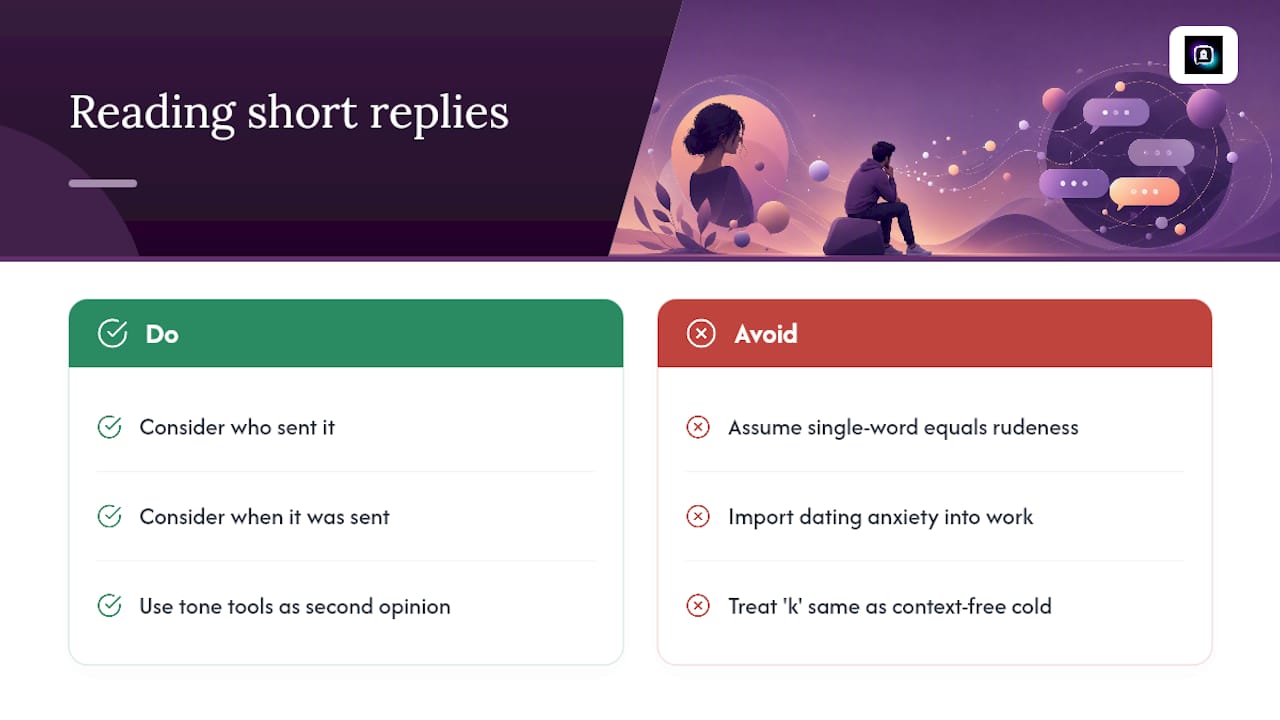
If the message was purely logistical, mirror the brevity instead of overcorrecting into a paragraph. "Got it!" or "See you then." closes the loop cleanly without making a scheduling text feel like a relationship checkup. This is also the category where professional replies live: a short "Noted" in a work thread usually signals efficiency, not attitude, and reading it emotionally is one of the most common misreads people make outside dating contexts.
If something feels off, a direct but gentle check-in beats guessing. "You okay? You seem quiet" or "Everything alright? Your texts feel shorter than usual" opens a door without accusing anyone of anything.
If you just want to keep it light, humor resets tone faster than analysis does. For the classics:
- "K" → "K as in okay, or k as in you're mad at me?"
- "Ok" → "Ok noted, captain."
- "Sure" → "That's a very committed sure."
- "Yep" → "Wow, three whole letters. I'm honored."
- "Fine" → "Fine like actually fine, or fine like we need to talk?"
That last one works because it names the ambiguity out loud instead of pretending it isn't there. Social-skills guidance backs this up: giving someone room and asking open questions tends to draw people out far better than pressing for an explanation.
Pro Tip: Send one clarifying or open-ended message, then actually watch what comes back. If the reply opens up, keep going. If it stays clipped again, that's your answer, and it's a better use of your energy to adjust than to send a second version of the same question.
For more scripts built around specific replies, see how to answer a good message with the same confidence you'd want reflected back at you.
Red Flags In Short Replies (What Not To Do)
The fastest way to turn a neutral "k" into an actual fight is to demand an explanation for it. Sending three follow-up texts in ten minutes ("hello?" "did I say something?" "wow ok then") reads as pressure, and pressure rarely produces the honest answer you're looking for.
Matching a short reply with a sarcastic or passive-aggressive one of your own ("k." with the same cold period) escalates a maybe-nothing into a definitely-something. If you're annoyed, say that plainly instead of encoding it into punctuation.
Some patterns are worth taking seriously rather than talking yourself out of:
- Consistent brush-offs every time you try to go deeper than logistics
- Refusal to commit to plans even after multiple attempts
- Contradicting signals, like claiming they're interested while never initiating or elaborating
- One-word replies specifically to emotional or vulnerable messages, repeated over time
One important distinction: work messages don't follow the same rules as personal ones. A colleague's "Noted" or "Got it" is task language, not a mood report, and treating it as a relationship signal will make you misread perfectly normal professional behavior.
When To Let A One-Word Reply Go
Not every short text deserves a follow-up, and not every pattern deserves your continued effort. A simple timeline helps take the guesswork out of it.
- A single short reply: Wait 24 to 72 hours before reading anything into it, or send one clarifying message if the topic actually matters to you.
- A repeating pattern over one to three weeks: Scale back your own effort to match theirs and see if they step up to fill the gap. If they don't, you have your answer.
- A relationship you actually value: Skip the text-based detective work entirely and propose a call or an in-person conversation instead. Some things aren't meant to be solved over "k."
If a friend or partner consistently gives you less than you're giving them, matching their effort isn't punishment, it's just accurate information exchanged both ways.
What Etiquette Experts And Research Say About Short Replies
Etiquette writers have landed on roughly the same conclusion from different angles: the word itself matters less than who sent it, when, and why.
A one-word answer can be completely appropriate for a quick confirmation and genuinely rude when it's used to shut down a conversation someone put real effort into. The letter "k" specifically tends to land colder than "ok" or "kk," even though all three technically mean the same thing.
That distinction between logistics and emotional effort shows up across professional communication too. Workplace short replies like "Noted" typically function as efficient signoffs, not emotional cues, which is part of why importing dating-text anxiety into a work Slack thread leads people astray.
Automated tone analysis, the kind Ghosttextai builds, works best as a second opinion layered on top of your own read of the situation rather than a replacement for it. Context, history, and relationship stage still do most of the heavy lifting; the tool just helps surface patterns you might be too close to see clearly.
Why I Think Most People Overreact To Short Texts
I've noticed that the anxiety around one-word replies is almost never about the word. It's about the story we build around it in the silence afterward. That gap between a "k" landing and your brain deciding what it means is where most unnecessary spiraling happens, and it's avoidable with one honest question instead of ten imagined ones. Try the scripts above on a low-stakes text this week and actually watch what comes back. Ghosttextai exists because most people would rather know than guess.
— DSean
Try Ghost Text When You Want A Second Opinion On A Text
Ghosttextai is the alternative to guessing alone at a screen for ten minutes trying to decode a "k." Upload a screenshot or paste the conversation, and it reads tone, intent, and emotional signals, flags red flags, and suggests replies tailored to whether you want to re-engage, clarify, or keep things light. It won't replace your own judgment, and it isn't meant to. It's a faster way to see what you might be missing before you hit send on a reply you'll second-guess later.
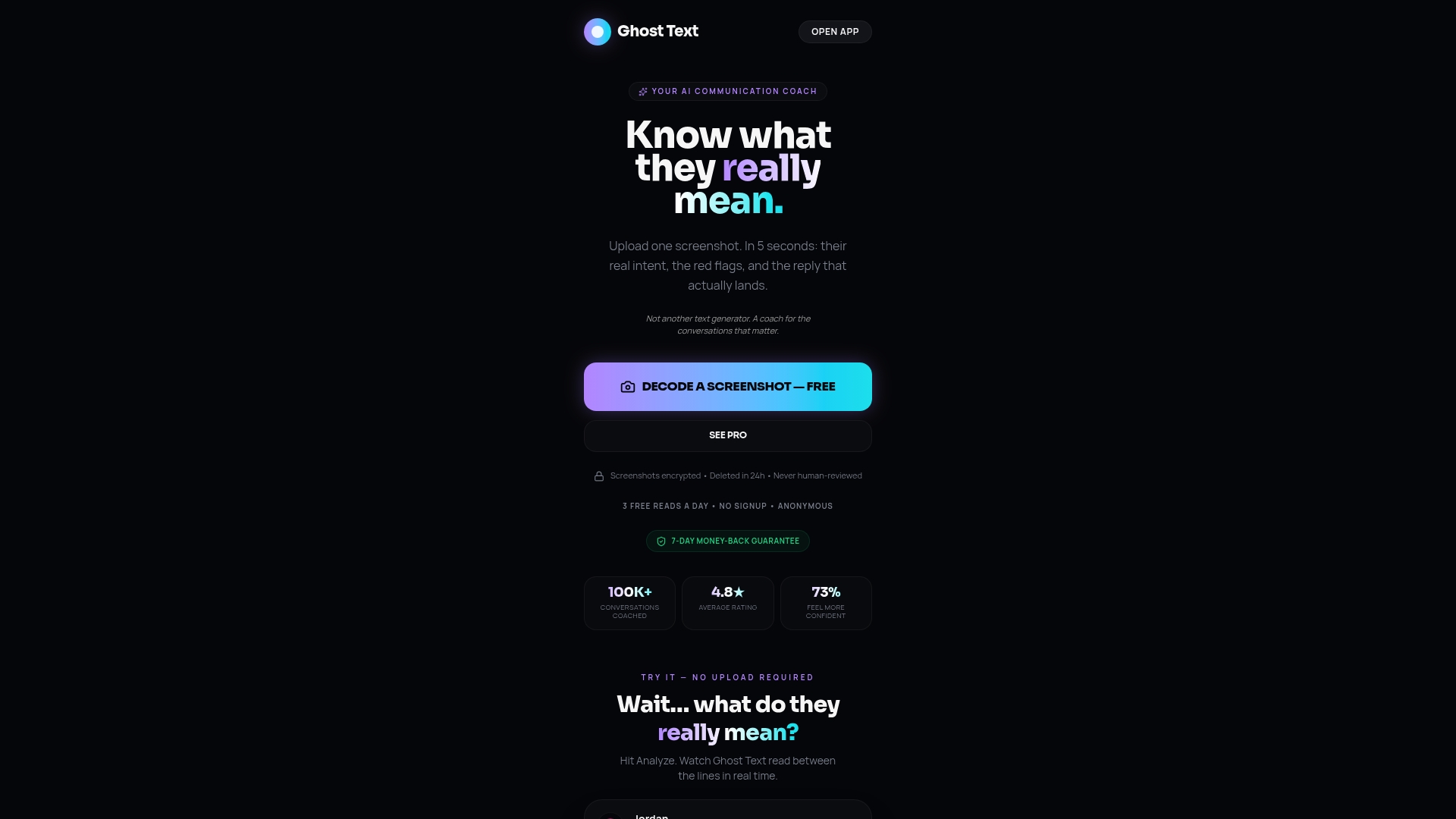
If you've ever reread a one-word text five times looking for a hidden meaning, that's exactly the moment this tool is built for. Start with a free read on Ghost Text and see what it flags in your next confusing exchange.
Sources
- Is It Really Rude to Respond to a Text with a One-Word Answer?
- What your colleagues really mean when they reply with 'Noted'