
Yes, texting can be emotional cheating, but the message content alone doesn't decide it. What matters is whether the texting builds an exclusive emotional bond outside your relationship, and whether it involves secrecy or the slow erosion of boundaries you'd otherwise respect. A friendly check-in with a coworker isn't the same thing as a nightly conversation you're hiding from your partner.
TL;DR:
- Emotional cheating through texting is identified by the development of an exclusive emotional bond and secrecy, not just flirtatious or casual messages.
- Red flags include sudden phone secrecy, deleting conversations, new access codes, late-night texting, emotional withdrawal, and defensive responses.
- Patterns like nightly goodbyes, private jokes, one-sided venting, and sexual shifting indicate crossing the emotional boundary, especially if kept hidden.
- Trust erosion from secret texting can cause long-term mental health issues and deepen relationship damage if left unaddressed.
- Establishing clear, transparent boundaries and using pattern observation can prevent emotional cheating, with AI tools aiding in interpreting ambiguous messages.
Table of Contents
- What Counts as Emotional Cheating Through Texting
- Common Signs and Red Flags of Emotional Cheating Texts
- Real Examples of Texting That Crosses the Line
- Why Emotional Cheating Through Texting Actually Hurts
- How to Confirm What's Happening and Talk to Your Partner
- Setting Healthy Texting Boundaries to Prevent It Happening Again
- Using AI-Assisted Analysis to Read Ambiguous Messages
- What We See Most Often, and What Actually Helps
- Get Clarity Before You Confront
- Sources
What Counts as Emotional Cheating Through Texting
Emotional infidelity through texting happens when someone builds a sustained emotional bond with a person outside their relationship, one that starts replacing or competing with the intimacy they share with their partner. It's not about a single flirty text or an old friend checking in. It's about where someone's emotional energy is actually going, day after day.
Clinicians who work with couples on this describe emotional affairs as a gradual relocation of attention and private life toward someone new. It rarely starts as an affair. It starts as venting to someone who happens to respond fast, listen well, and ask the right follow-up questions. Over weeks or months, that person becomes the one you text first when something good or bad happens, not your partner, according to Evolve Therapy.
That shift is the core of what separates a text-based emotional affair from a normal friendship. The line isn't drawn by whether the messages are sexual. It's drawn by displacement: whose number are you actually reaching for at 11 p.m. when you need to talk?
To judge a specific situation, run it through five questions instead of guessing:
- Who: Is this someone your partner knows about, or someone kept off their radar entirely?
- What: Does the content stay light and situational, or does it drift into personal, romantic, or sexual territory?
- When: Are these messages happening at hours or frequencies that replace time you'd normally spend connecting with your partner?
- Secrecy: Are you hiding the conversation, using a locked app, or deleting threads?
- Energy: Where is your emotional investment actually landing, and would you be comfortable reading these texts aloud to your partner?
Transparency is what separates a close, healthy friendship from an emotional affair, not the mere existence of the friendship. Two people can text constantly and be completely fine, as long as nothing is hidden and the relationship doesn't quietly become the emotional center of either person's life. The moment concealment enters the picture, even innocent conversations start functioning like an affair, because concealment itself signals that something about the connection wouldn't survive daylight.
Common Signs and Red Flags of Emotional Cheating Texts
Emotional infidelity rarely announces itself. It shows up in patterns, not single incidents, and the patterns tend to repeat across cases therapists see. Experts point to phone guarding, message deletion, and hidden late-night conversations as some of the clearest texting-based signals of an emotional affair, according to Marriage.
Here's what tends to show up, roughly in the order partners notice it:
- Sudden phone secrecy. The phone that used to sit face up on the counter now goes everywhere, face down, sometimes into another room during a shower or a phone call.
- Deleted threads and vanished notifications. Conversations that would normally sit in a message app disappear, or notifications get silenced for one contact specifically.
- New passcodes or app changes. A phone that was never locked suddenly needs a code, or a new messaging app appears with no clear explanation.
- Timing shifts. Texting spikes late at night, during work hours it didn't used to happen, or right when your partner steps away.
- Emotional withdrawal at home. Less sharing about their day, less curiosity about yours, and a general flatness that wasn't there before.
- Defensiveness when asked. A simple question about who they're texting gets met with irritation, deflection, or an outsized reaction that feels disproportionate to the question.
Two signals deserve extra attention because they're easy to miss. The first is private jokes and pet names with someone outside the relationship. These create an insider language that mimics the intimacy couples usually reserve for each other. The second is one-sided emotional venting, where your partner processes stress, disappointment, or excitement with this other person before, or instead of, processing it with you.
It's worth separating privacy from secrecy here, because they get confused constantly. Wanting some personal space with your phone is normal and healthy. Habitual concealment paired with defensiveness when questioned is a different animal entirely, and that combination is the actual red flag, not privacy on its own, according to Mustard Seed Christian Counseling.
Pro Tip: Track patterns over two or three weeks before drawing conclusions. One late-night text means nothing. A new nightly habit that always ends when you walk in the room means something.
Real Examples of Texting That Crosses the Line
Abstract definitions only go so far. Seeing how ordinary-sounding texts escalate makes the pattern easier to recognize in your own life.
Start with a message that looks harmless in isolation: "Hey, rough day. Glad I have you to talk to." Said once, that's a normal thing a friend says. Said nightly, paired with a locked phone and zero mention to a partner, it's a sign that emotional support has migrated somewhere it shouldn't be.
Compare that to something with clearer intent: "I keep thinking about our conversation last night. You get me in a way most people don't." That's not friendly venting. That's language usually reserved for a romantic partner, showing up in a channel a partner doesn't know exists.
A few more patterns worth flagging:
- The nightly ritual text. "Goodnight, talk tomorrow?" sent every single evening to the same person, especially if it happens after the partner is asleep.
- The secret vent session. Sharing a fight with your actual partner, in detail, with someone outside the relationship before you've even resolved it together.
- The escalating compliment. "You're the only one who actually listens to me" moves emotional dependency from a partner to a third party, one sentence at a time.
- The sexual pivot. Flirty banter that shifts into explicit content, even without any in-person contact, still counts as crossing a line most couples would consider a serious breach.
Not every ambiguous text is a crisis. "Miss talking to you, it's been a while" from an old friend reads very differently depending on context. Run it through the boundary test from earlier: is it hidden, is it frequent, and is it replacing the emotional role a partner should be filling? A message that fails all three checks is probably fine. A message that fails even one deserves a closer look, not a panic, but attention.
Text also strips out tone entirely, which is part of why these situations get so muddy. A dry joke can read as cold, and a caring check-in can read as clingy, purely because there's no voice or face attached. Deliberate punctuation, emojis, and moving anything serious to a phone call or in-person talk cuts down on that kind of misreading, according to OneLove.
Why Emotional Cheating Through Texting Actually Hurts
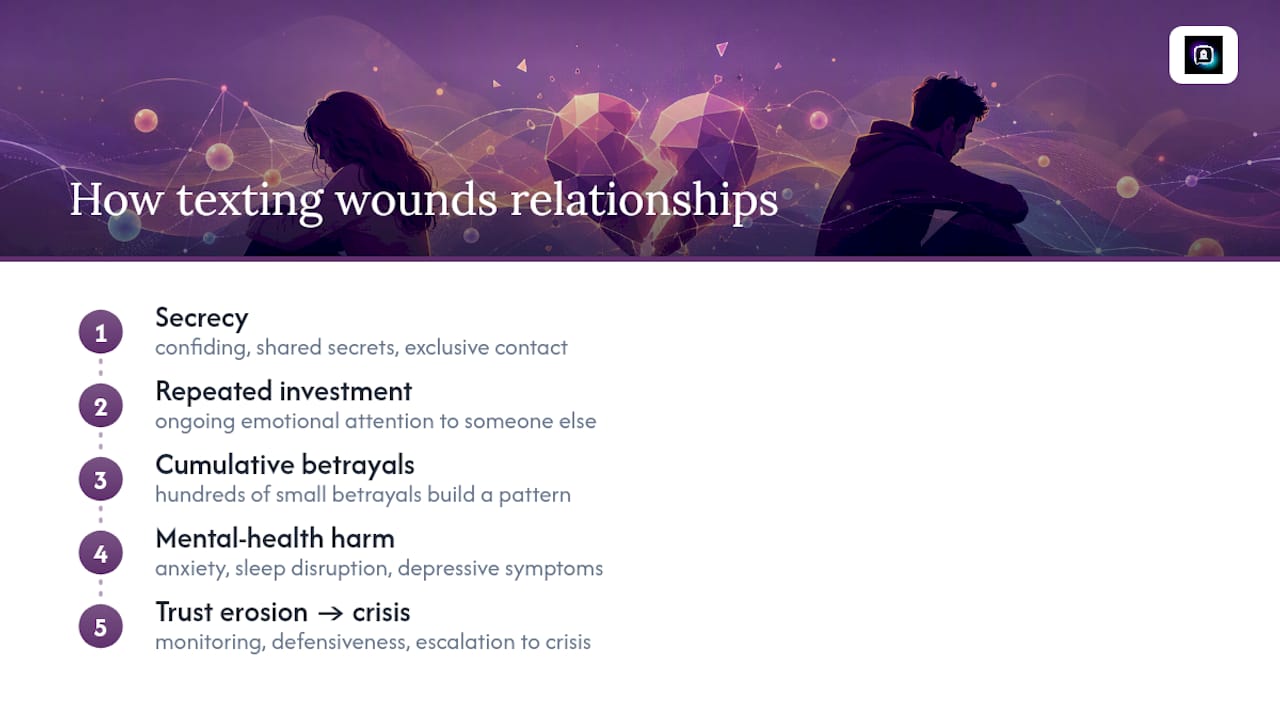
The pain of an emotional affair often surprises people, including the person who had it. Many assume that because nothing physical happened, the damage should be minor. Therapists who work with couples after discovery say the opposite is frequently true: emotional affairs can wound a relationship as deeply as physical ones, sometimes more, because they involve repeated, exclusive emotional investment and shared secrets built over time, according to Business Standard.
Part of what makes this so painful is the secrecy itself. Discovering that your partner has been confiding in someone else, laughing with someone else, and reaching for someone else's number during hard moments feels like a slow-motion replacement. It's not one betrayal. It's hundreds of small ones stacked into a pattern.
Betrayal and infidelity carry measurable mental-health consequences, including anxiety, sleep disruption, and depressive symptoms, according to peer-reviewed research on the psychological aftermath of relationship betrayal.
Left unaddressed, this pattern rarely stays static. Trust erosion compounds. The partner who discovers the texting starts monitoring, questioning, and doubting things that used to feel settled, and the partner doing the texting often digs in further rather than pulling back, especially if they feel unfairly accused before anyone's actually talked it through. That combination, defensiveness on one side and hypervigilance on the other, is how a text-based emotional affair turns into a full relationship crisis if it goes unspoken for too long.
How to Confirm What's Happening and Talk to Your Partner
Suspicion without evidence is corrosive, but reading every message on someone's phone isn't the answer either. The better move is to gather patterns, not private content: note timing, frequency, and behavioral shifts rather than combing through every word exchanged with another person.
- Watch for patterns over time, not single moments. A locked phone once means nothing. A locked phone that's suddenly a nightly habit, paired with less conversation at home, is a pattern worth naming.
- Prepare what you'll actually say before you say it. Lead with "I" statements: "I've noticed you're texting a lot at night and I feel disconnected from you," lands very differently than "Who are you texting?"
- Bring neutral evidence, not accusations. Describe what you've observed, not what you assume it means, and leave room for your partner to explain.
- Ask for transparency, not surveillance. Requesting that a conversation move into the open is reasonable. Demanding access to every message going forward usually breeds resentment instead of trust.
- Know when to bring in a professional. If the conversation turns into gaslighting, if your partner denies something you have clear evidence of, or if you sense any pattern of control or abuse, that's the point to involve a couples therapist or, if safety is a concern, a domestic violence resource rather than trying to resolve it alone.
Pro Tip: Have the conversation in person, never over text. The same tone problems that made the original texting ambiguous will make a confrontation over text even worse.
Setting Healthy Texting Boundaries to Prevent It Happening Again
Most couples never explicitly discuss what counts as acceptable texting with other people. That silence is exactly where ambiguity, and eventually resentment, grows. Counselors generally recommend negotiating expectations up front and building predictable, transparent habits rather than installing tracking software or demanding password access, since surveillance tends to damage trust further rather than repair it, according to Mustard Seed Christian Counseling.
A few boundary agreements that work well in practice:
- Agree on reply windows for non-urgent messages, so neither partner feels obligated to drop everything for a text from anyone, including each other.
- Rule out secret accounts or hidden apps as a baseline expectation, not an accusation.
- Set clear norms around texting exes or past romantic partners, even when the contact feels harmless.
- Keep serious conflict resolution off text entirely. Fights over text almost always escalate faster and resolve slower than the same conversation held in person.
If a boundary has already been broken, repair works best through visible, consistent action rather than one big apology. That means proactive transparency, offering to share context without being asked, a regular check-in cadence for a few weeks or months, and small trust-rebuilding steps that are actually measurable, like showing your partner a conversation before they ask to see it. Excessive texting with anyone, including a partner's own friends, deserves the same scrutiny as texting with a stranger. Privacy and transparency aren't opposites here. A couple can respect each other's personal space and still agree that nothing important gets hidden.
Using AI-Assisted Analysis to Read Ambiguous Messages
Sometimes the hardest part isn't the texting itself. It's not knowing whether you're reading too much into it. Tools that specialize in decoding text tone can flag tone shifts, intent signals, and potential red flags in a conversation you're unsure how to read, offering a second opinion when your own judgment feels clouded by anxiety or exhaustion.
These tools have real limits worth naming plainly. No AI can read someone's actual intent with certainty, and none of them replace a licensed therapist when a relationship is in genuine crisis. What they're good for is a neutral first pass, something to look at before you react, not instead of a real conversation.
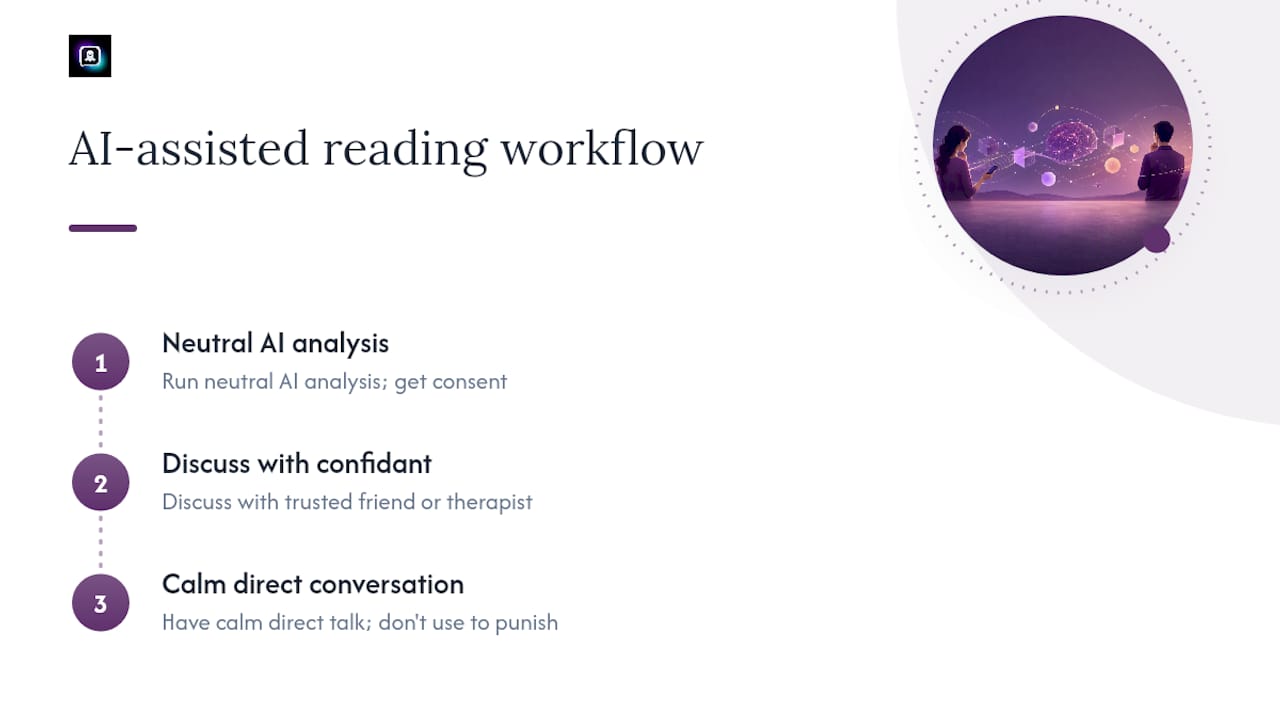
The workflow that actually helps looks like this: run the ambiguous messages through a neutral analysis first, talk it over with a trusted friend or therapist second, then use whatever you've learned to guide a calm, direct conversation with your partner. Get consent when the messages involve someone else's privacy, and never use an analysis as ammunition to punish rather than to understand.
What We See Most Often, and What Actually Helps
The pattern that surprises people most isn't the content of the messages. It's how often the secrecy itself, not any single text, is what actually breaks trust. A locked phone and a defensive shrug tell you more than a screenshot ever could.
The better move is almost always to lead with the pattern you've observed, not an accusation about what it means. "You've been texting a lot at night and it feels different" opens a conversation. "Who is she" closes one.
Most couples don't need an ultimatum. They need one honest conversation and a small, specific commitment they can actually keep, like agreeing to talk in the open going forward. Start there before you start anywhere else.
— DSean
Get Clarity Before You Confront
Reading the same three texts over and over, trying to decide if you're overreacting, is its own kind of exhausting. There are tools that provide a neutral read on tone, intent, and red flags in an actual conversation, so you're not walking into a hard talk with your partner based on a guess.

Upload a screenshot or paste the conversation you keep rereading, and Ghosttextai's analysis will flag emotional signals, tone shifts, and patterns worth discussing, the same kind of pattern-spotting covered throughout this piece. It won't replace an honest conversation or a therapist when things are serious, and it isn't built to be evidence for a fight. It's built to help you walk into that conversation clear-headed instead of spiraling. If you want an objective read before you say anything to your partner, try Ghosttextai on the conversation that's been bothering you.
Sources
- Marriage
- Peer-reviewed article (NCBI) cited for psychological consequences of betrayal
- When texts test trust: 5 ways to set healthy boundaries with technology — Mustard Seed Christian Counseling
- Texting dos and don'ts in relationships — OneLove