
Paperclipping is when someone from your past sporadically reaches out with low-effort contact to keep you as a backup, not to reconnect. The name comes from Clippy, the old Microsoft Office assistant that used to pop up uninvited and add zero value to your actual work. It's usually ego-driven or manipulative, not a genuine attempt to rebuild something real.
- The behavior: intermittent, low-effort messages after long silences
- The motive: validation or a backup option, rarely reconciliation
- The move: decide how much of your attention it's worth, then respond accordingly (more on that below)
Key Takeaways
Paperclipping is intermittent, low-effort contact from a past connection designed to keep you as a backup option rather than rebuild a real relationship.
| Point | Details |
|---|---|
| Definition | Paperclipping is sporadic, low-effort outreach from someone in your past, named for the disruptive Clippy assistant. |
| Spot the pattern | Long silence followed by a low-cost text, like, or meme that rarely leads anywhere is the clearest sign. |
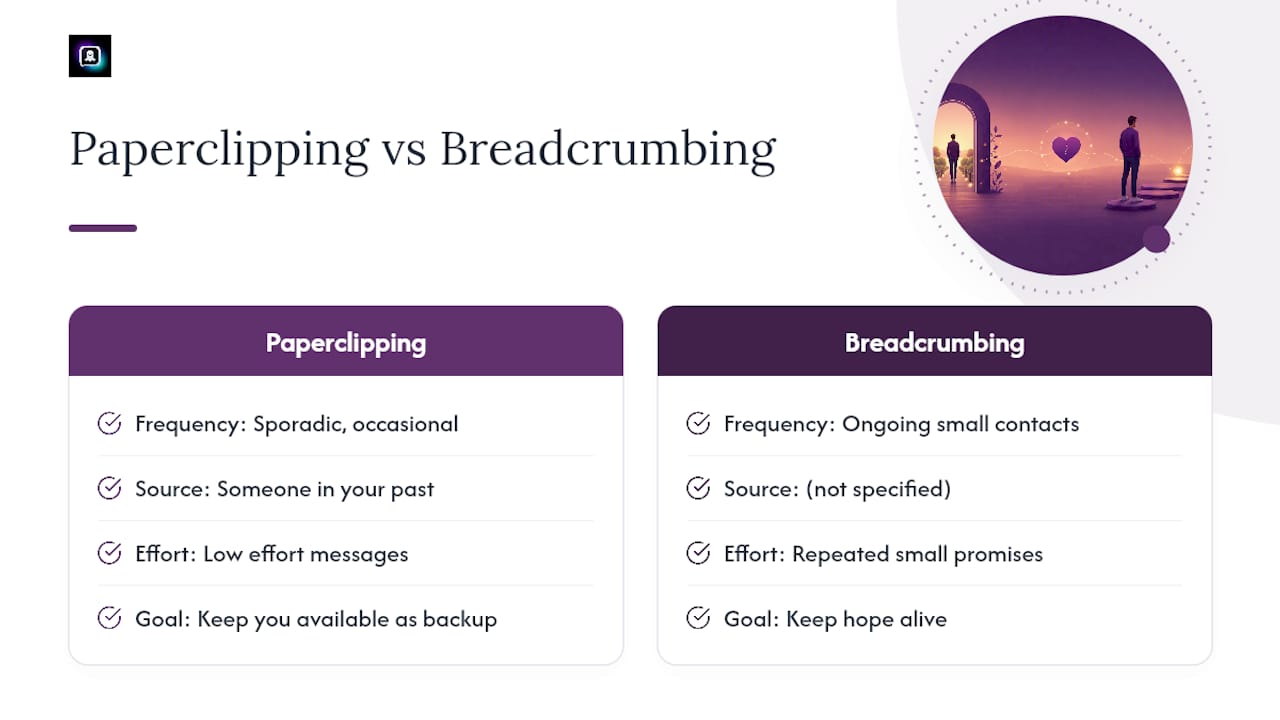
| Not the same as breadcrumbing | Breadcrumbing involves ongoing small promises, while paperclipping is occasional contact aimed at validation. |
| Response options | Ignore, call out the behavior directly, or respond while setting a clear boundary on what you'll accept. |
| Get a second read | Ghost Text analyzes the message pattern and drafts a boundary-setting reply when you're too close to judge it alone. |
Table of Contents
- What Is Paperclipping and Where Did the Term Come From?
- How Do You Spot Paperclipping in Your Messages?
- Paperclipping vs. Breadcrumbing, Ghosting, and Orbiting
- Why Do People Paperclip Someone?
- How Does Paperclipping Affect the Person Receiving It?
- How Should You Respond to a Paperclipping Text?
- When Should You Use a Message Analysis Tool?
- Trust the Pattern, Not the Text
- Let Ghost Text Read the Pattern for You
- Frequently Asked Questions
- Sources
What Is Paperclipping and Where Did the Term Come From?
The term surfaced as a way to describe an old pattern with new language: a random "how are you" text, an old post liked out of nowhere, a DM that goes nowhere. It borrows the Clippy metaphor deliberately. Clippy would appear on your screen unasked, distract you for a second, and leave without doing anything useful, which is exactly how this dating pattern feels on the receiving end.
Typical paperclipping looks like:
- A "hey stranger" text months after the last conversation ended
- A Like on a photo you posted, with no follow-up message
- A meme sent with no context and no real interest in a reply
- A comment on your story that never turns into an actual conversation
Not every reconnection attempt qualifies. Cosmopolitan's reporting on the trend notes that context matters. If someone actually wants to talk, meet up, or hop on a call, that's a real reconnection, not paperclipping.
How Do You Spot Paperclipping in Your Messages?
The pattern usually starts with silence, sometimes weeks, sometimes months, and then a message that costs the sender almost nothing to send. Watch for a rhythm: they vanish, something reminds them you exist (a story, a mutual friend, boredom on a Friday night), and then a quick low-stakes ping shows up.
Common outreach types include:
- A one-word "hey" or "miss you" with no plan attached
- A like on an old photo, timed to resurface in your notifications
- A random question ("did you ever watch that show we talked about?")
- A meme or reel sent with zero conversation starter behind it
The conversation rarely goes anywhere. You reply, they respond once or twice, then the thread goes cold again until the next cycle. That stall is the tell. Real reconnection tends to build toward a plan; paperclipping just resets the clock on your attention.
Pro Tip: Screenshot the pattern over time. Seeing three or four of these messages side by side, dated, makes the cycle obvious in a way that any single text never will.
Paperclipping vs. Breadcrumbing, Ghosting, and Orbiting
These terms get thrown around interchangeably, but they describe different behaviors. USA Today's coverage of the trend draws a useful line between paperclipping and breadcrumbing specifically: paperclipping tends to come from an ex checking in periodically for validation, while breadcrumbing is closer to a string of small promises meant to keep hope alive without any past relationship attached. If you want a deeper breakdown of that second pattern, breadcrumbing texts covers how to spot and respond to it directly.
| Term | What It Looks Like |
|---|---|
| Paperclipping | Sporadic, low-effort contact from an ex, aimed at validation |
| Breadcrumbing | Ongoing small promises or flirtation with no real follow-through |
| Ghosting | Contact stops entirely with no explanation |
| Orbiting | No direct messages, but they keep watching and liking your social activity |
The rule of thumb: if contact appears out of nowhere, costs the sender nothing, and never turns into a real plan, it's paperclipping.
Why Do People Paperclip Someone?
Most experts trace paperclipping back to a need for validation rather than any real desire to rebuild the relationship. Getting a response, even a short one, confirms they still matter to you, which is often the entire point.
- Validation-seeking: a reply, even a cold one, feeds the ego without any commitment attached
- Fear of abandonment: keeping you reachable feels safer than fully letting go
- Backup strategy: you become an option to fall back on if their current situation falls through
- Emotional immaturity: clinicians describe this as avoidance of real commitment rather than deliberate cruelty in every case
People with narcissistic tendencies or an anxious attachment style tend to do this more often, since both patterns involve using intermittent contact to manage their own emotional state. The intent isn't always calculated. Sometimes it's just habit. But you can judge it by outcome: if every single contact stalls out and never leads anywhere, the motive behind it matters less than the pattern itself. For a broader look at how manipulation shows up in texting specifically, dark psychology texting breaks down more of these dynamics.
How Does Paperclipping Affect the Person Receiving It?
Confusion is usually the first reaction, followed by a strange flicker of hope, then irritation when the message goes nowhere again. That cycle repeats until it starts wearing you down.

Recipients often report confusion, anxiety, and anger when the pattern keeps recurring, and the emotional cost compounds over time. Each low-effort text reopens a door you'd closed, and each stall closes it again a little harder than before. That repeated opening and closing is what erodes boundaries. What starts as a single confusing message can turn into months of checking your phone a little too fast when a name you used to know pops up.
How Should You Respond to a Paperclipping Text?
You have three real options, and the right one depends on how many times this has happened and how much it's costing you emotionally.
- Ignore it. If this is a repeat pattern and responding drains you, silence is a complete answer. You owe no explanation to someone who's been treating you as an option.
- Call it out. If you want clarity, ask directly: "I've noticed you reach out every few months without much else behind it. What's going on?" This forces intent into the open.
- Respond, but limit it. If you're open to talking but don't want to get pulled back in, set a boundary up front: "I'm around to chat, but I'm not looking to pick things back up where we left off."
Templates for setting these limits work best when they're short and don't invite debate. Something like, "I'd rather not keep doing this. If you want to actually talk, let's set a time to call," closes the loop without slamming the door.
Block or escalate when the pattern is obvious and repeated, especially if it's affecting your mental health or you've asked them to stop and they haven't. For more general scripts you can adapt to your own situation, reply templates for difficult messages has additional wording that works well here too.
Pro Tip: Decide your response before you open the message, not after. Reading it first almost always pulls you into an emotional reaction that makes the decision harder.
When Should You Use a Message Analysis Tool?
A tool helps most when you've read a message five times and still can't decide whether it's innocent or calculated, especially with someone who's paperclipped you before. Analysis works best on patterns, not single texts.
- Detecting tone shifts you might be reading through hope instead of logic
- Flagging red-flag language or manipulation patterns across a conversation history
- Drafting a reply that sets a boundary without over-explaining yourself
If you upload screenshots to any tool, only include conversations you have a right to share, and skip anything with sensitive information you wouldn't want stored. Good data handling and consent matter as much with an AI tool as with a friend you're venting to.
Trust the Pattern, Not the Text
If a message from someone who's ghosted you twice made your stomach drop for a second, that reaction is normal, not a flaw in your judgment. Your boundaries don't need their approval to be valid. For more on reading intent behind specific messages, the texting psychology breakdown is worth a look.
Let Ghost Text Read the Pattern for You
Ghost Text is the tool for the moment you're staring at a paperclip text wondering if you're overreacting or seeing it clearly. Upload the screenshot or paste the thread, and it flags tone, intent, and red-flag patterns in seconds, then drafts a reply that fits the boundary you actually want to hold.

That's the real value here: you stop rereading old texts trying to decode someone's motives alone, and you get a second read that's honest instead of hopeful. Ghost Text works on a freemium model, so you can run your first few analyses free before deciding if the full version fits your needs. Head to Ghost Text and paste in that confusing text before you type back a single word.
Frequently Asked Questions
What is the simplest definition of paperclipping? It's a sporadic, low-effort message from someone in your past meant to keep you available as a backup, not to rebuild a relationship.
Is paperclipping the same as breadcrumbing? No. Breadcrumbing involves ongoing small promises to keep hope alive, while paperclipping is occasional contact from a past partner focused on validation.
Why do exes paperclip instead of just staying away? It usually comes down to wanting proof they still matter to you without the effort or risk of full reconnection.
How do I know if I'm being paperclipped or if someone genuinely wants to reconnect? Look at where the contact leads. A real reconnection moves toward a plan or a call; paperclipping stalls out every time.
Should I ever respond to a paperclipping text? Only if you want to. Ignoring it, calling it out, or replying with a firm boundary are all valid, and the right choice depends on how much the pattern is costing you emotionally.
Sources
- How to Handle Paperclipping, a Toxic Dating Trend | Psychology Today
- What Is Paperclipping? Experts Explain the Toxic Dating Trend. | Cosmopolitan
- What is paperclipping? Another annoying dating trend explained | NBC News