
If he texts you first, remembers what you told him last week, and brings up plans without you pushing for them, that's a real pattern of interest, not a coincidence. Single signals mean almost nothing on their own. What matters is whether several of these behaviors show up together and repeat, which is the logic behind pattern-based tools like Ghost Text, the PLOS One research on communication behavior, and the "Signal Stack" concept dating coaches use to score texting interest.
TL;DR:
- Consistent initiation, detailed responses, and emotional sharing over multiple weeks strongly indicate genuine interest rather than fleeting signals.
- Actions such as suggesting specific plans, sharing personal content, or using personalized nicknames reveal a deeper level of connection and intent.
- Single signals like quick replies or emojis are weak on their own; they must be part of a cluster of consistent behaviors to reliably indicate interest.
- Over-analyzing isolated messages can mislead; tracking patterns across categories over time provides a clearer picture of his true feelings.
- Using multimedia, voice notes, or direct plans, especially when combined with other signals, significantly boosts confidence that interest is real.
Table of Contents
- Signs He's Interested Texting: 15 Patterns That Actually Mean Something
- Pattern or Noise: The Signal Stack Checklist
- From Texting to Meeting: Scripts and Timing That Work
- The Expert Take: Why Clusters Beat Single Signals
- How Often He Initiates Over Time Tells You More Than Any Single Text
- Nicknames and Personalized Terms Signal a Shift in How He Sees You
- Compliments and Teasing Both Point in the Same Direction
- Voice Notes and Multimedia Add a Layer Text Alone Can't
- A Personal Note on Overthinking This Stuff
- Let Ghost Text Take the Guesswork Out of His Texts
- Sources
Signs He's Interested Texting: 15 Patterns That Actually Mean Something
You don't need to decode every emoji or obsess over reply times. You need to know which behaviors, when they cluster, actually predict interest, and which ones are just noise from a guy being polite or bored. Below are the fifteen signs that show up most consistently across relationship research and real texting behavior, each with an example, the reasoning behind it, and a reliability label so you know how much weight to give it.
1. He texts you first, unprompted
If he starts conversations without you sending the opening message, that's one of the clearest signals available. A guy who isn't interested tends to let conversations die unless you revive them.
Example: He texts, "Random, but this reminded me of that thing you said about your dog eating a sock." No context needed, no reply to prompt it.
Reliability: Strong. Relationship guides consistently rank unprompted initiation among the top textable signs of interest, largely because it costs him effort and offers him nothing except your attention.
2. He replies consistently, not just quickly
Speed alone is overrated. What matters more is whether he replies within a reasonable window most of the time, not just when he's bored at 2 a.m.
Reliability: Medium. Fast replies feel good, but they're easy to fake with a phone in his pocket all day. Quick responses without message quality or consistency don't tell you much on their own. A guy who replies in two minutes with one-word answers is a different case than one who replies in two hours with three paragraphs.
3. He sends multi-sentence replies
One-word answers ("lol," "yeah," "nice") suggest low investment. Full sentences, follow-through on a thought, or unprompted extra detail suggest he's actually thinking about what you said.
Example: You ask about his weekend, and instead of "good, you?" he writes three sentences about a hike that went sideways and asks if you've ever tried that trail.
Reliability: Strong.
4. He asks follow-up questions
This is the single easiest sign to spot and one of the most telling. A man who's not interested answers your question and stops there. One who is interested asks something back, and it's specific, not generic.
Example: You mention a work deadline. He doesn't just say "that sucks," he asks, "Did you end up finishing it, or are you still stuck on the client feedback part?"
Reliability: Strong.
5. He remembers details and brings them back up
Callbacks are underrated. If he references something you mentioned two weeks ago, in passing, without you reminding him, he was paying attention the first time.
Example: "How'd the interview with your sister's friend's company go? You mentioned it a while back."
Reliability: Strong. This one is hard to fake because it requires actual memory, not performative interest.
6. He uses flirty or playful emojis
Emoji use is context-dependent, and meanings shift depending on the relationship and the conversation itself, but a sudden shift toward winking faces, playful teasing emojis, or heart variants after a casual exchange is worth noting.
Reliability: Weak to medium on its own, stronger when paired with playful text tone. Don't read a single 😉 as a confession of love. Read it as one data point among several.
7. He sends good morning or goodnight texts
Consistent daily check-ins signal that you're on his mind at the start and end of his day, which relationship research links to prioritization when it's paired with specific, personal content rather than a copy-paste message.
Reliability: Medium to strong, depending on specificity. "Morning" with nothing else is weaker than "Morning, hope you slept better than I did after that coffee at 9pm."
8. He suggests plans, not just talks about hanging out
There's a real difference between "we should hang out sometime" (vague, low-commitment, often filler) and "are you free Thursday, there's a taco truck by the park I've been wanting to try." The second one is a plan. The first one is a placeholder.
Reliability: Strong, and one of the most action-oriented signs on this list.
9. He shares photos, selfies, or personal content
Sending a picture of his dog, a meal he made, or something funny he saw is a small act of inclusion. It says, "I thought of you in this moment, outside of our conversation."
Reliability: Medium. Some guys share this stuff with everyone. Context and frequency matter more than the act itself.
10. He opens up emotionally
If he shares something a little vulnerable, a bad day, a worry about work, a story from his past, that's a bigger deal than it looks. Most men keep texting shallow until they trust someone.
Example: "Honestly today was rough, my dad's been in and out of the hospital and I haven't told many people."
Reliability: Strong. Emotional disclosure over text is rare enough that when it happens, it usually means something.
11. He sends random "just because" texts
No occasion, no question, just a text because he was thinking about you. A meme, a song, a "this made me laugh" text with no follow-up needed.
Reliability: Medium to strong, especially if it happens more than once.
12. He mirrors your texting style and energy
If you write longer texts and he starts writing longer texts back, or you use certain phrases and they show up in his messages later, that's a subtle sign of attunement. People naturally match the communication style of someone they want to connect with.
Reliability: Medium.
13. He apologizes or explains a delayed reply
"Sorry, work was insane today" might seem small, but it means he cared enough about the gap that he felt he owed you an explanation. Guys who aren't invested don't bother.
Reliability: Medium to strong.
14. He uses future-oriented language
Phrases like "we should," "next time," or "when we hang out" imply he's already picturing you in his future plans, even loosely. This is different from vague hypotheticals with no follow-through.
Reliability: Strong when paired with an actual attempt to set a date.
15. He engages with your social media posts
Liking your Instagram story, commenting on a post, or bringing up something you posted in your texts shows he's tracking your life outside the conversation itself.
Reliability: Weak on its own, but a useful supporting signal when combined with direct texting behavior.
Pro Tip: Scroll back through your last 10 text exchanges and count who sent the first message each time. If he initiated 4 or more out of 10, that's a meaningful, objective data point, not a feeling you're projecting onto the conversation.
One more thing worth flagging before you start analyzing every text: watch out for contact that only happens late at night. If the good morning texts are missing but the "you up?" texts are consistent, that's a different pattern than the one described above, and it's worth being honest with yourself about which one you're actually seeing.
Pattern or Noise: The Signal Stack Checklist
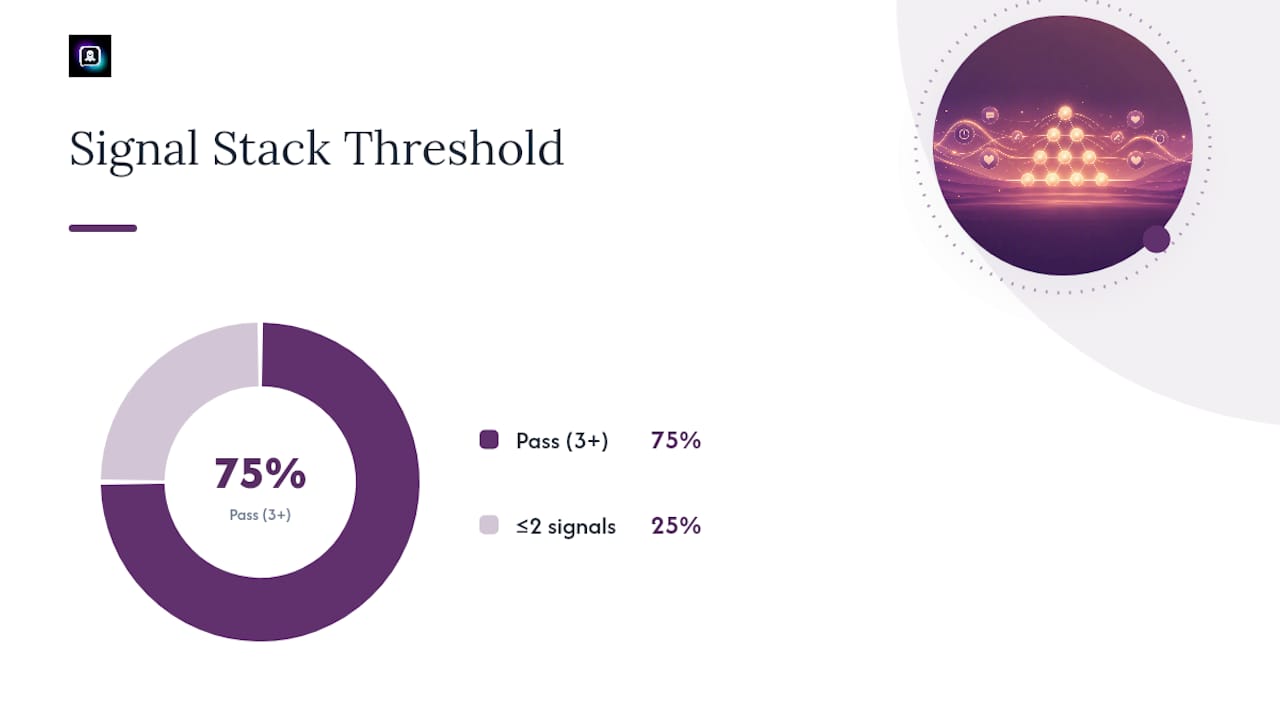
Here's the problem with reading texts one at a time: any single sign can be explained away. He might be a naturally chatty person. He might just have good manners. The Signal Stack approach solves this by scoring behavior across categories instead of fixating on one message.
Tally these four categories over your last two weeks of texting:
- Initiation. Who starts conversations, and how often? Count actual message threads, not just replies.
- Specificity. Are his messages generic ("haha yeah") or specific (referencing your actual words, plans, or details)?
- Emotional engagement. Has he shared anything personal, vulnerable, or beyond small talk?
- Escalation attempts. Has he tried to move things offline, or floated a real plan with a day or time attached?
You're looking for three or more consistent signals across at least a week or two, not a single great conversation followed by silence. A guy who nails one category and disappears from the rest isn't showing a pattern, he's showing a mood.
Score it with five quick questions: Who texted first the last three times? How often does he reply within a normal timeframe for him? Does he ask questions that require him to remember something? Has he shared anything personal? Has he suggested or agreed to a specific plan?
Timing matters too. Personality, work schedule, and even culture affect texting habits, so a slow but consistent texter isn't automatically less interested than a fast, sporadic one. The confounder to watch for is someone who's naturally warm with everyone. If his texting style with you looks identical to how he talks to his group chat, the signals are weaker than they'd be with someone more reserved who suddenly opens up just for you.
Pro Tip: Skip the "testing" games, waiting to reply, playing hard to get, sending vague bait texts. They don't reveal real interest, they just create confusion on both sides. A low-pressure invite tied to something you already talked about gets you a real answer faster than any guessing game.
From Texting to Meeting: Scripts and Timing That Work
Once you've spotted a real cluster of signals, the next move is low-risk and specific. Vague energy gets vague replies. Concrete plans get concrete answers.
Template A: Match his energy. If he sends something playful, mirror it back rather than overanalyzing it. "Lol you're ridiculous" works better than a three-paragraph response to a one-line joke.
Template B: Respond to flirting with a playful invite. If he teases you about something, tease back and attach a plan: "Okay, keep talking and see what happens. There's a burger place near me that apparently ruins other burgers for you forever."
Template C: Ask for a casual meetup tied to a shared interest. "You mentioned you like [specific thing he brought up]. There's [specific event/place] this weekend if you want to check it out."
On timing, wait for consistent signals across roughly one to two weeks before suggesting an in-person plan. That's enough time to see a real pattern instead of a single good night of texting. When you do suggest meeting, be specific: propose a day, a rough time, and a place, rather than the open-ended "we should hang out sometime." Vague invites get vague, noncommittal replies. Specific ones get a yes, a no, or a counteroffer, and any of those three tells you something real.
A few dos and don'ts worth keeping in mind:
- Don't play games designed to manufacture jealousy or urgency. They tend to backfire or attract the wrong kind of attention.
- Do be direct once the pattern is clear. Overthinking a message for an hour rarely improves it.
- Don't over-text. Two unanswered messages in a row is a signal to stop, not a cue to send a third.
- Do keep your reply energy proportional to his. If you need help figuring out the right tone for a reply, a reply confidence guide can help you calibrate before you hit send.
- Do check the etiquette around following up if he goes quiet. Rules for double-texting exist for a reason, and ignoring them usually reads as anxious rather than confident.
The Expert Take: Why Clusters Beat Single Signals
Relationship researchers have looked directly at this question, and the finding is consistent: communication patterns, specifically consistency, specificity, and emotional engagement, predict attraction far better than any isolated behavior. A single sweet text is a snapshot. A pattern is a trend line.
That distinction shows up constantly in how Ghost Text was built. The platform analyzes screenshots or pasted conversations to flag tone, intent, emotional signals, and red flags, then suggests replies, which is functionally the same job as the Signal Stack checklist above, just automated and applied to your actual conversation history instead of your memory of it.
Texting is a partial signal. It tells you a lot about attention and effort, almost nothing about chemistry in person, and it's easy to misread a naturally chatty person as romantically invested when they're just being themselves with everyone.
A few practical observations worth internalizing:
- Dry, short texting from someone who's warm and expressive in person usually means texting isn't his communication style, not disinterest.
- The strongest tell isn't any single message, it's whether the small details you mentioned in passing come back up later, unprompted.
- No text-based analysis replaces actually spending time with someone. Treat texting patterns as a strong hint, not a verdict.
How Often He Initiates Over Time Tells You More Than Any Single Text
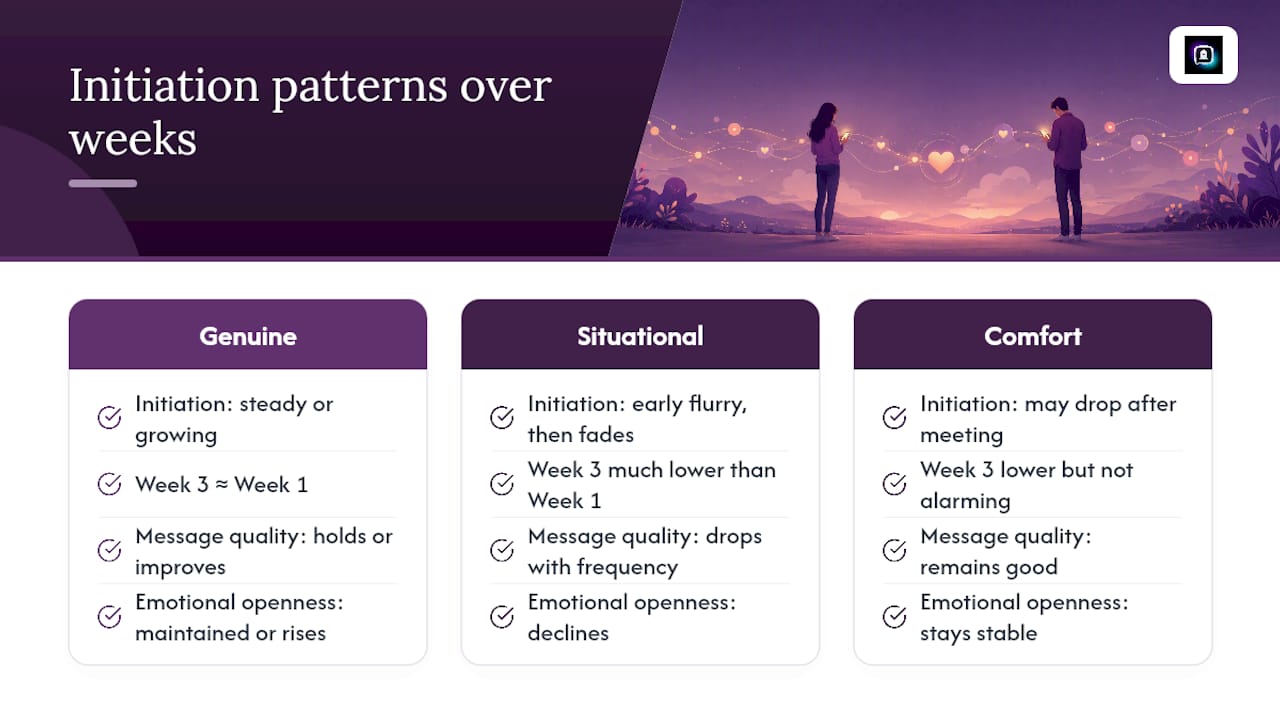
A one time flurry of texts doesn't mean much. What matters is whether he keeps initiating over weeks, not days. Interest that's real tends to hold steady or grow; interest that was situational (boredom, a slow week at work, a lonely Friday night) tends to fade fast once the circumstance changes.
Track this loosely across two or three weeks rather than judging it day to day. Look for whether he initiates roughly as often in week three as he did in week one. A guy who texted first constantly during the first week and then dropped to almost never by week three was probably riding a burst of novelty, not building something consistent.
Also pay attention to context shifts. Does he initiate the same way after a good date as he did before you'd met in person? Some men actually text less once they feel more secure, assuming plans are already understood, which can look like fading interest when it's really just comfort. This is exactly where the clustering approach from the Signal Stack checklist earns its keep: initiation frequency alone can mislead you, but initiation frequency combined with specificity and emotional engagement over time rarely does.
If the drop-off in initiation lines up with a drop in message quality and emotional openness too, that's a real signal worth taking seriously, not just a busy week.
Nicknames and Personalized Terms Signal a Shift in How He Sees You
When a guy starts calling you something other than your name, a nickname, a shortened version, an inside joke turned into a label, it usually marks a shift from "acquaintance" to "someone specific to me." Nicknames create a small private language that only the two of you share, and that exclusivity is the point.
Example: Somewhere around week two, "hey" becomes "hey trouble," referencing something you did on your first hangout. That's not random. He's building a shared reference point on purpose.
Watch for whether the nickname sticks or fades. A one-off joke nickname that never comes back is just banter. One that becomes his regular way of addressing you is a small but real sign that he's thinking of you as someone distinct from everyone else in his phone. It's a low-effort, high-signal move: it costs him nothing to type, but it requires him to have decided, even subconsciously, that you're worth a label of your own.
Compliments and Teasing Both Point in the Same Direction
Direct compliments are the obvious version of this sign, "you looked really good today" or "you're actually hilarious" are easy to spot and don't need much explanation. Teasing is the less obvious version, and it's often the stronger one.
Playful teasing, gentle jabs about something you said, mock-arguing over something trivial, calling you out affectionately, requires a level of comfort that most people don't extend to someone they're indifferent to. It's a way of engaging without the vulnerability of a straightforward compliment.
The pattern to watch for: compliments that come with specificity ("you're funny" is weaker than "the way you told that story about your coworker had me laughing at my desk") and teasing that stays affectionate rather than sharp. If the teasing ever tips into something that feels more like a put-down than banter, that's a different, less flattering pattern, and it's worth trusting that gut reaction over any texting theory.
Voice Notes and Multimedia Add a Layer Text Alone Can't
Some guys who are otherwise average texters suddenly step up their game with voice notes, photos, or short videos. This matters because multimedia takes more effort than typing a sentence, and it adds something texting alone can't: his actual voice, tone, and presence.
A voice note responding to something you said carries information text strips away entirely, hesitation, laughter, sarcasm that reads flat in writing but sounds obviously playful out loud. If he starts sending these instead of typing out long replies, that's often a sign he wants the conversation to feel more real, more like actually talking to you than trading messages.
Photos and short videos work similarly. Sending a picture of where he is, what he's doing, or something that made him think of you extends an invitation into his day that a text alone doesn't offer. It's a small act of transparency, showing you his life in real time rather than just describing it after the fact.
None of this replaces the core signals covered earlier, initiation, specificity, emotional openness still matter more. But multimedia use on top of those signals tends to reinforce them rather than replace them.
A Personal Note on Overthinking This Stuff
Here's the truth nobody likes hearing: you can talk yourself into seeing interest that isn't there, and you can just as easily talk yourself out of interest that's completely real. Both mistakes usually come from staring at one message for too long instead of looking at the pattern across two weeks.
The fix isn't more analysis. It's less rereading and more action. If the signals genuinely cluster, three or more categories, holding steady over time, trust it and suggest something concrete. If they don't, that's information too, and it's better to know now than to keep decoding a single "haha" for signs of a future together.
Try the checklist on your actual last ten texts before you draw any conclusions. Patterns don't lie the way a single message can.
— DSean
Let Ghost Text Take the Guesswork Out of His Texts
Running the Signal Stack checklist by hand works, but it takes time and a clear head, two things that are hard to manage at 11 p.m. staring at a screenshot. The tool does that analysis for you: paste in the conversation or upload a screenshot, and it reads tone, intent, emotional signals, and red flags, then hands you a suggested reply that matches the moment instead of your anxiety.

That's especially useful for a few common situations this article covers directly: figuring out if a mixed-signal text is actually mixed or just casual, drafting a reply that matches his energy without overthinking it for twenty minutes, and catching red flags early instead of explaining them away after the fact. If you want a second opinion beyond your own reading of the situation, or you want help with the reply guides and conversation analysis tools mentioned throughout this piece, start with Ghost Text using the free tier before deciding if the Pro features, unlimited reads and the interest meter, are worth it for your situation.
Sources
- PLOS One — (study on communication patterns and attraction)
- Marriage
- How to Figure Out if Someone Likes You over Text — wikiHow
- Datingcoach